- Seriously, a cesspool?
Category: About Advertising
Curns’ Ad Links for 29 September 2010
- Lucid Insiders talk about how online advertising systems are unaware of the offline advertising that is going on around them, although when one drills down into the online data it is apparent that them. What to do about television driving a spike in demand through an online sales channel?
- The online ad industry is rushing to introduce self-regulation for location-based marketing to allay privacy concerns around the billion-pound sector
- UK online use sees 38.4 million people using the internet in August; almost 20% of which comes from London
Curns’ Ad Links for 28 September 2010
- The number of smartphone owners in the EU-5 (UK, France, Germany, Spain and Italy) grew 41% between 2009 and 2010, to 60.8 million subscribers, according to a June 2010 report from comScore.
- Technology start-up PubMatic is launching a new tool to help websites determine how many tracking files are being installed on users’ computers.
- Hot on the heels of recent news about local display advertising, here's some news about local mobile. Guess what? Somebody predicts this market is growing to grow.
- Are bigger ad formats the way to go? I have been thinking about this for some time and i think fewer but bigger and better ads is the way ahead from premium display. Am I right?
- iMediaConnection.com reporting that there is evidence suggesting that audience data collected over the course of a campaign on a major site or network could be five to 10 times more valuable than the actual messaging or creative on which it is based.
- Some interesting points about managing frequency in digital advertising and a note that advertisers are still not demanding audience reporting.
- Smart move from Blackberry – pooling app inventory and passing to partner ad networks is a good way to get monetisation quickly.
Curns’ Ad Links for 27 September 2010
- Interesting to see what the UK publisher market thinks are important innovations in both content and technology,
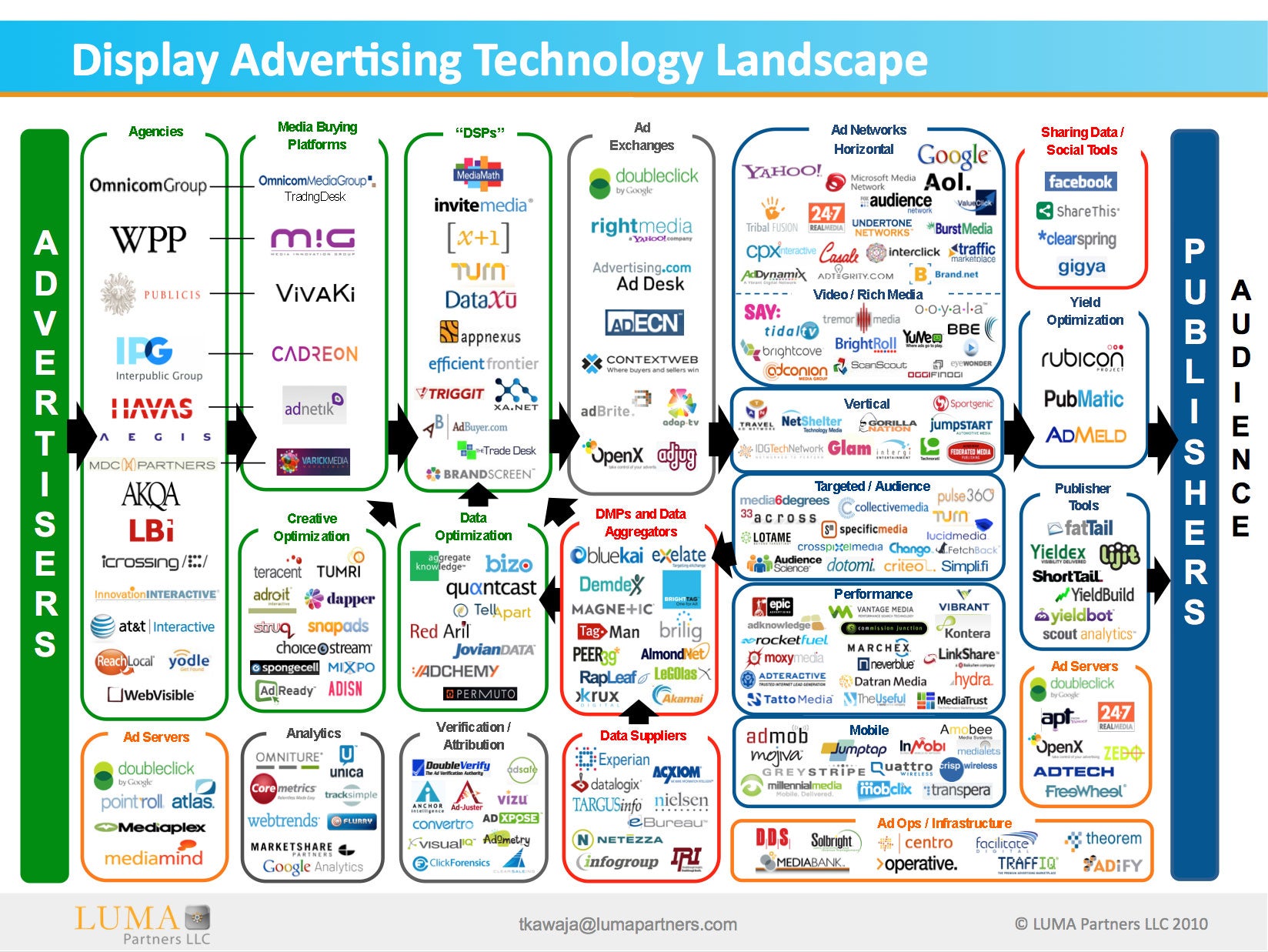
- This is the latest version of the display advertising landscape diagram. Lots of companies, lots of players and much consolidation to come?
- eMarketer reports that retargeted display ads gave a 1,046% lift in searches on brand terms within four weeks after exposure. 4 weeks seems a long period – or is that just me?
- BusinessWeek suggests that Apple's share of the mobile advertising market will be 21% by year end. I have to assume that's on revenue and not impressions or any other volume measurement because this article doesn't really make it clear.
Curns’ Ad Links for 24 September 2010
- The research found consumers are already receptive to the idea of mobile messaging – with a fifth (21%) of consumers already opted-in to receiving SMS and/or MMS from brands and their own mobile networks. Three quarters of respondents stated they would be happy to opt-in to such services, given the right incentive, such as attractive offers, money off vouchers or priority service from a brand.
- Phorm has served its first targeted ads to opted-in users in Brazil. This will be an interesting one to watch.
- TV commercials repurposed as online ads perform less well on many metrics than videos especially developed for the online space, research from Dynamic Logic has indicated.
Curns’ Ad Links for 23 September 2010
- One of the most common mistakes brands make in the digital space is the "me too" syndrome. A certain platform performs well for other companies, gets a lot of media attention, and suddenly it's, "We need one of those too."
- Local advertising spending is holding up better in 2010 than previously expected, according to estimates from BIA/Kelsey. The firm, which initially predicted a nearly 1% drop in overall local ad spending this year, forecast growth of 2.1% to $133.3 billion by year-end.
Curns’ Ad Links for 22 September 2010
- The Telegraph reports that companies need to embrace social media, just as their customers have done, says a senior executive at Google.
- Online advertisers and technology companies have been warned to act “quickly and responsibly†when it comes to privacy regulation if they are to avoid regulation. The European Union is currently implementing the privacy and electronic communications directive, which sets out new rules for dealing with “cookiesâ€.
Curns’ Ad Links for 9 September 2010
- Are bigger ad units the way to make digital advertising more effective?
- Good news for the online video market: Almost 50 per cent of the media buyers polled stated they planned to spend more money on Video On Demand (VOD) over the next six months.
Curns’ Ad Links for 8 September 2010
Curns’ ad links is a collection of links about the digital advertising industry, generally focused on the display advertising market and emphasising the technology that delivers great advertising experiences.
- HTML5 and client-side storage can have privacy implications for advertising. Here’s the latest information from Ars Technica.
- Adotas has one of the best articles I have read on how privacy needs transparency so that the world understands the trade-off between data and a (supposedly) free internet.
- Newspapers are having a difficult time recovering from the slump, but online revenue rose nearly 14 per cent to about $744 million in the second quarter compared with the same period a year ago, yet it still could not offset almost an 8 per cent drop in print advertising.
- ClickZ is looking at how Google’s Priority Inbox – and other things – impacts email marketers. It offers another take on the engagement metric, which is becoming popular: how often we interact with senders is a good way to understand what kind of messages we receive.
- Great piece at Mashable, featuring the opinions of some ad agency types on how digital media is changing the world of advertising for agencies. “Location Campaigns Are the New Targeting Mechanism” is just one headline.
Curns’ Ad Links for 7 September 2010
Curns’ ad links is a collection of links about the digital advertising industry; generally focussed on the display advertising market with an emphasis on the technology to deliver great advertising experiences.
- Experian Simmons data on attitudes toward advertising, quoted at eMarketer, shows 18- to 34-year-olds are actually more open to advertising than the general adult population. Fewer millennials said they did not like advertising and did not let it affect their purchase decisions.
- Another web-to-TV story: “Web-to-TV Gaining Momentum in the U.S.,” forecasts revenue from the sale of Web-to-TV video content to grow from $2 billion to more than $17 billion by 2014, says In-Stat. Unfortunately, the rest of the data is behind their paywall, so we can’t say much more.
- There are a number of articles today about technologies connected to the web and television. Lots of people have been trying to do it. Can Yahoo! succeed when they bring it to Europe next year?
- Rajeev Goel, CEO of PubMatic, says “Data leakage” sounds nasty. It does, so he talks about gardening. Who’s plucking your data? It sounds better than theft, and it’s an interesting point – publishers can learn from those who are selling their audiences.
- As I mentioned on Twitter, is there, or has there been, a commoditization of display advertising? Maybe it’s easier to say than to prove, but interesting coverage of Borrell Associates’ report suggests display advertising technology is powering online ad growth. They say that “Driving this growth will be the display format, a once quiet, even moribund subspace in the online ad industry.”
- On the Microsoft Advertising blog, a case study on how Microsoft used digital to increase brand favourability metrics around the launch of Windows 7. It might be Microsoft using itself as a case study, but I think it’s worth reading about their digital approach to a major consumer launch.
Curns’ Ad Links for 3 September 2010
Curns’ ad links is a collection of links about the digital advertising industry; generally focussed on the display advertising market with an emphasis on the technology to deliver great advertising experiences.
- Good post from ClickZ on the positive effects behavioural targeting can have on understanding audiences & qualified customers.
- Adfonic have an interesting take on the mobile advertising business with a blog post about data transparency in the mobile advertising sector. Can anybody validate the argument that mobile advertising has less detailed reporting than the online display business?
- StrategyEye is reviewing the recent Google Blog post on the publisher display advertising business. To be honest, I am not sure what the line ‘as it tries to challenge Yahoo!’s dominant position in the market’ refers to in the context of this post. Yes, Yahoo!’s display business may be bigger than Google’s, but the blog post is about the publisher business, and Google’s DoubleClick has an enormous market share.
Curns’ Ad Links for 2 September 2010
Curns’ ad links is a collection of links about the digital advertising industry; generally focused on the display advertising market with an emphasis on the technology to deliver great advertising experiences.
- This was posted earlier this summer, but I wanted to make sure we kept a record of it, as Tom makes a lot of interesting points about publishers and data. How are you protecting your data assets?
Curns’ Ad Links for 1 September 2010
Curns’ ad links is a collection of links about the digital advertising industry, generally focused on the display advertising market and emphasising the technology that delivers great advertising experiences.
- ClickZ asks the question, but does anybody know the answer? Does Facebook even know the answer right now? I wonder if it does. It would be an interesting play, but I wonder how many publishers will want to show Facebook all the extra data that advertising brings?
- DoubleClick discuss the future of ad-serving as they see it. Notably, the discussion focuses on efficiency, a key issue for the world’s biggest online publishers. It’s clear that the future of advertising is multi-media & multi-platform.
- The Advertising Standards Authority remit has been extended to cover advertisers’ own websites and social media. This is probably a good extension for the UK consumer, but I get the feeling that some media reports think this is the first extension to the digital space, which it isn’t. The IAB, as always, has a good summary of the new regulations.
- A great deal of the current privacy discussions centres on the use of tracking technologies and, in particular, the use of cookies. Of the two cookie types, Flash cookies are under the most scrutiny because you can’t clear them with your regular browser cookie settings. Rapleaf have a handy summary guide to their capabilities.
- I’m often writing about digital advertising where we’re stuck in a visual world: banners are what I discuss most, with video and mobile advertising – both visual forms – up and coming. Of course, audio advertising shouldn’t be forgotten, and in the latest edition of the Earshot Creative Review, David Couch discusses audio advertising on Spotify. Postcode targeting? It’s been around a while, you know …
Curns’ Ad Links for 27 August 2010
Curns’ ad links is a collection of links about the digital advertising industry; generally focussed on the display advertising market with an emphasis on the technology to deliver great advertising experiences.
Brand Republic’s piece on a survey that says users think online advertising is intrusive, repetitive, unappealing & cheap. I’m not sure any surveys will ever get people to say that advertising is a good and positive thing, but on the upside, it reminds us to innovate with formats more and on the downside, is 1000 people a decent sample?
In-game advertising is not something that I have covered too much before, but it’s both big business and, generally, quite inventive. This overview from TechRadar isn’t saying a lot that’s new but it’s a great summary.
An interesting piece from Econsultancy questioning how engagement is defined. This is a useful conversation if advertisers and going to demand the engagement metric. Is the concept to become as flawed as the click for understanding users & their intent?
An interesting discussion on engagement as a measurement for display: publishers are only paid when someone interacts with the ad. Perhaps this will launch that quest for new, more engaging formats?
I’ve been saying for a while that online ad formats need to develop again. We need to move beyond the banner. This survey, which shows 18-24 yr olds find off-line media more impactful than online, somewhat backs me up.
Curns’ Ad Links for 26 August 2010
Curns’ ad links is a collection of links about the digital advertising industry; generally focussed on the display advertising market with an emphasis on the technology to deliver great advertising experiences.
Catchpoint Systems, writing for AdMonsters, says they observed on several webpages that the requests to the tracking pixels are aborted or cancelled by Internet Explorer 7, which has roughly a 10-30% browser market share depending on the website. A major impact for online marketing?
Great news for the growth of digital advertising. This ClickZ article suggests that both targeted display and video ad serving are going to grow nicely in 2011.