Another year has passed and it’s my Dad’s birthday again. Last year he was somewhere in Russia – actually he’s in Astana which I know isn’t Russia – and I was asking if anybody knew Happy Birthday in Russian.
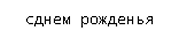
Well, this, apparently, is it (although clearly it could say anything):
So, for next year I just need the sound file. How do you actually say that?
For the first time in many, many year, the Pride festival took place in Hyde Park and I was there.
Well despite the weather and the somewhat officious woman searching my bag on entry, this year’s Pride in the Park in Hyde Park was fabulous – the best I have been to (probably ever – although my first Pride on Clapham Common was pretty cool too).
After breakfast at a friend’s house, PY and I headed down to Embankment for the parade. This is the first time I’ve ever marched with the crowd and it was brilliant – the only downside of actually taking part is that you do not get to see it all. In a bid to overcome this, we ran ahead and watched part of the parade (including the fabulous OutEverywhere bus) and then joined in at some point (for a great deal of the time we marched near a float that Josh from a previous Big Brother was prancing about on). The atmosphere was superb and the crowds watching were huge. Coming up to Piccadilly Circus was just a mass of people – it was quite exciting really.
Then we made the park. We made our way to the main stage and seeing Liberty X (who were surprisingly good), Ulta Nate (who sang a whole stack of songs that I was familiar with) and Blue (who were also very good). Later in the day we caught Tom Robinson and Jimmy Sommerville (this after standing on the sidelines singing along to Bananarama – but as nobody has a picture of that I will deny it at a later date).
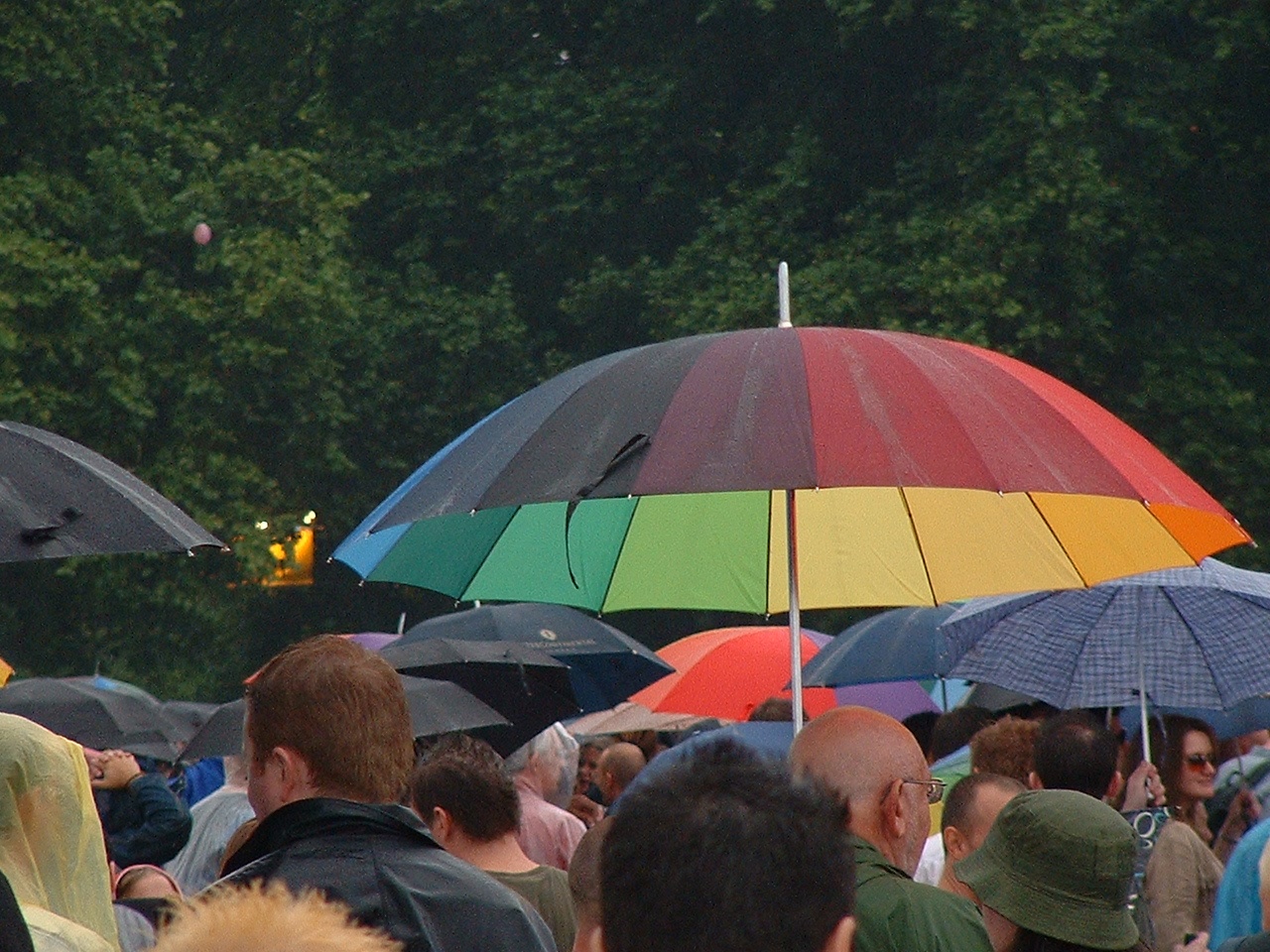
At some point in the afternoon – just after it started to rain – we had a wander around the market stalls (which seemed more varied than other times) and had a poke in some of the dance tents (although it’s not really my thing). By late afternoon, the rain was pouring but spirits were not dampened (and. luckily, for most of the afternoon the ground in Hyde Park held up).
It was an exhausting day but it was worth it and it was great to be with a bunch of other homos just having a good time. There will be some pictures in the gallery, eventually.
The issue of national identity cards is being raised again. What I am surprised about is this piece in The Telegraph – I thought they would be in favour of ID cards.
See also BBC NEWS: ID cards will ‘infringe civil liberties’. In all the hysteria about terrorism and ID cards, it is worth reminding ourselves that, “The terrorists who committed the atrocities in America on September 11 had legal papers”.
Still, I am unsure what to think about the whole ID card issue. What is telling is that, according to Charter 88, “Countries that already have identity cards have a written constitution and have those rights protected – we don’t”.
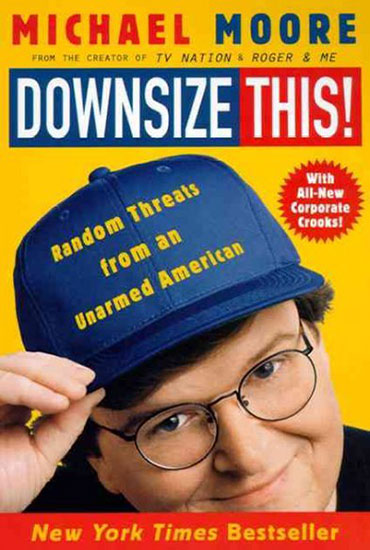
I have just submitted my reviews of Michael Moore’s Stupid White Men and Downsize This to Amazon. While reading the reviews I visited michaelmoore.com and was intrigued to read this.
Well, take a look at my Oscar “backlash”: On the day after I criticized Bush and the war at the Academy Awards, attendance at “Bowling for Columbine” in theaters around the country went up 110% (source: Daily Variety/BoxOfficeMojo.com). The following weekend, the box office gross was up a whopping 73% (Variety). It is now the longest-running consecutive commercial release in America, 26 weeks in a row and still thriving. The number of theaters showing the film since the Oscars has INCREASED, and it has now bested the previous box office record for a documentary by nearly 300%.
Inspired by Stupid White Men to read another of Michael Moore‘s books, I came away thinking that Downsize This was actually a better work. Sure, some of the scenarios are silly (‘What America Needs Is A Makeover’) and many of the examples a little dated (some have been overtaken by world events). It’s also true that some of the humour doesn’t seem to sit well with the subjects but it is, nonetheless, a very welcome voice in the sea of opinions.
Moore does attempt to be humorous with his staple subjects: corporate greed and accountability, right to freedom/life and social and environmental responsibility. Like Stupid White Men the book makes subjects accessible that are often not covered by mainstream media.
If Stupid White Men has made you think about reading more then this is a good start if you’re happy to have many more American examples as the main topic. If you’re looking for something a little more British then this is not the book for you.
Probably the most famous of American Liberal thinkers at the moment,Michael Moore is a US treasure, and they should treat him as such. Instead, the land of free speech tried to prevent this book from being published following the attacks on the World Trade Centre.
Thankfully, this book made it out. It’s certainly very US-centric (it was, after all, written for that market), but many of the points apply to much of the Western world. While suggesting that “we live in a society that rewards and honours corporate gangsters”, Moore does it with a humour that’s accessible and easily read.
Much political writing is hard to read, whereas this is written in small chunks and is easily digested. For those familiar with liberal writings, much of Moore’s work may appear superficial, but that’s to do with the style rather than the content. It is Moore’s style that has made this book number one on so many book lists, but it’s the content that people will remember. For the British reader, the challenge is to see where our democracy is following the US lead.
Why should you read this book? Because it puts the greed of the consumption society into perspective and genuinely makes you think about the society in which we live.
You can read other people’s opinions of the book at Amazon UK
In some respects it’s a fascinating tale of fame and hedonism. If, however, you’ve read biographies of other Eighties pop stars then you’ve heard a lot of it before. The story seems to have been repeated: humble beginnings drive creativity which lead to fame and then there is a some-kind of fa
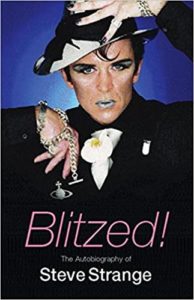
I’ve just finished Blitzed! The autobiography of Steve Strange and posted my review to Amazon:
Blitzed! The Autobiography of Steve Strange
I’ve just finished Blitzed! The autobiography of Steve Strange and posted my review to Amazon:
Steve Strange was an icon of the Eighties music scene, a visionary and a leader. I suspect he’s often overlooked, but his contribution was vital. His clubs kick-started a movement, and the band he fronted,Visage, were pioneers of what became the New Romantics: make-up, big hair, big hats, and even bigger shirt lapels and cuffs. From the beginning of the decade, and out of the punk movement, came the classic Fade To Grey. Visage and Steve Strange were combining fashion and music in a radical new way.
Blitzed has an informal style, which makes it quite readable. Strange name-drops his way through a decade and apologises quite a lot for his behaviour. It’s a cautionary tale of a rise to fame, money mismanagement, and drug addiction. It’s the story of London squats and club-land rivalry and of a community that knew they were changing nightclubs, the fashion scene and music – and doing it all in a few short years. It is a struggle to stop a man falling over the edge and trying to make sense of a life where once his name was in lights, but the money is long gone.
In some respects, it’s a fascinating tale of fame and hedonism. If, however, you’ve read biographies of other Eighties pop stars, then you’ve heard a lot of it before. The story seems to have been repeated: humble beginnings drive creativity, which leads to fame, and then there is a kind of fall (usually, drink or drug-induced). Blitzed is an enjoyable read, but Boy George will give you more, and Marc Almond will take you further. If you knew the club scene of the time, there’s an insight into the door policies of the new breed of Eighties clubs and how they worked. If you are looking for the story of Visage, then, obviously, it’s covered here, and this will be a valuable reference – but it’s more about the man than the band.
If you remember the decade, then you’ll read this book regardless, but, sadly, I felt there could have been a little more. Nonetheless, Blitzed reinforces Steve Strange’s rightful place as a leader of a movement that’s certainly not about to fade away.
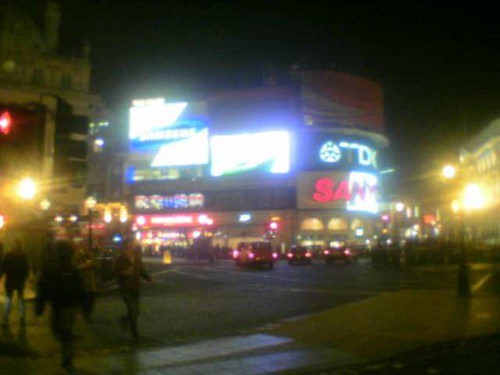
I acquired a new mobile ‘phone earlier in the week and it has a tiny camera in it which I used to take a picture of Piccadilly Circus at night
Piccadilly Circus
I acquired a new mobile phone earlier in the week. I didn’t actually choose the model. I acquired a new mobile phone earlier in the week. I didn’t actually choose the model because I was sent it. It’s bigger and heavier than my previous mobile, and it doesn’t have a radio, which I really liked when I was walking to work. It does, however, have a calendar function, which I find quite useful, and it has one of those built-in cameras that people rave about.
It’s not the greatest camera in the world, but it is quite cool to have a camera that you carry with you all the time. For no real reason, on Tuesday night, I decided that I wanted to take a shot of Piccadilly Circus (I work just around the corner). I have just pulled the image off the phone. It’s not a great photo (in fact, it’s a pretty poor one), but I am really quite happy with it. There is something about the colour and the light that suggests the real buzz you get from walking across Piccadilly Circus at night. Now, let’s see how many more photos I post.
Obviously, I am not the only person in the world to have a camera in a phone, I am not the only person to get excited about it, and I am not the only one to blog it. Guess there’s very little unique about me!
You know, I am really impressed by the new version of Opera (which has always been a browser I have used).
You know, I am really impressed by the new version of Opera (which has always been a browser I have used). I love many features while others, like the new M2 mail client, I am not too sure about. I think they may have something in the different approach to mail, but I may just be too stuck in my emailing ways. Still, if you want to check out how your pages may look on smaller screens (phones, pdas etc.) if the vendor has selected Opera then boot up Opera 7, go to your site and SHIFT F11 for Opera’s small screen rendering. Left is my site as it looked the other day. I think it proved the power of style sheets as the whole thing is still quite browsable (is there such a word) and readable in the reduced format.
America is the only real super-power with the economic and military force to pretty much try and do what they like around the world
Where does Britain go next? Polly Toynbee wrote an excellent piece in Friday’s Guardian [via Politix] about the state of the Union (European) and our (so-called) special friendship with America. Sadly, I really believe that the friendship is now very much a one-way street. We support the US, or we don’t. They don’t much care.
America is the only real superpower with the economic and military force to pretty much try and do what they like around the world. Yet a European Union – in several guises – could be a threat to that power and, therefore, a stabilising influence on a very one-sided world. And, if we are honest, even the Americans should understand that could be a safer way for the world to be. A second democratic super-power born not out of ideological fights, but pieced together from a similar model to that from which the US grew. In essence, a powerful and united European Union (united by stance and not necessarily under one flag) would provide the series of checks and balances the United Nations seems unable to provide at the moment.
Depending on your viewpoint, this war may (or may not) be right in many ways. Regardless, we are there now, and we are fighting alongside the US and other nations. When the dust settles on Iraq – as it eventually will – what will the new world order be like? Will we follow the US into any nation they care to wage war against (rightly or wrongly)? Can we still hold our heads high at meetings of the EU and look our neighbours in the eye? Are we capable of stepping back and looking for our appropriate place in the new world order? I hope we can.
On Iraq, I believe that the prevailing mood of the British people is sound. They do not doubt that Saddam is a brutal dictator, but they are not persuaded that he is a clear and present danger to Britain.
It must be an odd career being a politician – whatever you do, somebody will disagree. After all, there is always somebody with a different coloured rosette. If your opinions are not being shouted down in some debating chamber due to political differences, then you run the risk of being called self-serving. It’s one job where you know you will not be popular everywhere.
So is Robin Cook, former Foreign Secretary and now former leader of the House of Commons, a man of integrity or self-serving? I don’t know him, so I can’t answer that. What I do believe is that his resignation speech last night was one of the best speeches I have ever seen by a politician. It wasn’t bitter (although there was a sadness to it), and there were no personal attacks (even though he resigned because he disagreed with Government policy). He is not leaving his post because of some scandal, but because he feels he can’t continue to serve in a Cabinet that supports a war he does not. With it, he loses the trappings of office (house, car, staff?) and returns to the back benches.
I don’t know much about Robin Cook. I know that last night’s address was remarkable. He was eloquent and appeared to speak with a sincerity and conviction you do not see often in the modern politician. His argument (regardless of your stance) was delivered with a calm clarity that is also unusual. I admired the fact that he spoke to the House of Commons before the press and seemed, genuinely, to respect the workings of the British democracy. Isn’t it a shame more politicians don’t do that?
Now, some have suggested throughout the day that he was positioning himself for a role if all goes wrong for Tony Blair. But doesn’t taking a stance and having the integrity to declare when you believe something is right or wrong mean that you are positioning yourself? You can’t do anything about that. If he is proved to have been right, then it’s only proper that people turn to him in the months to come. If he is wrong, at least he has his integrity intact. If more of our elected representatives cared more for the policies than public opinion or their image and spoke with the passion that Robin Cook did, I think British politics would be a better place.
Perhaps Claire Short should take another night to think about it.
Far from Heaven is a strange film set in a place called Hartford in 1957, and it really does look like it. It’s melodramatic – as all 1950s movies should be – and it’s got that feeling (you could say retro as the look is very in at the moment) which makes you think, for some reason, that Formica is the path to happiness for us all.
Cathy and Frank are a successful couple living in a well-to-do house with successful friends and the appearance of a respectable, 50s suburban family life. She lunches and hosts parties, the maid looks after the children, and he is a top salesman. The family, however, is rocked when Cathy (Julianne Moore) catches Frank (Dennis Quaid) in a passionate embrace with another man. This repressed homosexuality eventually wrecks their marriage, and Cathy finds comfort in the friendship of Raymond Deagan (Dennis Haysbert) – a black man in a time when white men and black men could not ride in the same part of the bus.
The film is certainly moving, and there are some scenes where you see and feel the emotional trauma the pair go through. The reaction of the middle classes is an insight into what, for me, seems like a different world. It’s played well, and the three leads should all be praised for their performances. Far and Heaven addresses difficult issues in an interesting way, but the 50s styling allows you to distance yourself from the characters’ feelings and opinions. I suspect that some of the fear and prejudice still lie beneath many, and this film won’t make people address them.
Some of the scenes seem too forced, stylised, or stereotypical to be carried off believably. Having said that, it’s an enjoyable film and one I would recommend.
UPDATE 24 MARCH: Sadly, Julianne Moore didn’t win for this or The Hours. However, Michael Moore did win Best Documentary Feature for Bowling For Columbine.
I went to see a client this morning: nothing too unusual in that fact. It was a client I have worked with over several years – the internet arm of a well-known organisation. Again, nothing too exceptional. Nice chat, coffee and a new product overview (from my part). As I had not seen them for a while, I thought it would be nice to go back. Now, don’t get me wrong, it was great to see people there. What was sad were the changes that have happened to the online group over the last year. Gone are the product managers, most developers and many of the other staff. They are now much, much smaller than they were.
Again, nothing too unusual in this, but today it struck me as sad. The ideas and the passion, the desire to make something happen and be part of it that all those people had – gone. How many people in so-called new media industries have been through it (some, several times)? I have been through the cut-back mill as people around me are “downsized” to allow companies to survive. Yet, today – I think – was the first day the scale of it struck me. I can’t explain it, and I am not sure that I want to try, but today I think I understood how the internet was built up and how it failed to deliver on those dreams for many people.
The “why” of it all is a different story for a different day. Today is about the good people who have moved on. Hopefully, they’re doing better.
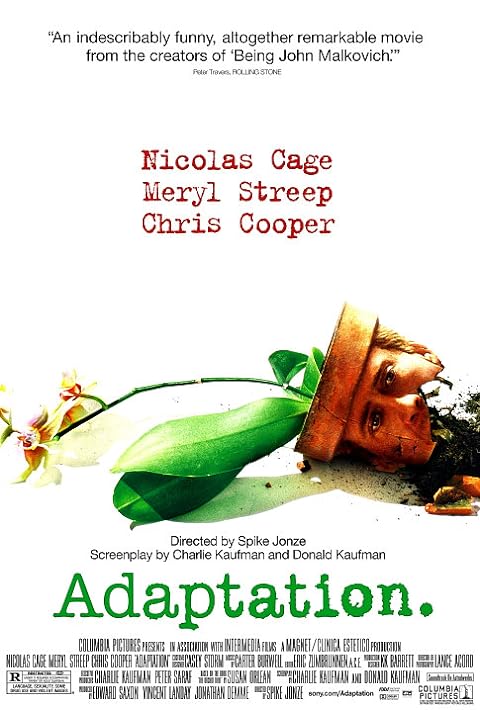
It’s wowed audiences and received Oscar nominations(for Nicolas Cage, Chris Cooper, Meryl Streep and for Charlie Kaufman’s writing) but it didn’t do very much for me. Sadly, I was almost asleep, which I guess isn’t a good review.
In theory, it’s an interesting movie. Instead of being able to write a screenplay based on Susan Orlean’s bestselling novel “The Orchid Thief“, Charlie Kaufman (and his twin brother, Donald – more about him later) write a movie telling the tale that the film can not be written. We suffer with the author as he faces writer’s block and is tormented by false starts. Of course, during this process, we also get to see something of The Orchid Thief itself as characters within the novel have to face their own torments.
Charlie Kaufman is, of course, a real screenwriter (he wrote Being JohnMalkovich), and the tale appears somewhat autobiographical. Donald Kaufman, who shares the writing credit and is – I imagine – also nominated for The Oscar, is fictitious: a plot device to add to Charlie’s trauma and help finish the film.
I’ve heard great things about this film – and that made me want to see it. I read a great feature on it in a recent edition of Empire which also made it sound interesting and people have raved about it. I was looking forward to seeing it and, sadly, I left the cinema bitterly disappointed. You can’t fault the film on originality, story-telling or acting (Streep is fantastic, Cage superb as both twins) but something didn’t work for me. It’s terrible when that happens in a film, but this time it didn’t work. It would be an interesting take to see if I could watch it again and if I could get more out of it.
Unfortunately, I do think that while it’s clever it’s also confusing. Those who understand more about the screenwriting process or the struggles of the author may get more out of it.
I may be attaching a misplaced purity to the weblog concept. I wouldn’t impose those same ideals on the population as a whole, so why should I do it to the blogosphere? Freedom to write whatever I want is a fine thing, and perhaps I am imposing concepts of integrity that are incompatible with this freedom?
Yesterday’s post started a whole train of thoughts about the concept of blog integrity and why should we care? I am sure it’s the idealist in me that is attaching a great deal of importance to the billions of words blogged on a daily basis. Perhaps I shouldn’t care because the power of blog-space is that people write opinions and thoughts in a way that they want to. It’s not for anybody else to say that I shouldn’t be allowed to promote a new mobile ‘phone because either I want to or the company sent me a free ‘phone.
I believe I might be attaching a purity to the weblog concept that is misplaced. I wouldn’t place those same ideals on the population as a whole, so why should I do it to the blogged world? Freedom to write whatever I want is a fine thing, and perhaps I am imposing concepts of integrity that are incompatible with this freedom?
I’m not sure where these thoughts are going, but they are challenging my blog ideals. I mentioned in one of my posts yesterday to the UK Bloggers list that, perhaps, blogs were just catching up with other media. I suspect that is true, but in a way I hadn’t thought of – the fact that they are as exploitable, commercially, as any other media.