Elsewhere: Blogging & Advertising

If you decide that your audience will accept advertising, what does this mean, and how will it work for a blog?

Over on the ukbloggers-discuss mailing list at Yahoo Groups, we’ve been discussing advertising, prompted by Tom Coates asking, “Did we ever come to any conclusions about the appropriateness of advertising?” in the context of blogging. In essence, we’re saying that blogging is personal and, if you decide that your audience will accept advertising, what does this mean and how will it work for a blog?

I started quite open to the concept,

I believe advertising is a compromise. Are you comfortable with a reader questioning your independence? I know it’s a very grand term, but, nonetheless, it’s at the heart of the advertising debate. It may not matter to the vast majority of readers, but it could (should?) to some. I don’t think anybody, but me, cares about my independence, but it is the reason why I wouldn’t want any advertising on my blog.

But is it that simple? Blogging generally costs something – hosting, bandwidth, time and effort. Should a blogger be entitled to get a little something back? I don’t think advertising is a bad thing on blogs,

When typing my previous post, I was being very careful not to say that I felt the acceptance of advertising is inappropriate (because I don’t think it is), but I do believe that while it shouldn’t change what you do or what you say, it may very well change the way you are read. And for some people, that’s a consideration (admittedly, probably not for many).

Or am I putting an undue emphasis on editorial independence for bloggers? Perhaps I am. Is it a silly notion to (try to) apply to weblogs in all their forms?

But then Tom introduced me to projectblog.com, a site aimed at recruiting bloggers with reasonable audiences “who would be willing to help advance their marketing efforts”, and introduced the concept of blogging about products you may have been sent as freebies or paid to write about. I think I turned cynical,

My first reaction was that it proved my point about editorial independence. Then, I was going to cite traditional broadcast media. There are some rules there to ensure a clear distinction between programme and advertising content.

However, when you think about it, how many morning DJs talk about having seen a new blockbuster that’s not released yet? Many of them. And most of them went for free. You do not consciously think their opinion is biased.

Perhaps the online world is playing catch-up with traditional media. And I can’t decide if that’s a good thing or not.

Maybe it’s sad that I cling to the notion that connected networks somehow empower people. I am not against the commercial web, but weblogs are a great example of a (generally) positive use of the technology. When the marketers get involved, it changes my expectations. It’s not a surprise, but the next time somebody raves about something new, won’t you question it (even a little bit)?

Is it possible to turn into a world-weary cynic in the space of two hours?

And now? Well, I stand by my thoughts that you should be clear about what you write. Blogging to me is the fulfilment of the web’s promise of personal publishing for everybody. But, of course, money always gets in the way and there’s nothing wrong with advertising online. After all, it’s what I do, isn’t it?

A Quieter Life

It’s time for my friends to give me a quick injection of reality.

Thank goodness that tonight I am going out with a group of friends. They are some of my oldest friends in London (by that I mean I have known them longest and not that they are all ancient). I’ve just decided that I am quite relieved, as I am having one of my “why do I stay here” days.

I love London. There is no doubt that it is one of the most vibrant and wonderful cities around. I love the dirt, the pollution and the travel chaos. I love the way the British put up with congestion with some quiet mutterings. There would be riots in some counties.

I don’t use London as much as I should. I work, and I travel home to my little Zone 3 house. Sometimes I go out with friends and visit a much larger range of bars than I ever would in a smaller town. I see films before they hit the screens in the rest of the UK, and even get to see films and theatre that never make it outside the West End. Occasionally, I will visit a gallery or museum or wander the historic sites. I adore the view from The London Eye, think St Paul’s is a great place for quiet contemplation, the South Bank is a wonderful place to relax and believe the Thames Barrier is one of the finest structures around. Oxford Street, Covent Garden and surrounding areas have every shop you could ever dream of – and many you couldn’t (or wouldn’t). If I lived here for the rest of my life, I probably wouldn’t have time to see and do everything I would like to.

Yet today I am having a “get me away from here” day. Take me somewhere where the pace is slower, people are friendlier (but not as pushy), and I can see the sky, not commute an hour each way on an overcrowded train. I think it started last night when I watched one of those programmes about people who give it all up and set up home in France, Italy, or Spain. They seem to live off the land and suddenly develop gardening talents that would make Alan Titchmarsh proud. They rebuild old barns and turn them into holiday accommodation that pays for their entire existence. They spend all their days on the land with the one they love and are at peace. Wouldn’t it be idyllic?

I imagine I would be bored. It’s not really a life for me – yet. I would miss Theatreland and Soho, but today I feel I still want that stillness and peace, that de-stressing lifestyle. I know it’s a lie, but I want the dream. And that’s why I am glad I am off to the bars of Soho tonight. It’s time for my friends to give me a quick injection of reality.

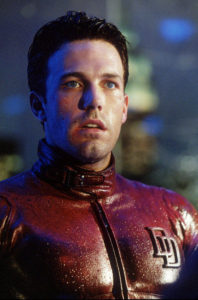
Ben Affleck In Tight Leather

Ben Affleck in tight leather – why are you looking for those pictures?

Ben Affleck in tight leather

Looking at the referrer logs for this site, a lot of people are getting here thanks to my mention of Ben Affleck in tight leather (I assume in my Daredevil review). If you really want a picture of Ben Affleck in tight leather, go here, here or here.

The official Daredevil site is here. Enjoy

Dear Mr. Secretary

The sacrifice of global interests to domestic politics and to bureaucratic self-interest is nothing new, and it is certainly not a uniquely American problem

U.S. Diplomat’s Letter of Resignation

I am surprised the resignation letter of John Brady Kiesling (political counselor at the United States Embassy in Athens) has not been more widely reported (New York Times | ZNet). In the letter he says:

“The sacrifice of global interests to domestic politics and to bureaucratic self-interest is nothing new, and it is certainly not a uniquely American problem. Still, we have not seen such systematic distortion of intelligence, such systematic manipulation of American opinion, since the war in Vietnam”.

Many good points are made, some of which I believe we in Britain ought to be asking ourselves. Why, Mr Blair, have you been unable to convince your fellow MPs? Why has America and the UK failed to convince a great deal of the rest of the world that this is a proper course of action? While I have no doubt that there is much that can not be made public, the fact that we have failed to convince foreign leaders of the rightness of our approach is, to me, the most serious cause for concern. If we have to go to war, I would like to believe that it is being done with the backing of the world. The current talk of re-building the Middle East seems to be the worst kind of message coming from the West, and especially the US. Who gave them (or, indeed, us) the right?

Although I don’t like it, I am not anti-war. But war only if appropriate and only when all other reasonable actions have been taken. Then, with the support of the rest (or at least a majority) of the world, I would concede war is necessary. Until it does, we have to be very careful indeed.

As Mr Kiesling says, it all smells suspiciously like something in Vietnam. And we know how that ended up, don’t we?

Continue reading “Dear Mr. Secretary”

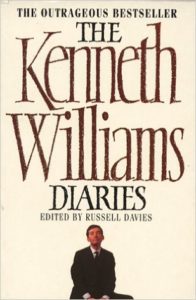
Elsewhere: The Kenneth Williams Diaries

The diaries are very well written and Davies’ editing not intrusive. Williams certainly didn’t appear to edit himself and the result is a frank and articulate book.

In my quest to ensure that I review every book that I read for Amazon (because I find other people’s reviews very useful) I’ve added my latest. It’s for the Kenneth Williams Diaries. I seemed to be reading them for ages – there are forty years worth of entries. It’s interesting for me because, during the time I was reading them I have also been maintaining this blog. While this isn’t quite a diary, the process is very similar and one paragraph in the diaries struck me as interesting:

The preoccupation with diary writing is caused by various things: the desire to keep a record which can be useful later, and committing to paper what can’t be communicated to a mentor … oh! all kinds of reasons, but fundamentally it is about loneliness.

Is it? Maybe it is. Who knows?

The Kenneth Williams Diaries, Edited by Russell Davies (Harper Collins, 1993)

Kenneth Williams DiariesI honestly think Kenneth Williams was unique. He certainly seemed to hate much about himself and didn’t have a great deal of time for a lot of other people. Sadly, the Diaries’ reputation precedes them and I expected more of the bitchiness that he is – supposedly – famed for. Despite that, there is plenty of Kenneth’s acid tongue in this book. His barbs are aimed squarely at his fans, his colleagues and the shows he felt obliged to work in. Some of the most intriguing insights are those that relate to the Carry On film series. Before Carry On made him famous, he was a well-respected stage actor. The Carry On films made him legendary (and wealthy) but he often felt they were beneath him.

Kenneth is well aware of his own nature. On 20 March 1987, he writes, “Everyone was v. nice to me … it is extraordinary that I’m so liked because I’m invariably rude & tetchy”, and that sums up much of the book. You get a sense of love for the theatre, plays, and poetry and even for some of the work. However, he is also offensive to many and seemed to have few good words for much of British Theatre. Much of the hate stems from inner turmoil over the lack of companionship in his life (“Never to speak of my love for a man”) and from the frustrations of his nature. Obsessed by noise and cleanliness, the very act of living seems painful – and in the end, his illness and genuine pain appear to get too much for him.

The diaries are very well written and Davies’s editing is not intrusive. Williams certainly didn’t appear to edit himself and the result is a frank and articulate book. Words seem to flow easily which is, perhaps, not surprising for a man who made a living in the final years of his life from his large collection of humorous anecdotes. Spanning over forty years it’s hard to keep track of the players in Kenneth’s life and at 800 pages it’s not a light read. Nevertheless, the diaries are a vivid, malicious and (at times) very funny read into the world of a man who, in his day, was considered outrageous.

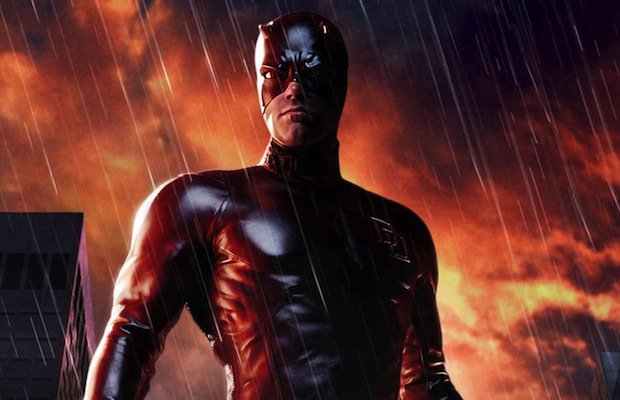
Film: Daredevil

I really can’t be sure what made this film fail for me. Maybe it was too dark for a super-hero flick or maybe that the story was not compelling. Maybe it was the fact that at least one villain survived for a sequel in a far too obvious fashion.

I was very surprised that I did not enjoy Daredevil more. It’s darker and more disturbing than many a super-hero flick and while this, for some, may be the appeal, it just didn’t do it for me. It’s also oddly constructed. We first meet the superhero as he collapses on the floor of a church. Why? Well, he’s halfway through a battle with one of the villains – Bullseye (an Irish hitman capable of killing talkative old ladies on planes with nothing more than his finger and a peanut).

And so the film lurches backwards as we are told Matt Murdoch/Daredevil’s story. He grew up with his father -a boxer – and singled out for the bully treatment when he was a kid. Blinded in a dockside accident by a hazardous chemical, Daredevil’s face remains remarkably unmarked as he matures in the talented pro bono lawyer played by Ben Affleck.

Once the Flashback sequence is over we return to our hero in mid-Organ scaling (as in church organ) battle. Who considered the middle of the narrative a sensible place for us to join? I guess it has worked before, but not here. In true super-hero style, our almost dead star rises and battles to the end. Of course, as in all such movies one wonders why the world hasn’t worked out that Matt Murdoch and Daredevil are the same. They are Ben Affleck in red leather.

Ah, dear Ben. I appear to be in the minority who were not convinced by his portrayal of a superhero. He was too “leading man in a romantic comedy” for me, despite the tight leather gear, which didn’t seem to turn him into the sex-hunk that I thought it might – Chris O’Donnell looks better in tight leather in Batman and Robin. Colin Farrell tries hard to be brutish with sex appeal, and he almost pulls it off, especially considering the target on his forehead isn’t really that great to look at.

I really can’t be sure what made this film fail for me. Maybe it was too dark for a superhero flick, or maybe the story was not compelling. Maybe it was the fact that at least one villain survived for a sequel in a far too obvious fashion. Daredevil may be a comic hero, but you don’t have a super-hero “thing” to latch on to (Superman flies, Spider-Man has a web, and Batman has a utility belt). Daredevil’s other senses are enhanced. Big wow. Maybe it was the violence that felt too real and not comic-book enough, or maybe it was that the supporting characters never really moved from being one-dimensional support.

I guess, in the end, I would have been disappointed if this crime-fighter had come to my rescue. I’d have been happy with Batman, thrilled if it was Superman and delighted if Spider-Man liberated me. If Ben turned up in red leather, I just might have laughed.

An Email From Space

We should continue to push the boundaries of technology and exploration.

While the investigations into the loss of the Space Shuttle continue, some argue that the Shuttle itself should be scrapped,

The space shuttle is impressive in technical terms, but in financial terms and safety terms no project has done more harm to space exploration. [Source: time.com]

For me, the most compelling story in the media today is from BBC News who have the text of an e-mail from shuttle victim Laurel Clark.

I feel blessed to be here representing our country and carrying out the research of scientists around the world. All of the experiments have accomplished most of their goals despite the inevitable hiccups that occur when such a complicated undertaking is undertaken. [Source: BBC News]

Pop

I am currently listening to pop. This is a difficult thing to write. Pop is not considered to be a credible music genre by people who listen to lots of music. Pop is considered the home of the boy band. Pop is the cheap and nasty side of music.

I am currently listening to pop. This is a difficult thing to write. Pop is not considered to be a credible music genre by people who listen to lots of music. Pop is considered the home of the boy band. Pop is the cheap and nasty side of music. People, especially people of my age, should have grown out of pop, but I have not. I enjoy the throw-away nature of it. The three-minute perfect pop song can take you away from your day and, if this week’s other entries are to be believed, away from your fellow commuters.

Actually, I hope, the current music I am listening to is considered the good side of pop (see, I am joining in the criticism of the genre). Not for me the sounds of the Cheeky Girls or S Club Juniors. No, I hope my current selection is a little more discerning.

I own a reasonable amount of music but I don’t purchase CDs weekly like some people. But I am listening to three recent albums which must be the first time that has happened to me in a long while. My current favourite is Justin Timerlake’s Justified. That is followed closely by Erasure’s new release (just last Monday), Other People’s Songs. Finally, I been unable to resist Will Young’s From Now On. Yes, unable to resist!

Continue reading “Pop”

Film: 8 Mile

I have no idea if this in any way reflects real life in downtown Detroit. I have no clue if rap culture is, in any way, well served by his film but it is a great movie which I thoroughly recommend.

I walked out of the Odeon loving Eminem’s 8 Mile. On reflection, I still think this is a great movie. Who cares if it’s Saturday Night Fever or Karate Kid for a new generation? Does Eminem’s apparent turn around about all things gay worry me? Not at all. This is an excellent film. I do, however, have one question, where are all the guns?

I have never visited Detroit nor any of its downtown neighbourhoods. Fortunately, I’ve never been in the middle of any kind of big gang culture. But in this movie, there were two guns (three if you count the paint-ball). One is pulled on Jimmy (Eminem) and one is waved around by Cheddar Bob, who promptly shoots himself while those involved in the gang fight around him look on like they’d never seen a gun. If I were to believe the news media, this place would have been crawling with weapons and Jimmy would have probably pulled several on his attackers. A movie for nice liberal sensibilities? It just struck me as odd. Perhaps it’s real, but it seemed wrong.

That is, however, but a small gripe. Like yesterday’s film, The Good Girl, we have a central character with an apparently dead-end life but dreams of something better. This time, the lead is surrounded by people who believe in him although he doesn’t believe in himself. The final battle, where Jimmy – or Rabbit – proves himself to be great, is a freestyle rap event that is so far removed from anything in my life or frame of reference that I have no idea if it’s believable, amusing or insulting. Having said that, it is a great conclusion to the movie and had me hooked.

Surprisingly, Eminem’s music doesn’t dominate the movie. I was slightly disappointed there wasn’t more. We first hear his musical talents when he sings a lullaby to his sister. A repositioning of man whose music has been the centre of controversy for years? So, if we don’t get to hear much of his music, how does he stand up as an actor? Pretty well, I would have said. His baseball-cap (and hood) mask much of him revealing only a cool, moody, brooding man writing rap lyrics on scraps of paper to music pumped into his head through headphones. As the movies is apparently based on some of his own life, I suspect this wasn’t a great leap for him to play. He does pull it off with conviction and you can take the journey into Jimmy’s world and lose sight of Eminem. I’d be interested to see if he acts again and with the huge box office takings predicted, most will bet he will.

I have no idea if this in any way reflects real life in downtown Detroit. I have no clue if rap culture is, in any way, well served by this film but it is a great movie which I thoroughly recommend even if you are asked to believe that, when life hits rock bottom, you’ll win on the bingo.

Film: The Good Girl

Good. But not good enough. While Aniston is good, she is not great. It seems much of the praise is due to the fact that she is playing against the Friends Rachel-type. She an actress for goodness sake, if she only has that one role she has no career. This role proves she can play against type and, I guess, that means she is an actress.

What has surprised me about Miguel Arteta’s The Good Girl, starring Jennifer Aniston, are the generally positive (if not glowing glowing) reviews for this film.

Admittedly this is not quite the Jennifer Aniston vehicle that you would expect from Hollywood right now. It’s no romantic comedy, rather a drama following Justine (Aniston), a woman in a dead-end job in a dead end town, who falls for Jake ‘Donnie Darko’ Gyllenhaal’s Holden Worther. Not much to it so far and certainly not enough reason for the praise.

So, to the plot. Problem one for our lead, Justine is married to a full time stoner (part time painter) played with conviction by John C. Reilly. Problem two, Holden seems to think he is Holden Caulfield, the central character in Catcher in The Rye. If I was to say he was “unhinged” I’d be playing it down. So, cue a crisis of conscience for her and a serious infatuation/breakdown for him.

While Aniston is good, she is not great. It seems much of the praise is due to the fact that she is playing against the Friends Rachel-type. She an actress for goodness sake, if she only has that one role she has no career. This role proves she can play against type and, I guess, that means she is an actress. Her narration is okay but somewhat draining to listen to. Gyllenhaal’s good but, given the characters are odd-balls not a million miles apart, he is not as engaging as he was in Donnie Darko.

I guess it hangs on the believability of the adulterous relationship and, for me, it was not that credible. Perhaps it hangs on the ability for Aniston and Reilly to be a couple at the end, but it’s not convincing. There were words unspoken which should have been spoken. Where are the sparks? Where was the fire and the passion between any of the characters?

Sadly, it lacked the ability to engage me for the one and three-quarter hours. Which meant I started to feel the cinema seat beneath me. At that point, I knew this wasn’t going to be added to my “greatest films” list. Which is a shame. Good. But not good enough.

Entitlement Cards

The consultation period for comments on the introduction of ID cards in the UK is coming to an end

A lot of the blogs I read regularly have highlighted STAND and there seems to be a lot of negative feeling about the introduction of identity/entitlement cards in the UK. I am very undecided as I think they could make so many things easier.

It’s disappointing that there are not more privacy controls in place to make illegal use/access of the data a criminal offence. It’s also very worrying that there doesn’t seem to have been more debate about them and greater publicity surrounding the consultation period. I feel it’s important to add my voice but do I have time to sensibly consider my own thoughts on the matter? I just don’t know what to say. [consultation]

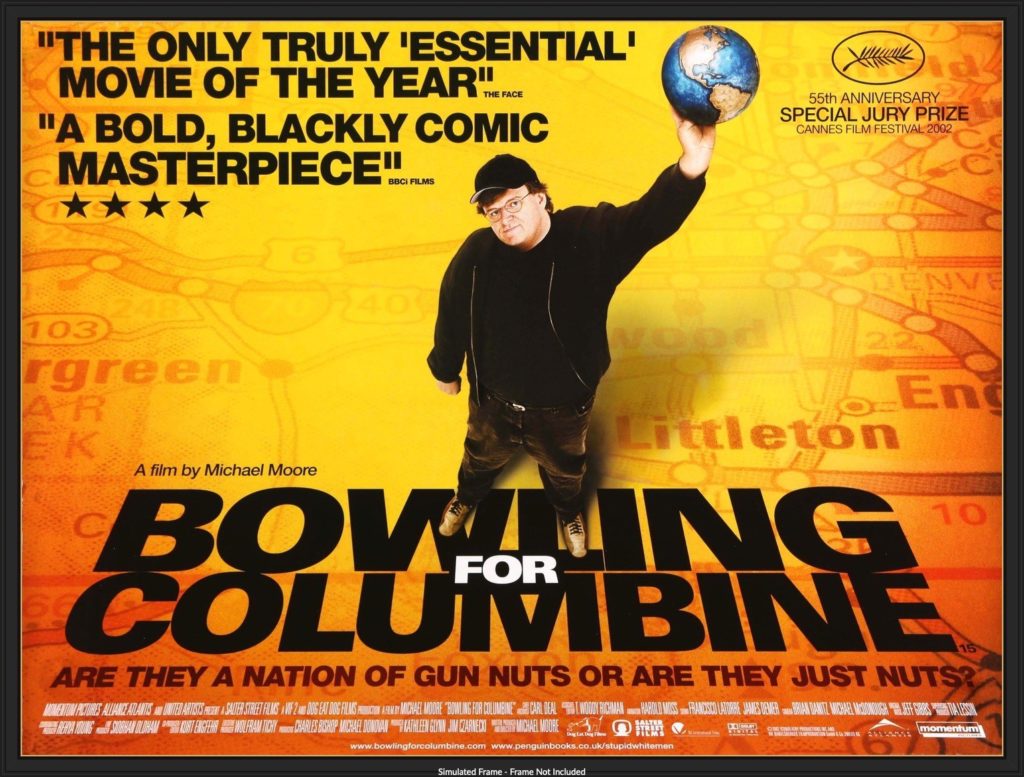
Bowling for Columbine

A film investigating America’s gun culture, contrasting it with Canada’s similar laws but lower death rates.

What a fantastic film! Michael Moore’s Bowling for Columbine is as good a piece of filmmaking as any I have seen for several years. It is also a documentary, which means, I guess, that few people will see it. Well, you should.

It’s an investigative piece that looks at the United States of America’s love of guns – in all their forms. While it appears many Americans think it’s a constitutional right to protect their family with a shoot first mentally, Moore contends that this obsession with the freedom to bear arms results in unnecessary deaths (accidental and intentional). Contrasted with Canada, similar gun laws and ownership, but considerably fewer deaths, it seems Moore may have a point.

The statistics played out on the screen are not always given a context, and some of his points are rather laboured, but Bowling For Columbine has some moments you’d think were fiction (the final K-Mart statement – I won’t spoil it), yet are horribly real.

And yes, the clip that’s been doing the rounds of the film shows Moore getting a free gun when opening a bank account, which appears very real. Funny, it really does appear that these things really do “only happen in America”.

The Grand Old Duke

A backstage tour at The Duke of York’s Theatre is a fascinating look at the old London theatre.

It is often said that those of us who call London home do not benefit from the great advantages that the capital city brings. People have been heard to suggest that Londoners do not use London. Well, glancing through a copy of this week’s Time Out, I came across the backstage tour of The Duke of York’s Theatre on St. Martin’s Lane and decided to go. The tour wasn’t very expensive and lasted almost two hours, and I reckon it must be one of the best value guided events around.

It is a fascinating tour of the old London theatre that was built when the area was underdeveloped and helped transform that side of Charing Cross Road into the entertainment area it is today. It’s the theatre that first staged Peter Pan, the theatre that first saw actors agree to the forming of UK Equity and it has seen many greats play its stage since.

I can now say that I have appeared on the West End Stage, and standing on the stage looking into the auditorium, I was surprised at how close theatregoers would appear to the actors. I was also struck by how small the stage area really was and by how big the under-stage area is. Also intriguing to know that Capital Radio once owned it.

A lesson learned, that’s for sure. I will be spending more time each week with the what’s on listings and trying to take advantage of what this city has to offer.