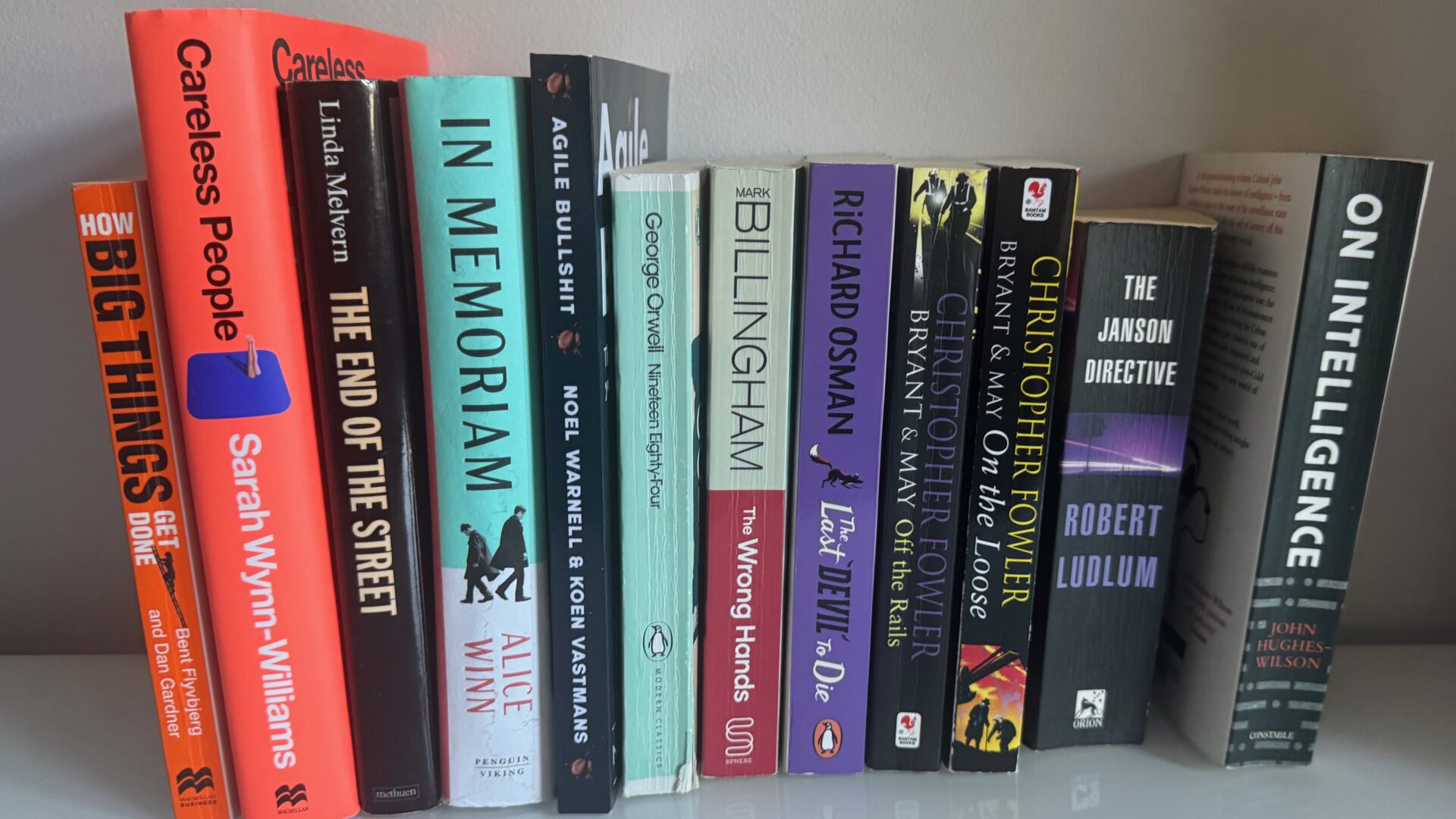
Last week, I finally got around to photographing the books I read last year. They can go to a charity at the weekend. I know I am unlikely to re-read them. I failed my reading challenge: on 12 of 15 books read. At least it’s the equivalent of one a month.
As always, there’s a mix of books that I think are interesting and detective stories, which are a guilty pleasure and, when on holiday, I can read in a day or two.
I started the year reading Bent Flyvbjerg’s How Big Things Get Done. Does it contain the secret to delivering large-scale projects on time and on budget? Maybe. Get your team right and plan to the tiniest degree. Don’t be the Sydney Opera House, be Frank Gehry. I read it because we have a large-scale project coming up at work; not sure how much I actually took away.
I spent a few years working at Facebook and was interested in Sarah Wynn-Williams’ Careless People: A Story of Where I Used to Work, as she was at the company when I was, working at very different layers of the business. I wondered how much of the company she writes about I’d recognise. I think what’s most scary about this book is that, for most of the people I worked with and me, we wouldn’t recognise this from our experiences, yet it rang weirdly true. The villain is very one-sided in this story.
The villain in the next book is a bit less clear, although at the time, the world would have pointed to Rupert Murdoch. The End of the Street by Linda Melvern might have been my favourite book that I read last year. It’s the tale of how the Fleet Street unions were defeated and how the newspaper industry changed forever. There was passion for the newspaper business from both sides. News Corp. felt it couldn’t change the business incrementally, so it adopted an extreme modernisation approach. Perhaps newspapers survived a little longer because of it, perhaps not. Given where the newspaper industry is today, it feels like a historical story. But the innovator’s dilemma is real. Whether this was the right approach remains unclear.
In Memoriam by Alice Winn is a very well-regarded novel, but this was my second attempt to read it. I am glad I stuck with it. Gaunt and Ellwood, at a public school and in the trenches. All their friends are dying all around them. Eventually, I was hooked. I really enjoyed this even though it’s not the kind of novel I’d usually read.
Another book I tried to read before is Orwell’s Nineteen Eighty-Four. And I nearly gave up this time, too, but somewhere along the line, I got hooked. Is the Ministry of Truth even more real today than it was when it was imagined?
Warnell & Vastmans’ Agile Bullshit was another book I read because of work. Agile ways of working are a nice theory, and I’ve seen them successfully implemented in practice, but when the process generates more discussion than the outcome, then something is wrong. I thought this book would back up some of my thinking. It didn’t. And I still think the word ‘ceremonies’ to mean meetings is one of the most pompous things about agile.
The next four books are all detective-based and a cracking good read. Mark Billingham’s The Wrong Hands is the second of his books that I read. An easy read, with a decent plot, if you don’t mind severed hands in a briefcase. Next, it’s back to The Thursday Murder Club in The Last Devil to Die. This time, the case leads the team into the antiques business, which practically screams ‘cosy murder mystery’, and this gives you exactly that, with Richard Osman’s brilliant, engaging style.
I believe one of my great discoveries of the past few years is Christopher Fowler’s Bryant & May series. They always seem to be on the verge of the Peculiar Crimes Unit being closed. In Off the Rails, they have a week to find a killer, with the twist that they’ve caught this killer before. In On the Loose, the unit is closed, yet the case must be solved. I love this series and wholeheartedly recommend it to anyone. The intricate London details are phenomenally woven into all the stories without seeming out of place.
As a fan of Robert Ludlum’s Bourne series, I found The Janson Directive at the back of the shelf featuring a new character. Paul Janson, a former undercover agent for a deniable government agency known as Consular Operations, is asked to do one last job: rescue the billionaire Peter Novak. Today, we know just how bad the world’s billionaire class can be, and their views on reshaping the world are best ignored. I don’t think it was written as a manual for bored rich people to do bad in the world, but 13 years after its writing, bits of it are strangely contemporary. Also, another cracking good action adventure.
I ended the year by completing On Intelligence: The History of Espionage and the Secret World, which somehow got recommended after Nineteen Eighty-Four. There’s a lot in this book, and it offers fascinating insights into how intelligence works, with real examples from throughout history. If you want to know how intelligence (on both sides) ensured a successful D-Day landing, then that’s in one of the chapters. It’s an accessible telling of the espionage world, but as with all things secretive, you can’t help but wonder what’s not being told.