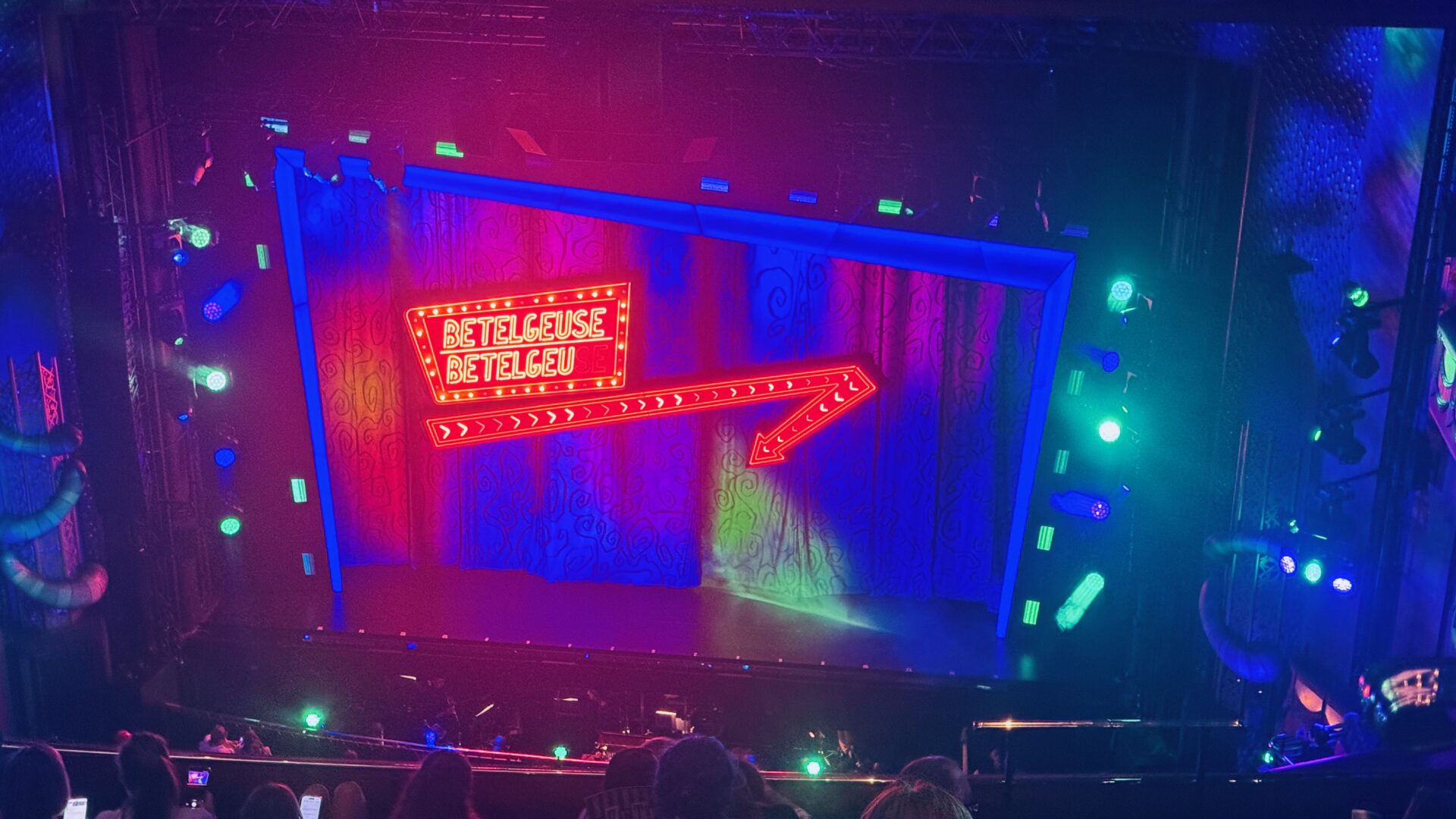
I’m not sure how we ended up seeing so much theatre recently, but tonight we went to see the West End transfer of Beetlejuice The Musical.
Based on the film but not the same, the musical makes Beetlejuice the main onstage character, and Lydia (played by Hannah Nordberg) has a more developed story arc, mourning her dead mother, than happens in the film.
Mainly, it’s a funny show that breaks the fourth wall and talks to the audience, with plenty of contemporary references and a Radio 2 tote bag. This may seem odd, and I had to look it up. In London, this is used in place of the NPR equivalent in US productions. Having a demon offer the tote bag as a symbol of the underworld to middle-class theatregoers is a bit of fun poked at the stalls; it stands out as both ridiculous and charming. Very much like the whole production.
David Fynn (who we last saw in School of Rock) was excellent as Beetlejuice. He has a real stage-filling presence and has a much bigger role than the character does in the film, holding the whole plot together and breaking the fourth wall to talk to the audience. The staging changes frequently, perhaps too frequently, but is quite impressive. The music, however, is a little less memorable. Predictably, the easily remembered songs are those used in the film, originally by Harry Belafonte: Day-O (The Banana Boat Song) and Jump in the Line, which are what stick with you.
I thought Creepy Old Guy in Act Two was clever as it pokes fun at the source film’s plot device of having a centuries-old demon trying to marry a teenager. Dead Mom is delivered by some great vocals, and should be the emotional heart of the show, but writing this now, I only remember the song with the memory of the performance. Maybe I need to hear it again.
Don’t let that put you off. This is a self-referential, self-aware musical with comic bits and songs, meant to be enjoyed in the moment.
Palladium Superstar feels flat, despite later flashes of second-act brilliance.
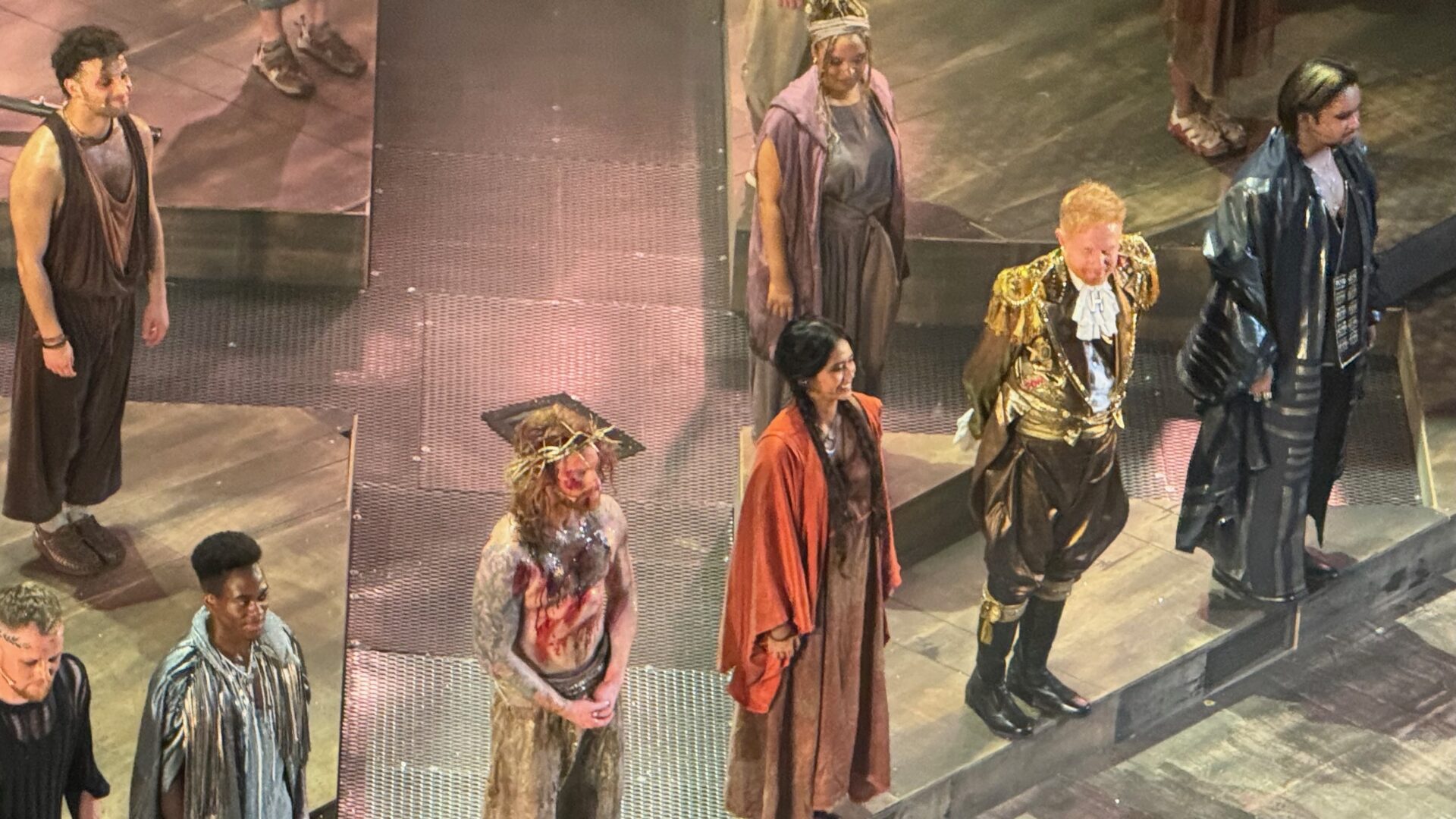
The cast of Jesus Christ Superstar takes their bow.
It’s World Cup season, and if you heard somebody say it’s a game of two halves, you’d immediately assume they were talking about one of the matches on television, not the latest production of a West End musical.
The current production of Jesus Christ Superstar at the London Palladium is directed by Tim Sheader, who spearheaded the Regent’s Park Open Air Theatre production of this musical. In fact, the official website says, “The award-winning Regent’s Park Open Air Theatre production of Jesus Christ Superstar comes to the West End.” This has left me entirely bamboozled, because I saw that version in the park and was blown away, so much so that we went back to a concert version of it in 2020, when everybody, including actors, had to be socially distanced. Remember those days? This evening, I left the Palladium definitely not feeling that I had been blown away by what I had seen.
The current run is certainly marketed on the star performers playing the roles of Jesus and Herod. Pop-rock and Eurovision star Sam Ryder is Jesus, while the role of Herod is played by a revolving door of big names who drive the price of seats up. Tonight, it was Modern Family star Jesse Tyler Ferguson who was playing Herod. PY and I were a bit confused because, when we originally looked at ticket prices for his performances, they were through the roof, and we thought we had booked for one of the less well-known celebrities. Perhaps it’s best we don’t name them. Anyway, it turns out that wasn’t the case. I mention that because it should have added a bit of extra magic to our night. But…
I really don’t know how to describe how I felt about Act One, except that I walked into the interval bar, and when PY asked how I felt, I said it was as flat as a pancake, fully expecting one of our theatre disagreements. Yet we were both of the same opinion. Jesus Christ Superstar opens with much more of a bang, and this was a whimper. For many of the early scenes, Sam Ryder is wandering the stage, looking a bit lost, as if he stumbled into the Palladium by accident. And I really felt the whole of the first act didn’t use his voice to its full extent.
The rotating casting of Herod is, to me, a bit of a gimmick designed to drive up prices. Still, I can see how interesting it is to observe the role played by different people who may attract different audiences to the theatre. So, credit for trying to bring in more diverse audiences. But there’s a second gimmick, and I really don’t understand the point of this one.
In the Regent’s Park production, scaffolding was used as part of the backdrop and scenery and also served as a location for the orchestra. It provided a kind of urban realism and a rock-stadium aesthetic to a quite intense production. It’s been extended at the Palladium to allow for the sale of audience tickets on the stage. Tonight, I felt that this caused two problems.
The first is that, quite frankly, the people on stage are quite distracting. They’re standing, looking at the players, and many of them burst into grins as soon as an actor approaches them. Additionally, the gritty realism provided by the staging and enhanced by the lighting is ruined when an audience member wears bright clothing. A woman in my eyeline was wearing a long, flowing white skirt: a lovely summer outfit for our current weather, but not really in keeping with the atmosphere they’re trying to set. I learned later that on-stage audience members are asked to wear black. Perhaps they should enforce the rule, but I guess that’s pretty hard if you’re raking in the extra cash from the tickets.
The other issue I have with accommodating audience members on stage is that the performance area needs to extend into the auditorium. For this show, it’s more than I’ve ever seen at the Palladium. And that meant a huge swathe of the audience on the upper levels missed fairly extensive parts of the action. PY reckoned he’d lost sight of a third of the action. These tickets were not sold as restricted-view tickets, and many people missed the action for much of the evening.
Now, to me, Act Two was a totally different production. It came alive, and energy surged. Sam Ryder’s voice was properly shown off. Jesse Tyler Ferguson, camping up Herod a little bit, blew a lot of the other performances off the stage, and he’s only there for one song. Can’t knock him for taking the money, especially as he gave a great performance. I’m not sure I’d say the second half came anywhere close to the performance I remember from Regent’s Park, but it definitely improved my overall feeling about the evening.
I still haven’t figured out what the messages with the cast performing with handheld microphones mean, but I’m sure there’s something in it. And I can’t figure out why it switches from what are obviously wireless microphones to ones with enormously long cables. I can see the point of using one of them to tie up Christ; it’s probably some message that I’m not quite getting, but I wish I’d caught that bit.
There are other notable performances. David Thaxton is fantastic as Pontius Pilate; his performance is tremendously conflicted, for example, when he’s not sure what to do with Jesus. And, to be clear, Sam Ryder’s performance of Gethsemane is an example of why he should be so right for the role.
But somehow, it didn’t work for me. Flat seems like a good one-word description. JCS should be more, and the Palladium has all the pieces; they didn’t fit together for me. I can’t put my finger on why this lands differently from Regent’s Park. It can’t be simply because they’re now doing it with a roof.
I wholeheartedly recommend seeing something new instead.
The dark of the moon has never looked so inviting.
I hadn’t heard of Dark of the Moon until we came across a ticket offer for tonight. Charing Cross Theatre is turning into a great spot for new (to us) musicals—we’ve seen Mythic, Violet, and Stiletto there over the past few years.
I don’t know the play Dark of the Moon is based on, but apparently it’s reasonably well regarded, according to The Internet. But I have to get this out of the way right at the start: the plot is preposterous. A witch boy falls for a human girl, strikes a deal to become mortal, and everything unravels when small-town prejudice and temptation intervene. It is a supernatural folk story, and I guess there is no rule that says it needs to be plausible. But it takes a bit of time to flip the switch that allows it to seem normal.
Richardson and Berney wrote this in 1945, and yet it doesn’t feel like a period story. Sure, the setting of a tight-knit Appalachian community closing ranks against what it doesn’t understand is not familiar (perhaps with the exception of some country music songs), but the dynamic is not. Intolerance doesn’t need a small town; it just needs enough people convinced they’re protecting something worth protecting. And that seems like a very contemporary theme to me.
What impressed me almost immediately was the staging. For what I believe is still an early-stage production, Libby Todd’s set is simple, but cleverly used. The village opens up to reveal its houses and shops, then closes back in to create a village square — or clears itself entirely to give the witches their performance space. Better still, the building rooftops serve as the witch world’s domain, a neat metaphor for the coven’s life high in the Smoky Mountains above the town.
The music and lyrics come from Grammy Award-winning, multi-platinum-selling songwriters Lindy Robbins, Dave Bassett and Steve Robson, and you can hear the quality in it. Ordinary Life, one of the opening numbers and recurring themes, sounds right out of the bluegrass country that I imagine when somebody says Smoky Mountains, yet it is also contemporary. Where some reviewers have found the blend of country, bluegrass and rock uneasy, I thought the rockier numbers integrated well. They bring a burst of energy at times. Certified Rockstar, in particular, is a genuine stand-out, a song that could hold its own in a much bigger show.
Much of the credit for that goes to Glenn Adamson as John, the Witch Boy. He is, possibly, best known for playing Strat in Jim Steinman’s Bat Out of Hell, and those echoes can be heard in the production. Adamson, in full rock-god mode, is captivating, and he brings to life John’s bewilderment at everything it means to be human, with the full spectrum of emotions, which keeps the character interesting even when the plot strains credibility.
One dramatic device did wear on me, however. A character from the past — a former witch, a kind of predecessor whose fate shadows the whole story — is sign-posted rather too heavily from early on. The telegraphing is so persistent that the eventual revelation lands with a “d’oh” rather than a gasp. I can’t remember the name you should be listening out for.
The ending. I won’t spoil it, but I left the theatre wishing the writers had taken the other path — the one I’d hoped for — even if that might have strayed too far from the source material. Perhaps my preference for the alternative ending means the show has done its job of making me care.
Nominated for thirteen Fringe Theatre Awards, and not without reason. A flawed but genuinely interesting piece of new musical theatre, with several star performances at its centre: I didn’t mention Barbara Allen (Lauren Jones), who is also fantastic. Go and fill the theatre.
A spoiler-light theatre review of Daniel’s Husband, where a cosy dinner party becomes something far more urgent.
Daniel’s Husband at the Marylebone Theatre, January 2026
I’ve been to see a play. I may as well make this the week of three reviews. My verboseness won’t continue for the year (although I secretly hope it will).
I try to enforce a personal rule — if not a philosophy — when it comes to theatre: the less I know about the plot beforehand, the better. When invited to a performance, I almost never want to know the plot or what the reviewers said. People had said Daniel’s Husband was good, but that’s about it, and I am delighted to have kept to my rule because this play benefits from that lack of pre-knowledge. Not only was I walking into this story completely blind, but it was also my first time visiting the Marylebone Theatre. So the whole thing felt new.
Almost no spoilers here, but stop now if you are going to see it and want the real experience.
Because I knew nothing of the plot, the play’s structure caught me completely off guard. It is very clearly a “play of two halves”. The first act is a witty comedy in which we are invited into the stylish home of Daniel and Mitchell for a dinner party.
If I’m honest, after a while I did wonder if that was it: an evening of light-hearted comedy, with a few intellectual arguments thrown in to amuse — in this case, about the heteronormative state of marriage. It’s light and breezy. Even when ‘mother’ arrives, it’s humorous, if a little awkward.
And then, the shift happens.
The second half is a dramatic illustration of the brutal reality of the legal status of unmarried partners when a crisis hits. It is emotionally quite powerful; laughter subsides, and maybe your heart breaks. It took me a while to process the second part.
The moment the play shifts from scene-setting humour to high-stakes drama is one of the most effective mood changes I’ve seen on stage. This transition is anchored by a monologue delivered by Daniel (Joel Harper-Jackson), perfectly pitched off the back of the first part.
Looking back, it’s clear what’s being set up in the first half. In hindsight, the basis of the conflict that’s so essential for drama becomes obvious, but it is nicely masked in the warm tones of a cosy life.
The cast is flawless across the board. Luke Fetherston is heartbreaking as Mitchell, watching his belief crumble in the face of a cold legal reality. Liza Sadovy, as Daniel’s mother Lydia, is equally brilliant; she starts as the basis for some of the laughs but transforms into a formidable force. I don’t think you can love her; you might hate her, but one of the smart achievements of this play is that you understand her even when you want to scream “no” at her.
I don’t want to spoil the plot, but the message is clear: don’t procrastinate life’s admin.
A gloriously smutty, nostalgic spectacle, irresistibly entertaining.
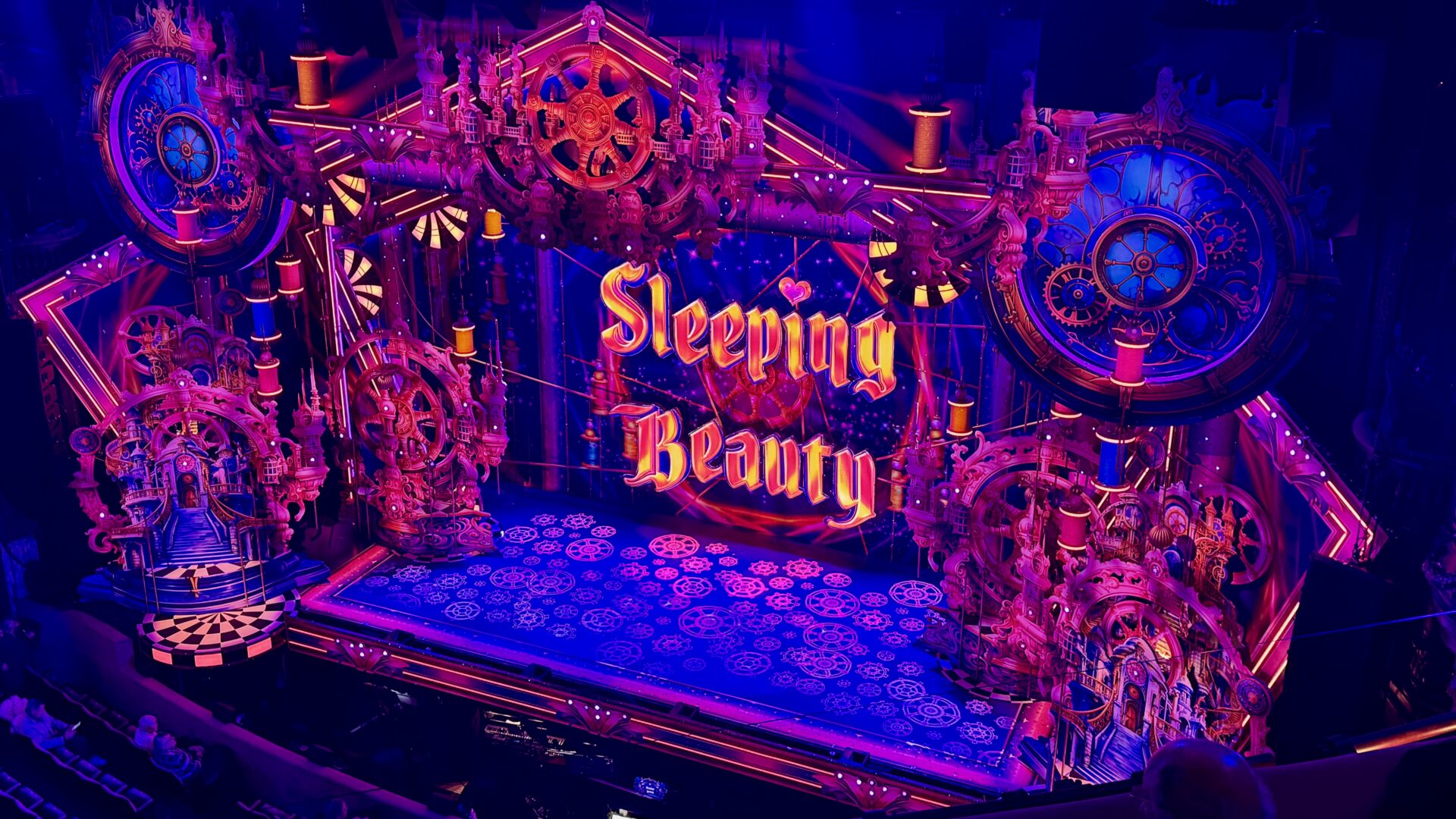
When Sleeping Beauty’s Castle Gets a Steampunk Makeover
It seems like I am in the mood to write reviews this week. So here comes another one. I do not expect this trend to continue all year.
Sleeping Beauty at the London Palladium – A 10th Anniversary
If you’re heading to the London Palladium expecting a sweet, Disney-fied retelling of Sleeping Beauty, you’ve clearly missed the memo of the last decade. Now in its 10th anniversary year, the Palladium pantomime (this year there’s a Sleeping Beauty plot somewhere) has faced a wave of headlines from outlets like Metro, branding it a “smut-fest” after reports of families walking out. But let’s be honest: if people are still shocked by the innuendo after ten years of this specific brand of comedy, that’s on them. This isn’t just a panto; it’s an institution with a well-established “adults-first” policy. Do your research. I really don’t have much sympathy for people who don’t know what this is. Although I do expect news outlets to run with and embellish this story every year.
What makes this year feel different is how self-referential the show has become. It’s been heading this way for a while, but this year’s opening retrospective is a masterclass in nostalgia, setting a tone that feels less like a fairy tale and more like the series finale of a beloved sitcom. Like the best long-running comedies, the jokes here are funnier because we’ve come to know the characters: we know Nigel Havers will be the charming punching bag, and we know Julian Clary will have a new, increasingly ridiculous entrance, and make a gag about somebody’s hand on it.
This “insider” feel is probably the secret to its enduring appeal for the regulars, but it does make me wonder: what do the newbies think? If you haven’t been along for several of the last nine years of lore, you might feel like you’ve crashed a private party.
Amidst this whirlwind, the show’s ringmaster is Rob Madge as the Diva of Dreams. While the rest of the cast seems content to let the plot drift out of the stage door in favour of sketches, Madge is the one who keeps the show flowing. They act as the essential “glue,” holding onto the limited plot and preventing the evening from devolving into a disjointed series of routines. Madge brings a modern, theatrical energy that bridges the gap between the “old guard” and the new.
The big draw this year is Catherine Tate as the boo-able Carabosse. While she delivers exactly what the crowd wants (including a show-stopping appearance of “Nan”), I had a nagging sense that she is underused. Tate is a comedy powerhouse, yet she often feels relegated to “special guest” status. Between the impressions and the sketches, you can’t help but feel she could have given even more if the script allowed her to go beyond her “greatest hits” reel.
There is no denying that Julian Clary is the heart of this machine. However, this year feels more like “The Julian Clary Show” than a balanced ensemble piece. In years past, the magic came from a heavyweight team; the presence of the late Paul O’Grady, the charm – and songs – of Gary Wilmot, or the triple-threat energy of Charlie Stemp provided a balance that kept the show from relying too heavily on one person. While Clary holds it all together with effortless camp, the absence of those contrasting “anchors” is felt.
Visually, the staging is bigger, better, glitzier, and (probably) more expensive than ever. From the neon sets to the “forest of thorns” in Act 1, the production values are impressive. However, some elements are starting to feel familiar. Paul Zerdin remains a master ventriloquist, but after a decade, his routine lacks “newness.” When a show becomes this self-referential, there’s a fine line between a “classic callback” and just running out of fresh material.
It’s still a 5-star spectacle with heights of staging wizardry. It’s loud, it’s proud, and it’s very, very blue. If you want a plot, go elsewhere. If you want to see the most expensive variety show in London anchored by the King of Innuendo, there’s no better place to be. It helps if you’ve watched the “previous seasons” to get the most out of the jokes.
A busy October of theatre visits: five very different productions, each a reminder of London’s endless stage creativity.
To see a show or not to see a show? (The answer is always yes)
For some reason, October turned out to be a fantastic month for theatre visits. Some of these were planned months in advance; a couple were very last-minute, which meant that I saw five very different productions, from quiet intimacy to loud, inventive spectacle.
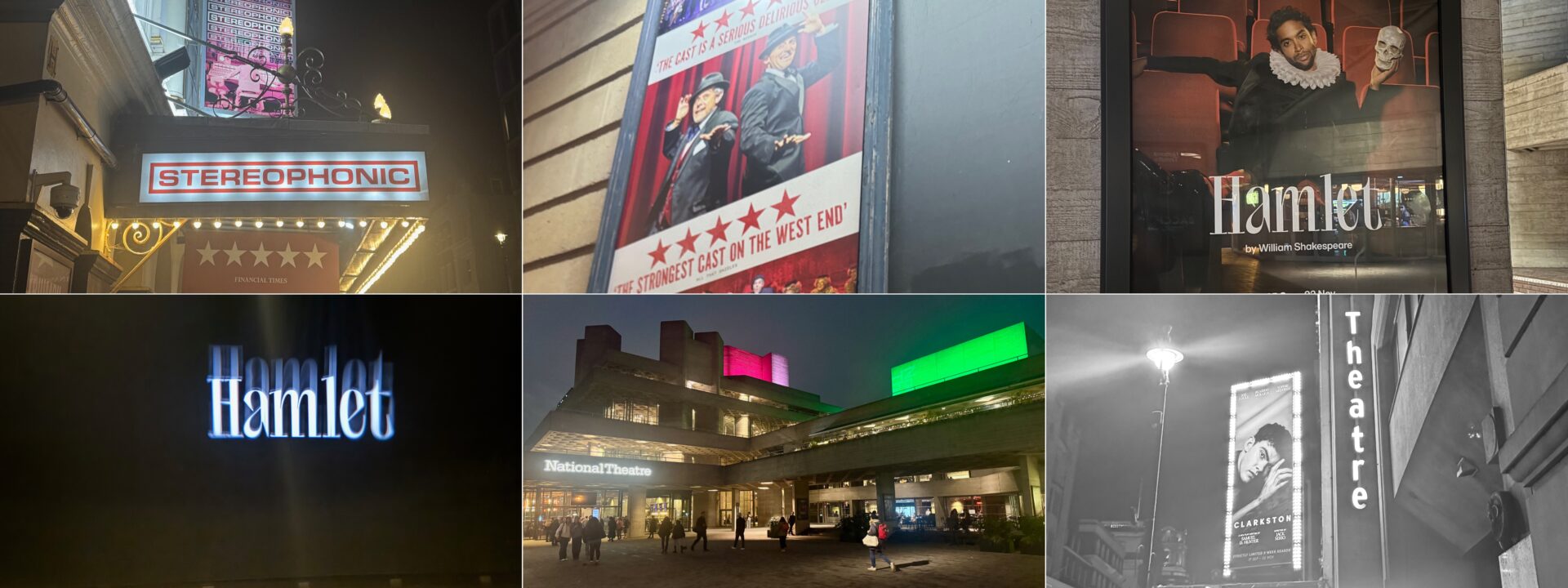
Clarkston — 8 October, Trafalgar Theatre
Joe Locke, best known from Heartstopper, starred in the UK premiere of Clarkston, a tender three-hander about two lost souls working the night shift in a Costco warehouse.
Jake, newly employed in the warehouse, is tracing the route of his ancestor, the explorer William Clark, while facing a recent Huntington’s diagnosis; the other lost soul, Chris, is bound to his small-town life by a chaotic mother, Trisha.
It’s beautifully acted — Locke is excellent, but Ruaridh Mollica quietly steals the show with a performance full of tension. I must mention Chris’s mother, played by Sophie Melville, who is also magnificent, injecting unstable energy just as the plot might slow. Overall, a simple setup with quite powerful performances.
It clearly brought a good number of Heartstopper fans to Whitehall for a mid-week performance, which must be a good thing. The Guardian’s review, perhaps less enthusiastic than I would have been.
Still playing, until 22 November 2025.
The Bacchae — 13 October, National Theatre (Olivier)
Euripides reimagined for the modern age: loud, kinetic, and full of swagger. This Bacchae mixed rap, spoken word and pounding beats, transforming the ancient tragedy into something fast-paced and streetwise. King Pentheus branding Dionysus and his followers “terrorists” added a touch of contemporary relevance.
The set — unadorned movable platforms — opened with an unforgettable image: a blood-soaked white horse’s head looming over the stage. It was visceral, fast-moving and utterly gripping. One hundred minutes without an interval flew by.
Time Out gave this one fewer stars than I would have, questioning whether it even works as a tragedy. I would have definitely suggested you go to see this, but sadly, it ended last weekend.
Hamlet — 15 October, National Theatre (Lyttelton)
Two nights later, another National Theatre production — but a different energy entirely. Hiran Abeysekera’s Hamlet bounded across the stage in beanie hats and oversized jumpers, his performance full of humour and restless energy. The costume might have been modern, the setting aiming for some period between then and now, though the language stayed pure Shakespeare.
Francesca Mills’s Ophelia was brilliant, her descent into madness raw and unflinching. The production never quite found a political edge, and I christened it “bouncy”, which feels like the right word.
The Observer, who don’t seem to be giving out stars these days, said what a lot of the reviews have commented on: that soliloquies are gabbled and that rather spoils the effect. Despite the pace of this performance, I think it felt slow. But it was certainly worth watching.
This one is still running, also until 22 November 2025.
The Producers — 24 October, Garrick Theatre
After so much tragedy, The Producers was an amusing tonic. Mel Brooks’s gloriously tasteless musical, now revived from its Menier Chocolate Factory run, remains, IMHO, one of the funniest shows ever written.
Bialystock and Bloom’s plan to profit from the world’s worst musical — Springtime for Hitler — is still hilarious and, surprisingly, hasn’t been cancelled. It’s satire at its sharpest, making me wonder what today’s equivalent might be.
The Evening Standard gave this one five stars; “The line Bialystok quotes from a review of Springtime for Hitler also sums up The Producers: ‘It was shocking, outrageous and insulting – and I loved every minute of it.’”
Finally, Stereophonic: a fly-on-the-wall drama about a 1970s rock band recording an album. It’s definitely not Fleetwood Mac — though the parallels are obvious. The “play with music” cleverly blends dialogue and original songs by Will Butler of Arcade Fire, capturing both the tedium and the magic of studio life.
It’s long, occasionally exhausting, but the second half finds its rhythm. I wasn’t entirely convinced it merited its thirteen Tony nominations, but it’s smart, stylish and very well performed.
WhatsOnStage gave this five stars, as did a number of others, but I agree with The Times, a little editing (in my view of the first half) would have helped.
Another production that finishes on 22 November 2025. I wonder what’s happening after that?
I don’t know when I’ve seen so many shows in such a short time. That’s five shows in one month, showcasing the varied nature of London theatre. Yes, I enjoyed some more than others, but I’m glad I went to them all and would recommend you see any of them (just get into a comfortable position for Stereophonic). There’s so much talent out there, it’s amazing.
Step inside Grease: live songs, fairground rides and unexpected dancing
We left the house just before six this evening and made our way over to Battersea Park for Secret Cinema’s latest immersive extravaganza, which this year is themed around Grease; you know, the one with John Travolta and Olivia Newton-John that might have a different take on the story if it were made today.
I had been expecting something that looked like the set of an American high school – Rydell High banners, bleachers and a lot of quiffs – and that’s pretty much what we walked into.
The weather app promised warmth, although by the time I reached Chelsea Bridge, the sky remained cloudy. Still, it’s partly outdoors, and I’d opted for a white T-shirt (seemed fitting for the ’50s theme) and a black bomber jacket I own. It’s not quite a leather jacket, but it more or less worked. I don’t own jeans, so that was the one part of the outfit I compromised on. As I went through the Chelsea Bridge gate at Battersea Park, it was apparent that the unofficial dress code for men was white T-shirts and for women anything pink. So, I fitted in OK. Plenty of people had made a full-on effort, but I didn’t feel out of place in my ‘try to make it work from my existing wardrobe’ look.
Entry was smooth and straight away we found ourselves in a little fairground set – Ferris wheel, fun house, hook-a-duck, Shake Shack (complete with the wobble machine they actually use in the film). We grabbed a drink and a chicken burger and, unable to find a free seat, stood eating while dancing along to the ’50s soundtrack.
At about 7.30pm, the Rydell High principal appeared on the tannoy and called us all in for the first day of school. They played the opening beach scene from the film on the big screen and, after that, brought us inside. This whole thing is exceptionally well done. Unlike the older Secret Cinema events, you’re not just watching the film – it’s cut up so that parts of it are projected, and then the big scenes are suddenly acted out in front of you, complete with live singing. Rydell High itself is a collection of mini sets – soda shop, cafeteria, dance hall, auto shop, bleachers and so on – and you move between them as different moments unfold.
Seats are limited if you’re not VIP, which, at first, feels slightly annoying, but you quickly realise that wandering from scene to scene is much more enjoyable. If you’re sitting in the VIP area at the back of the drive-in, you’d miss quite a lot – although, granted, your feet might be less tired by the end.
We spent most of the evening near the auto shop, which meant we had The T-Birds practically in front of us for Greased Lightning and a bunch of other scenes. Occasionally, a crew member gently nudges you into a slightly different position so a scene can play out nearby; they also encourage you to dance, which most of us did without any hesitation – if you can call my shuffle a dance.
It’s difficult to explain why the switching between film and live action works so well, but it does. I assume the little pauses are as much for cast changes as they are for us to queue up for another drink. The food and drink, incidentally, are not cheap – over £8 for a fairly small alcoholic can – but it didn’t take anything away from the evening.
The finale happens back outside in the fairground, where the closing scenes from the film are played out live and on screen. The cast were brilliant – it must be an exhausting performance, particularly given that some of it is almost lip-synced to the soundtrack. I loved that the cast entirely performed the big songs (there’s a live band as well), rather than just lip-syncing over the film.
We stayed for about half an hour afterwards. The funfair stays open, and you can still get a beer or a glass of wine. It’s the first Secret Cinema event I’ve been to where I could imagine it being turned into something more permanent – a bit like the ABBA Voyage experience. They’re not doing that here, but the location feels good enough, and the music lends itself to a proper party atmosphere. Everyone happily sang along to the big numbers.
A brilliant night out – definitely one of my favourite Secret Cinema experiences.
Small disclaimer: I bought tickets to a preview show. Shows can change while previewing, so what officially ‘opens’ could be different.
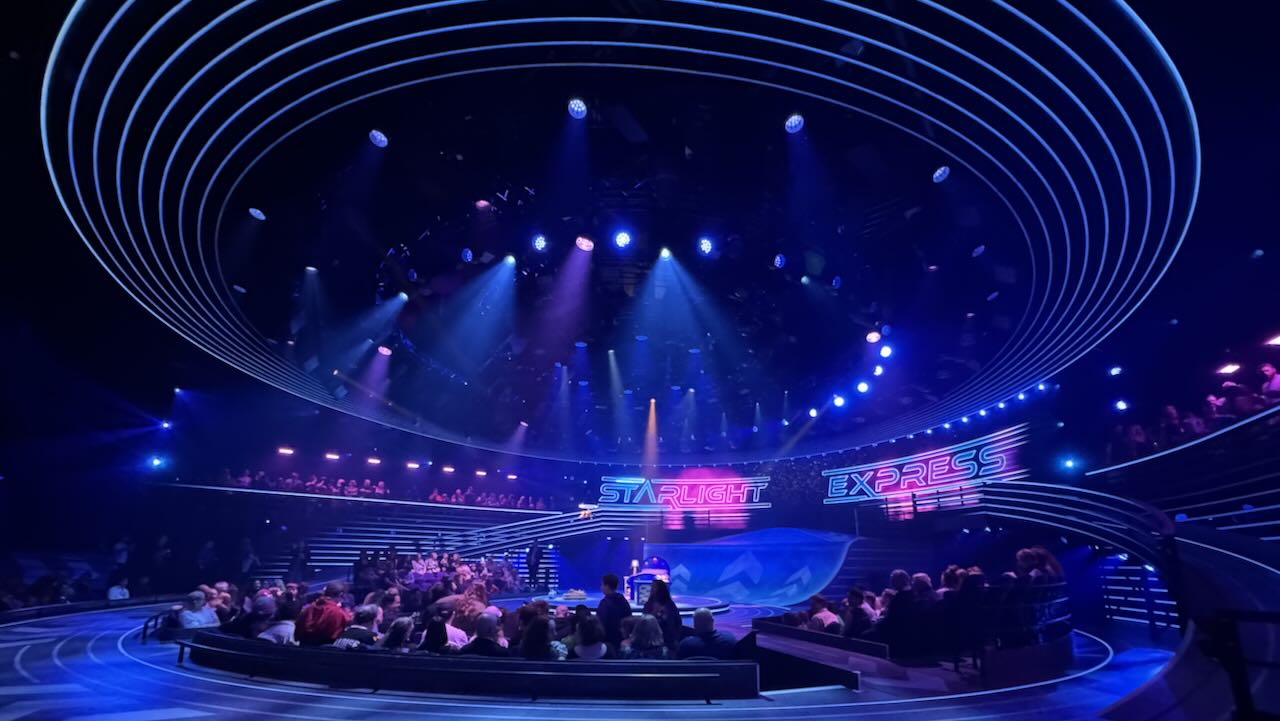
Last year, when they released tickets for the new Starlight Express (London, 2024), I bought a couple without realising they were for the first preview night. Effectively, we were part of one of the first paying audiences to see the show. However, quite how many people had paid would be interesting to know, as we were surrounded by people who had something to do with the production (lanyards, notebooks and “see you at the drinks”). Lord Lloyd Webber was at the back. I’m curious to see if the presence of insiders impacted how the audience responded. More on that below. The Producer and Director introduced the performance. I wanted to get my thoughts down quickly so that, when the real reviews come out, I can see if they agree or disagree with what I initially thought.
Before diving into the review, it’s important to provide some context. I was a fan of Starlight’s 1992 reworking at the Apollo Victoria, having seen it multiple times and even catching the touring production. The soundtrack was a regular on my playlist. This fondness for the earlier version undoubtedly influenced my expectations and, I suspect, will colour many of the reviews.
Nonetheless, it was time for the show to be updated. That is neither good nor bad; it’s inevitable. And, if you want to stage a big comeback production, you’ll need to sell a lot of tickets and appeal to more than the nostalgia crowd. Starlight Express is a family show, and today’s kids are not as enthralled by trains as previous generations. This version is updated with new and revised characters and songs (both new and rewritten). You won’t see the Starlight of 1995. This is, however, still Starlight Express. It has not changed beyond recognition. There weren’t many kids in tonight’s auditorium, but there were some, so it’s a small sample to comment on below.
There’s good and disappointing (maybe, bad).
The new Starlight Auditorium is stunning. It’s a wonderful place to see the show. Like the Apollo Victoria, the skaters are out amidst a portion of the audience. We sat in a central-ish area they called Platforms, and the races happened all around us. The video screens are still there, and adding race position scoreboards (new to me) is a nice touch. The introductions peddled the line that the original was one of the first immersive shows. Maybe, but by today’s immersive experiences, this is still a theatre show: you must stay in your seats, and there’s no interaction. That may be nitpicking, but it felt like bandwagon jumping to me. But I can reassure anybody that, in the right seats, you are up close to the action, and that’s part of the Starlight experience that’s been maintained.
In the intro, somebody said there were twelve professional debuts among the performers. They were all incredible. I have no idea how you could skate, dance, and sing for two hours while maintaining the needed control. And our seats were up close. I’d like to think I’d notice the pain if they were suffering. To a player, they looked like they were loving it. And that remains as infectious as it was the first time I saw it.
The inclusion of new songs is relatively seamless. The score has been reworked to fit: at times, I sat trying to work out if I was hearing something new or revised. And the new songs are good: they’re not as familiar, but they’re good (although at least one has been played in the German production for years). The sound system remains as epic and theatre-filling as I remember from other productions. It makes it feel like an experience.
The reworked songs are more complex to comment on because, in my head, you sing along to words that are not there anymore, and that must influence my thoughts. I’m delighted they still work, even rewritten. Somewhere along the way, they sing “going faster than the limits allow,” which (and I had to look it up) is lifted from Tire Tracks and Broken Hearts from Whistle Down The Wind, but immediately made me think of Meatloaf. I’m curious if Jim Steinman gets credit (assuming it’s his lyric).
It’s more than just the songs that have been updated. Engines are no longer named after countries: the German, Russian, French and Italian trains have generic ‘Golden Eagle’ or ‘Orange Flash’ style names. The British train, which never appeared due to leaves on the line, is still referenced. I trust that’s a nod to earlier productions rather than somebody thinking it’s still an original joke. Ashley, the smoking car, is replaced with a ‘quiet car’. The freight ‘Rustys’ are now named after their loads: Lumber for wood, Slick for oil, etc. There’s an additional freight wagon, Hydra, named after the hydrogen it transports. It’s an important introduction to the story. Greaseball is a female character, Electra is a non-binary, “they”. Poppa is Momma. None of this matters, although it’s harder to distinguish between the engines. But the stereotypes of the older versions would jar. The trains have always been about the characters they represent, which works, just as it has always done. One of the criticisms of the 90s reworking was that the original villain, the Caboose, was removed, and the bad guy’s deeds were spread across other characters. In this version, the baddie is restored.
The child controller plays a much more significant part in the reworked show and is a central character. It’s probably one of the better changes.
I wish I could end there because, to this point, I can wholeheartedly recommend that people go and see the show. Fantastic staging, performances, and additive, non-destructive updates would be an excellent place to stop.
But there is a change, and that’s with how the story gels. The tale has changed over other incarnations, and so there’s no reason why the story should not evolve again. At its heart, it was, and is, the story of the underdog steam engine you’re rooting for to win the race and couple with his love, Pearl. It’s all still there. But in this production, the subplots drown out the core story.
If something like Starlight were written today, Electra would be the hero engine, and Steam would be relegated to the evil characters. That would be too big a rewrite for Starlight. So we have Hydra, the hydrogen truck that propels Rusty to the win. But there’s now a new storyline of the good fuel that weaved amongst the others. ‘He Whistled At Me’ has Rusty questioning if whistling at a carriage was appropriate, which takes some of the meaning away from the ‘whistling’ references: it can’t be seen in the same context as before. These don’t sound like significant issues; perhaps they are not. But they blurred the central premise that the audience cheers on Rusty because why wouldn’t you cheer on Hydra or the carriages?
I headed to the interval bar, commenting that the show didn’t feel like it had the pace it should have. It’s about something other than speed skating: who knows if the track is faster or slower? This should be an energy-filled extravaganza. It has the setting, the music, and the cast, but somehow, it’s not. What felt modern, fast, and upbeat 40 years ago needs a turbo boost to feel the same today. And Starlight 2024 doesn’t have it.
You want the audience to cheer when the races start, but they don’t. Applause is played as sound effects. When the cast tried to get the audience to clap along, they succeeded with a portion of the audience, but I observed a lot who didn’t join in, most notably to my eyes, the Producer sitting at the other end of the row where I was seated. Maybe it’s all those insiders I mentioned earlier, but if they can’t be upbeat at the first public performance, why should anybody else?
And to my aforementioned sample of children. Just three in my eye line, so probably unrepresentative. But they didn’t seem involved, one even resting their head on a parent’s shoulder as if to sleep. I don’t know what was missing for them, but the show needs to win kids to succeed. Truthfully, as we were leaving, another child was wide-eyed and singing Starlight. An auditorium with more children might have more energy: it’s not pantomime, but it needs that level of engagement. I hope my experience was an exception, not a crystal-ball view of the future.
I wanted to love it. That could be part of my problem. I didn’t. But I didn’t hate it either: far from it. I enjoyed it. There’s much to be in awe of, notably staging and casting. But I want a new generation to love Starlight as I do, and I fear this production lacks the pace, excitement, and clarity of who to root for to make it a winner with people unfamiliar. The nostalgia crowd will go, and it might be a profitable undertaking on that alone. Abba Voyage proves there’s a market, but I wonder if it’s enough.
I have my fingers crossed. Maybe I’ll even go again to see if I revise my thinking. I will, no doubt, think about it for days to come. We’ll see.
For the last two years, this mug has been one of a number in rotation for my morning coffee. It’s a souvenir from the mid-1980s West End show Time (The Musical).
The show ran for about two years at the Dominion Theatre, which had to be remodelled to accommodate the set. I remember going to see it as a child, but mainly I remember the huge floating head of the narrator, Akash, pre-recorded by Laurence Olivier. I think Cliff Richard was appearing when we went, although that might just be a trick of the memory.
I haven’t heard the music for years. The only pieces I can vaguely recall are a recording featuring Laurence Olivier’s spoken words and a song called Time by Freddie Mercury.
The music was never readily available on CD. There was a recording of the concept album on iTunes for the musical’s 25th anniversary, but it seemed quite expensive. It’s a little sad that the music hasn’t been able to live on as much as it might because it has been locked away. I wonder if anybody has an actual cast recording rather than the concept album.
The Lyric Theatre on Shaftesbury Avenue is currently home to a production of Festen, David Eldridge’s adaptation of the cult film by Thomas Vinterberg The play, directed by Rufus Norris, no longer had the original cast, but I don’t think that matters: it’s a stunning piece of theatre.
thisistheatre.com sums it up well: Patriarch Helge Klingenfelt is celebrating his 60th birthday with his family at a magnificent old hotel in the Danish countryside. Gathered together are his loyal wife Elsa, his daughter Helene, and sons Christian and Michael. As the evening progresses Christian feels compelled to break the silence surrounding a dark family secret. The effect is explosive and sets the tone for a celebration no one will forget! [Source]
I don’t want to give the plot away any more, but you can read a little more at The Independent’s review (and some non plot-spoiling reviewer’s comments at the Festen site). Regardless, it’s a powerful piece of work with some excellent acting. It’s hard to pick anybody out, but Stephen Moore (Helge), Paul Nicholls (Christian) and Lisa Palfrey (Helene) are just three of the wonderful performances.
Credit must also be given to designer Ian MacNeil and all the others involved in the staging of this work. It’s a simple, yet stunningly effective, set that is a wonder. The stark, dark stage that opens the play hides some very clever set work.
As it appears only to be running until the start of May I would advise you to go now! thisistheatre.com has tickets.
Having read the positive reader comments on the BBC’s story about The Producers, I suspect I may be a lone voice in expressing a little (and just a little) disappointment. I hadn’t read many reviews, but I did know about the reception it had received in the US and the praise heaped on Nathan Lane and Matthew Broderick.
I haven’t seen the film, which, judging by the number of people sitting around me who had, means I was possibly one of only a small number of people in the audience who hadn’t. I wonder if that made a difference?
I saw it a week or so ago, and it was good but not as good as all the raving would imply. While Nathan Lane’s talent, comic timing and performance cannot be faulted, I did find weaknesses in the show. I thought some of the musical numbers in the middle were slow, and the Ulla character was not engaging at all – in fact, she was positively irritating. James Dreyfus was camp (which, I guess, is the intention) but in that 1970s OTT cringe-worthy way. Humour is, of course, personal and subjective, but I found it only amusing and not laugh-out-loud funny, as many of the reviews suggest.
Still, I would take issue with the review of Lee Evans’ performance, which says ‘he just about holds his own’. I would argue that he did far more than that. He too was excellent, believable & humorous, and while I’ve never been a big fan of his stage antics, he worked well in the role. In fact, for me, he worked so well I can’t imagine Broderick in the role.
I will, however, recommend the show because it stands out from much of the rest of the West End right now – it is good. It has some wonderful comedy and delightful musical moments. But those individual moments do not, in my opinion, add up to a great whole. I even bought the soundtrack in the hope that familiarity with the songs will make me warm to more of them.
The fact that it is one of the better shows on the West End right now possibly says more about the other shows.
I went to see a preview of the London version of The Producers today and was, like last night, a little taken by surprise. This time, however, it was with disappointment, not pleasure. I’ve been talking to PY and trying to explain my disappointment, but he doesn’t get it: he loved the show. I did not know the plot, nor had I seen the film, so I wasn’t let down by the story, but I had read that Nathan Lane had taken Broadway by storm.
You can’t fault Nathan Lane: he’s superb, and his comic timing is excellent. Lee Evans seems born for his role as the sidekick Leo Bloom, and some of the songs are great. Others, however, feel weak, and parts of the story just aren’t engaging. James Dreyfus camps it up in John Inman style, while Ulla, the Swedish blond bombshell, is so lost in the stereotype that any humour is lost.
Don’t get me wrong, it is a good show. I can’t imagine Richard Dreyfuss in it, and I imagine it will be hard to replace Nathan Lane in January. If you’re going to see it, I would suggest trying to get tickets now because, without Lane’s superb performance, I am not sure where this show will go. The fact that it is one of the better shows on the West End right now possibly says more about the other shows.
Sadly, The Producers disappointed.
UPDATE: Well, the reviews are out, and I may be a lone voice expressing disappointment. I wrote an updated review for the Yahoo Group: Gay Boy Musicals Fans UK (you can read it here if you’re not a member of the group).
You feel yourself pulled along by the way the cast at The National seems to be enjoying themselves.
I went to see A Funny Thing Happened On the Way To The Forum tonight and it took me a little by surprise. I wasn’t really sure what to expect but I was thoroughly entertained. From the opening, A Comedy Tonight, you feel yourself pulled along by the way the cast at The National seem to be enjoying themselves. It’s a high camp farce set in Roman times featuring double entendres and mistaken identity by the bucket load (you almost expect a vicar to appear from a cupboard) but it’s joyful and not at all cringe-worthy as many farces are. Sondheim’s music isn’t the best you will ever hear (in fact, much of it isn’t memorable) but during the performance it’s entertaining. Such a shame it is coming to the end of it’s run. I discovered a US version of the soundtrack featuring Nathan Lane which ties in nicely with tomorrow –more then.
Jesus Christ Superstar at The New Wimbledon Theatre with James Fox as Judas.
So I have to take it all back to TV pop stars. Last night I went to The New Wimbledon Theatre to see the touring production ofJesus Christ Superstar. PY bought tickets for my birthday. I had heard the soundtrack as a child but never seen the musical until I was in Norway a couple of years ago when I saw it in Norwegian – which of course made little sense to me but was an amazing staging in an outdoor setting. This one was, thankfully, in English. Fame Academy star James Fox was Judas, and he put in a superb performance. He was very impressive, with a much more powerful voice than I thought he had the last time I saw him perform his own material.
Glenn Carter was excellent as Jesus (although it seems to have been a role he has played many times), and the rest of the cast were also very good. The only thing I found a little odd was Herod’s Song, which was unnecessarily campy, but overall, it was an excellent night out and worth seeing. Last night was the first night, and it was sold out. I hope the rest of the run is like that, as it deserves it.
Amanda Holden was good but the rest of the show wasn’t great.
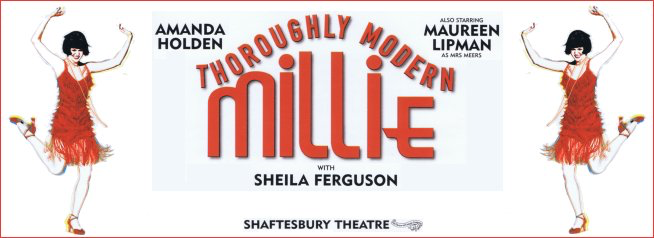
PY and I have a knack for seeing musicals in London’s theatreland just before they close. We’re just back from seeing Thoroughly Modern Millie at the Shaftesbury Theatre, which we decided to do very last minute.
Amanda Holden is the Kansas girl arriving in New York at the height of the Roaring Twenties and is something of a revelation. She was truly excellent and carried the show. It’s such a shame that it’s closing, and she has had some of the blame, but I didn’t think it was a killer show.
Although it’s set in the twenties, it was written much more recently, yet, sadly, it had a somewhat dated feel, which Anything Goes (which is older) didn’t have when we saw it a few months ago. I don’t think it’s helped by Anita Dobson’s character, Mrs Meers, a failed actress pretending to be an Oriental landlady. The character seems dated, and the impersonation of a Chinese woman is somewhat patronising. I had wanted to see Maureen Lipman in the role (she starred when the play first opened) and was described by one review as, Grotesque and comical, she’s verbally and physically sharp-witted” [source], but I think I am glad I didn’t. I don’t think it was Dobson, but the character who was uncomfortable.