Leaving Metropolis

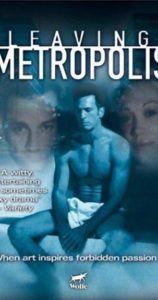
Sometimes, I get a block when trying to write about the films I have seen. Usually, that just means I end up with quite a short entry. However, with Leaving Metropolis, I am going to sum up the film in the words of a reviewer at IMDb:

This film is basically a gay love triangle. David is a famous painter with “painter’s block.” He has a live-in, HIV-positive, pre-op transsexual black live-in friend, Shannon. He has a famous-newspaper-columnist fag-hag friend, Kryla. To get his muse back, David decides to become a waiter again. He ends up waiting tables at a small diner owned by Matt and Violet, a married couple (recently married? it’s not clear). David is immediately attracted to Matt. Soon, as David encourages Matt’s secret talent for drawing comic-book characters and boosting Matt’s self-esteem, Matt begins to fall for David. David then paints a series of erotic images of Matt. The film ends predictably enough: Lots of tragedy (divorce, death, friends falling out, etc.) but also a “hopeful ending” (everyone starts over anew).

[Source]

It’s an enjoyable fantasy ride of a film, well-made with interesting characters. Matt (Vince Corazza) holds the screen well and is certainly worth seeing.

Far From Heaven

Far from Heaven is a strange film set in a place called Hartford in 1957, and it really does look like it. It’s melodramatic – as all 1950s movies should be – and it’s got that feeling (you could say retro as the look is very in at the moment) which makes you think, for some reason, that Formica is the path to happiness for us all.

Cathy and Frank are a successful couple living in a well-to-do house with successful friends and the appearance of a respectable, 50s suburban family life. She lunches and hosts parties, the maid looks after the children, and he is a top salesman. The family, however, is rocked when Cathy (Julianne Moore) catches Frank (Dennis Quaid) in a passionate embrace with another man. This repressed homosexuality eventually wrecks their marriage, and Cathy finds comfort in the friendship of Raymond Deagan (Dennis Haysbert) – a black man in a time when white men and black men could not ride in the same part of the bus.

The film is certainly moving, and there are some scenes where you see and feel the emotional trauma the pair go through. The reaction of the middle classes is an insight into what, for me, seems like a different world. It’s played well, and the three leads should all be praised for their performances. Far and Heaven addresses difficult issues in an interesting way, but the 50s styling allows you to distance yourself from the characters’ feelings and opinions. I suspect that some of the fear and prejudice still lie beneath many, and this film won’t make people address them.

Some of the scenes seem too forced, stylised, or stereotypical to be carried off believably. Having said that, it’s an enjoyable film and one I would recommend.

UPDATE 24 MARCH: Sadly, Julianne Moore didn’t win for this or The Hours. However, Michael Moore did win Best Documentary Feature for Bowling For Columbine.

Adaptation

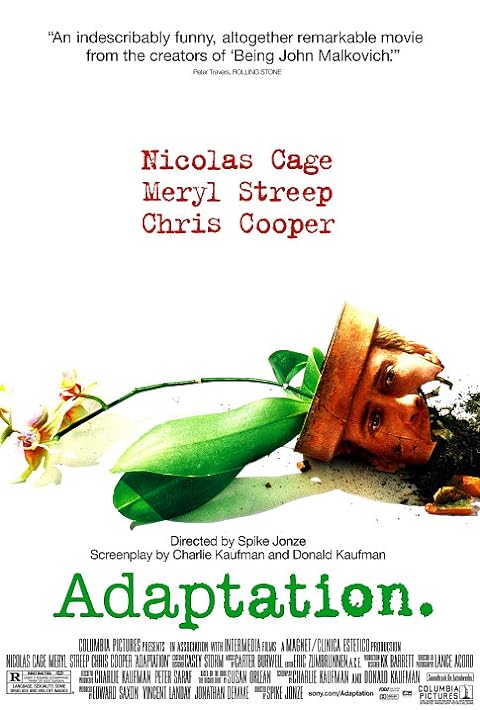
Adaption Movie Poster, 2003

It’s wowed audiences and received Oscar nominations(for Nicolas Cage, Chris Cooper, Meryl Streep and for Charlie Kaufman’s writing) but it didn’t do very much for me. Sadly, I was almost asleep, which I guess isn’t a good review.

In theory, it’s an interesting movie. Instead of being able to write a screenplay based on Susan Orlean’s bestselling novel “The Orchid Thief“, Charlie Kaufman (and his twin brother, Donald – more about him later) write a movie telling the tale that the film can not be written. We suffer with the author as he faces writer’s block and is tormented by false starts. Of course, during this process, we also get to see something of The Orchid Thief itself as characters within the novel have to face their own torments.

Charlie Kaufman is, of course, a real screenwriter (he wrote Being JohnMalkovich), and the tale appears somewhat autobiographical. Donald Kaufman, who shares the writing credit and is – I imagine – also nominated for The Oscar, is fictitious: a plot device to add to Charlie’s trauma and help finish the film.

I’ve heard great things about this film – and that made me want to see it. I read a great feature on it in a recent edition of Empire which also made it sound interesting and people have raved about it. I was looking forward to seeing it and, sadly, I left the cinema bitterly disappointed. You can’t fault the film on originality, story-telling or acting (Streep is fantastic, Cage superb as both twins) but something didn’t work for me. It’s terrible when that happens in a film, but this time it didn’t work. It would be an interesting take to see if I could watch it again and if I could get more out of it.

Unfortunately, I do think that while it’s clever it’s also confusing. Those who understand more about the screenwriting process or the struggles of the author may get more out of it.

—
Originally posted at musak.org

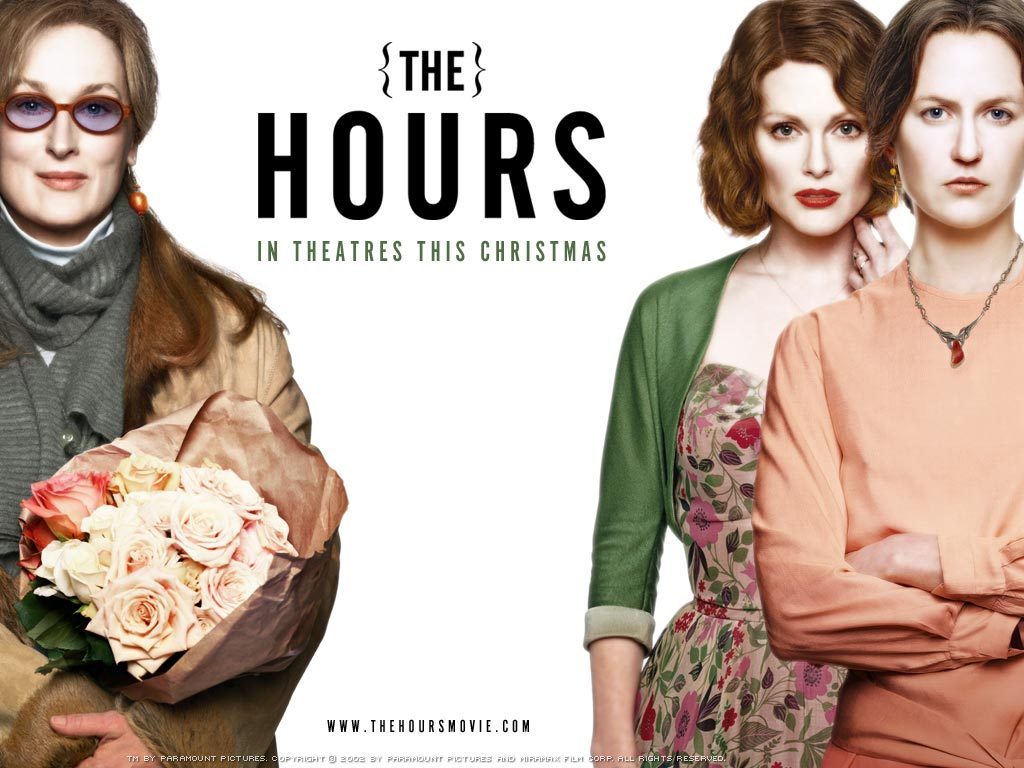
The Hours

The Hours

I came out of The Hours somewhat stunned. This is a remarkable film, and I thoroughly enjoyed it. Nicole Kidman, Meryl Streep and Julianne Moore are all superb and utterly believable. The link between the three (Kidman as Virginia Woolf, Moore as a 1950s depressed housewife and Streep as a confident modern woman) is seemingly only linked by a book – Mrs Dalloway.

The lives of the three are crumbling in various ways, and this is conveyed well on screen. Kidman –hardly recognisable thanks to great make-up –is superb and going slowly mad in 1920s Richmond. Moore’s character appears to have feelings of worthlessness, while Streep is coping with modern-day New York, while her relationship seems to be going nowhere, and a good friend suffers from AIDS.

This isn’t a happy film. Many of the scenarios are quite sad, but it isn’t really a depressing film either. It’s engrossing and engaging, and even the supporting characters are played brilliantly.

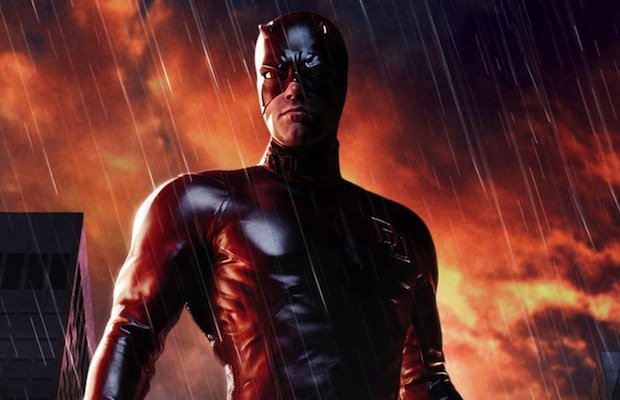
Film: Daredevil

I really can’t be sure what made this film fail for me. Maybe it was too dark for a super-hero flick or maybe that the story was not compelling. Maybe it was the fact that at least one villain survived for a sequel in a far too obvious fashion.

I was very surprised that I did not enjoy Daredevil more. It’s darker and more disturbing than many a super-hero flick and while this, for some, may be the appeal, it just didn’t do it for me. It’s also oddly constructed. We first meet the superhero as he collapses on the floor of a church. Why? Well, he’s halfway through a battle with one of the villains – Bullseye (an Irish hitman capable of killing talkative old ladies on planes with nothing more than his finger and a peanut).

And so the film lurches backwards as we are told Matt Murdoch/Daredevil’s story. He grew up with his father -a boxer – and singled out for the bully treatment when he was a kid. Blinded in a dockside accident by a hazardous chemical, Daredevil’s face remains remarkably unmarked as he matures in the talented pro bono lawyer played by Ben Affleck.

Once the Flashback sequence is over we return to our hero in mid-Organ scaling (as in church organ) battle. Who considered the middle of the narrative a sensible place for us to join? I guess it has worked before, but not here. In true super-hero style, our almost dead star rises and battles to the end. Of course, as in all such movies one wonders why the world hasn’t worked out that Matt Murdoch and Daredevil are the same. They are Ben Affleck in red leather.

Ah, dear Ben. I appear to be in the minority who were not convinced by his portrayal of a superhero. He was too “leading man in a romantic comedy” for me, despite the tight leather gear, which didn’t seem to turn him into the sex-hunk that I thought it might – Chris O’Donnell looks better in tight leather in Batman and Robin. Colin Farrell tries hard to be brutish with sex appeal, and he almost pulls it off, especially considering the target on his forehead isn’t really that great to look at.

I really can’t be sure what made this film fail for me. Maybe it was too dark for a superhero flick, or maybe the story was not compelling. Maybe it was the fact that at least one villain survived for a sequel in a far too obvious fashion. Daredevil may be a comic hero, but you don’t have a super-hero “thing” to latch on to (Superman flies, Spider-Man has a web, and Batman has a utility belt). Daredevil’s other senses are enhanced. Big wow. Maybe it was the violence that felt too real and not comic-book enough, or maybe it was that the supporting characters never really moved from being one-dimensional support.

I guess, in the end, I would have been disappointed if this crime-fighter had come to my rescue. I’d have been happy with Batman, thrilled if it was Superman and delighted if Spider-Man liberated me. If Ben turned up in red leather, I just might have laughed.

Film: 8 Mile

I have no idea if this in any way reflects real life in downtown Detroit. I have no clue if rap culture is, in any way, well served by his film but it is a great movie which I thoroughly recommend.

I walked out of the Odeon loving Eminem’s 8 Mile. On reflection, I still think this is a great movie. Who cares if it’s Saturday Night Fever or Karate Kid for a new generation? Does Eminem’s apparent turn around about all things gay worry me? Not at all. This is an excellent film. I do, however, have one question, where are all the guns?

I have never visited Detroit nor any of its downtown neighbourhoods. Fortunately, I’ve never been in the middle of any kind of big gang culture. But in this movie, there were two guns (three if you count the paint-ball). One is pulled on Jimmy (Eminem) and one is waved around by Cheddar Bob, who promptly shoots himself while those involved in the gang fight around him look on like they’d never seen a gun. If I were to believe the news media, this place would have been crawling with weapons and Jimmy would have probably pulled several on his attackers. A movie for nice liberal sensibilities? It just struck me as odd. Perhaps it’s real, but it seemed wrong.

That is, however, but a small gripe. Like yesterday’s film, The Good Girl, we have a central character with an apparently dead-end life but dreams of something better. This time, the lead is surrounded by people who believe in him although he doesn’t believe in himself. The final battle, where Jimmy – or Rabbit – proves himself to be great, is a freestyle rap event that is so far removed from anything in my life or frame of reference that I have no idea if it’s believable, amusing or insulting. Having said that, it is a great conclusion to the movie and had me hooked.

Surprisingly, Eminem’s music doesn’t dominate the movie. I was slightly disappointed there wasn’t more. We first hear his musical talents when he sings a lullaby to his sister. A repositioning of man whose music has been the centre of controversy for years? So, if we don’t get to hear much of his music, how does he stand up as an actor? Pretty well, I would have said. His baseball-cap (and hood) mask much of him revealing only a cool, moody, brooding man writing rap lyrics on scraps of paper to music pumped into his head through headphones. As the movies is apparently based on some of his own life, I suspect this wasn’t a great leap for him to play. He does pull it off with conviction and you can take the journey into Jimmy’s world and lose sight of Eminem. I’d be interested to see if he acts again and with the huge box office takings predicted, most will bet he will.

I have no idea if this in any way reflects real life in downtown Detroit. I have no clue if rap culture is, in any way, well served by this film but it is a great movie which I thoroughly recommend even if you are asked to believe that, when life hits rock bottom, you’ll win on the bingo.
Film: The Good Girl

Good. But not good enough. While Aniston is good, she is not great. It seems much of the praise is due to the fact that she is playing against the Friends Rachel-type. She an actress for goodness sake, if she only has that one role she has no career. This role proves she can play against type and, I guess, that means she is an actress.

What has surprised me about Miguel Arteta’s The Good Girl, starring Jennifer Aniston, are the generally positive (if not glowing glowing) reviews for this film.

Admittedly this is not quite the Jennifer Aniston vehicle that you would expect from Hollywood right now. It’s no romantic comedy, rather a drama following Justine (Aniston), a woman in a dead-end job in a dead end town, who falls for Jake ‘Donnie Darko’ Gyllenhaal’s Holden Worther. Not much to it so far and certainly not enough reason for the praise.

So, to the plot. Problem one for our lead, Justine is married to a full time stoner (part time painter) played with conviction by John C. Reilly. Problem two, Holden seems to think he is Holden Caulfield, the central character in Catcher in The Rye. If I was to say he was “unhinged” I’d be playing it down. So, cue a crisis of conscience for her and a serious infatuation/breakdown for him.

While Aniston is good, she is not great. It seems much of the praise is due to the fact that she is playing against the Friends Rachel-type. She an actress for goodness sake, if she only has that one role she has no career. This role proves she can play against type and, I guess, that means she is an actress. Her narration is okay but somewhat draining to listen to. Gyllenhaal’s good but, given the characters are odd-balls not a million miles apart, he is not as engaging as he was in Donnie Darko.

I guess it hangs on the believability of the adulterous relationship and, for me, it was not that credible. Perhaps it hangs on the ability for Aniston and Reilly to be a couple at the end, but it’s not convincing. There were words unspoken which should have been spoken. Where are the sparks? Where was the fire and the passion between any of the characters?

Sadly, it lacked the ability to engage me for the one and three-quarter hours. Which meant I started to feel the cinema seat beneath me. At that point, I knew this wasn’t going to be added to my “greatest films” list. Which is a shame. Good. But not good enough.

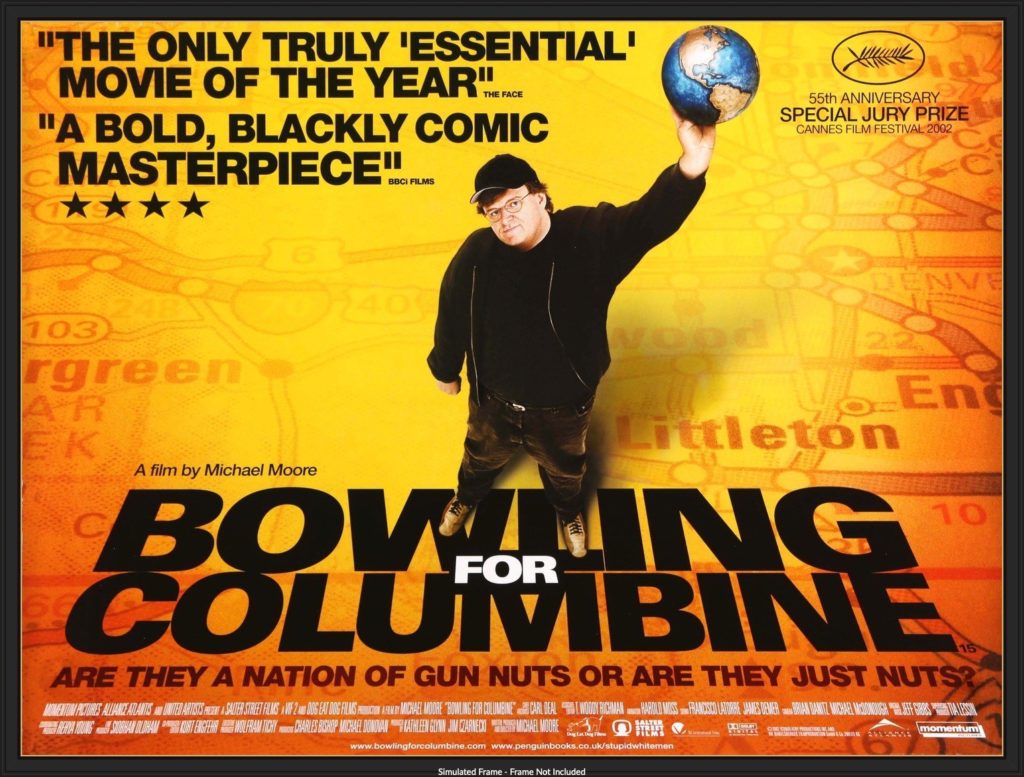
Bowling for Columbine

A film investigating America’s gun culture, contrasting it with Canada’s similar laws but lower death rates.

What a fantastic film! Michael Moore’s Bowling for Columbine is as good a piece of filmmaking as any I have seen for several years. It is also a documentary, which means, I guess, that few people will see it. Well, you should.

It’s an investigative piece that looks at the United States of America’s love of guns – in all their forms. While it appears many Americans think it’s a constitutional right to protect their family with a shoot-first mentality, Moore contends that this obsession with the freedom to bear arms results in unnecessary deaths (accidental and intentional). Contrasted with Canada, which has similar gun laws and ownership but considerably fewer deaths, it seems Moore may have a point.

The statistics played out on the screen are not always given a context, and some of his points are rather laboured, but Bowling For Columbine has some moments you’d think were fiction (the final K-Mart statement – I won’t spoil it), yet are horribly real.

And yes, the clip that’s been doing the rounds of the film shows Moore getting a free gun when opening a bank account, which appears very real. Funny, it really does appear that these things really do “only happen in America”.

The Lord of The Rings

Predictably, there are few surprises in this second film. However, it remains a stunning piece of cinema and one that I will certainly see again and again.

Being New Year’s Eve, I decided to hide away from some excessive partying and see The Lord of the Rings: The Two Towers in central London.

The second cinematic instalment starts more or less at the point we left off with Frodo dreaming of Gandalf’s fall. I began by thinking we were in for a decent length of reworked footage from the first film, but, of course, I was wrong.

If you haven’t seen the first film and haven’t read the books, you will need to do one of them before seeing this film, for no concession is made to explain the previous tale. Thus, we must accept that the Fellowship is now split into three, and we have three stories.

Frodo and Sam’s tale gets darker as the film progresses, as Frodo comes under the influence of the ring. They are joined by Gollum, who is a superb character despite being a computer-generated image.

The second group, Aragorn, Gimli and Legolas, go in search of Merry and Pippin, only to find themselves rushing to the aid of King Theoden of Rohan and featuring some amazing battle sequences. Merry and Pippin themselves find the company of the Ents, whose role seems to have been played down in the film. The Ents are my favourite characters from the books, and I had been waiting to see if they could be brought to life convincingly on screen. Peter Jackson has done an amazing job with them, and I was only saddened that they didn’t appear more.

There are, perhaps predictably, few surprises in this second film. There is little to discover in the central characters and, with perhaps the exception of Gollum, very little seems to be learned about newer characters. However, it remains a stunning piece of cinema and one that I will certainly see again and again.

The Guardian has a summary of the main players. Other reviews can be found at Empire Online and Teletext.

Die Another Day

Bond has been around for 40 years. Is he sill up to it?

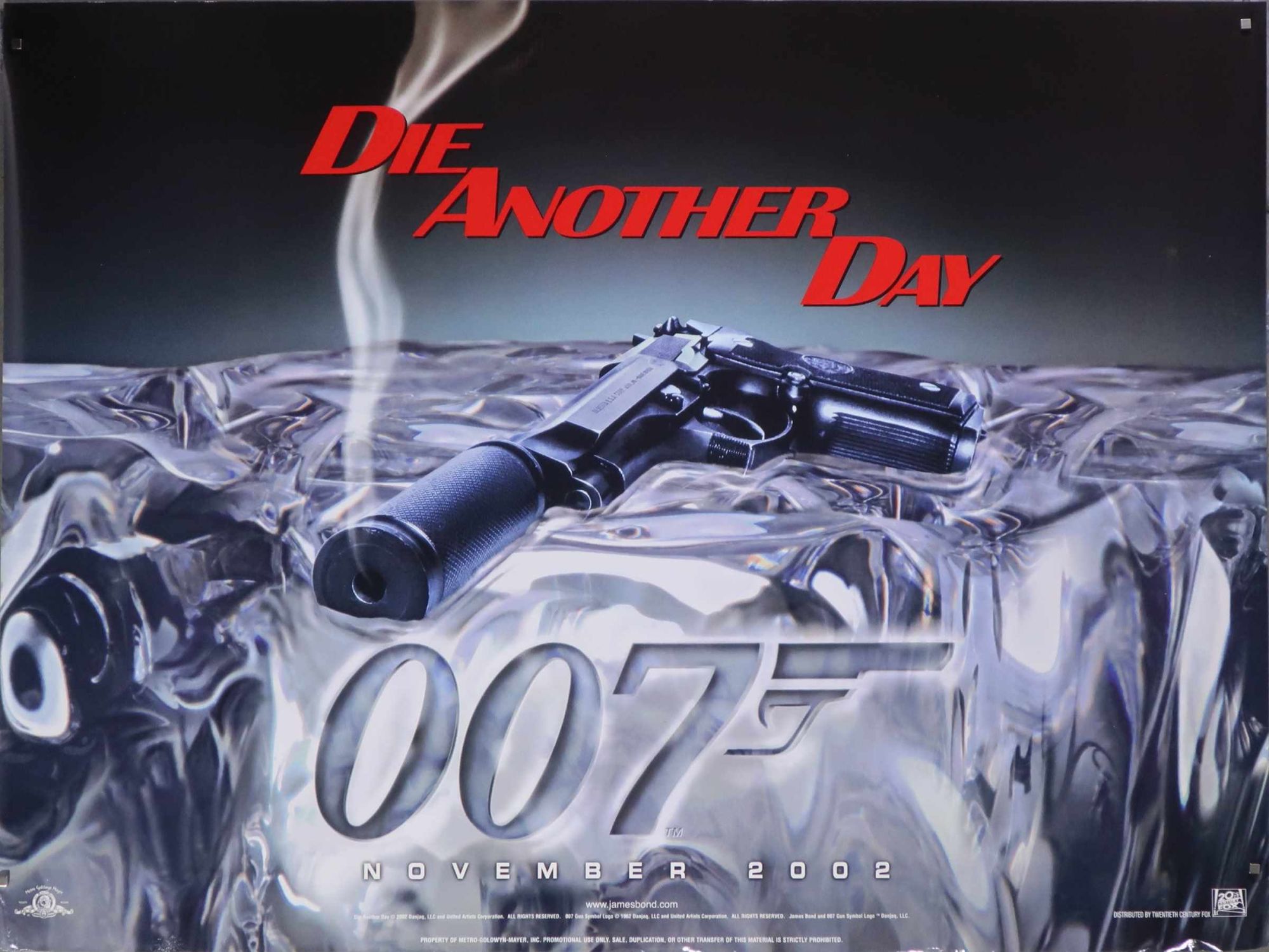
Die Another Day film poster

I saw the new James Bond film today. Apparently, Bond is 40 – which means the formula has been around for a while. Die Another Day is as cheesy as many a Bond, yet it remains an entertaining cinema experience. I’m sure, however, that it won’t be voted a classic. It’s less secret-agent, more agent-detective, and the Bond-girls are now more MI5-partners (or more accurately NSA-partners). There are some fantastic scenes on the ice (using The Eden Project as a backdrop) and gadgets galore. If I had any complaints about the film, it would be the quality of some of the effects, which is, to say the least, not up to standard. [Official Site]

Donnie Darko

The Guardian asked, “Is it a horror film?” A black comic parable of Generation X angst? A teen drama with a psycho edge? If not, what the hell is it?

Possibly the strangest and most compelling film I have seen all year, and it hasn’t had a great deal of coverage. Donnie Darko’s website is very weird, and I am not sure you’ll get much from that.Tom, on the other hand, raves about it. You can read more reviews here or at The Guardian. I can’t explain it. Go see it.

My Big Fat Greek Wedding

My Big Fat Greek Wedding (2002)

My Big Fat Greek Wedding (2002)

My Big Fat Greek Wedding was something of a hit-and-miss film. You learned a lot about the Greek (lead) character, Toula, and her family relationships. But you learned very little about her love interest, Ian. If the point of the film was to show the development of Toula from the shy woman living life for her father by waiting tables (“seating hostess”) in his restaurant to the confident, beautiful self-styled woman that Ian Miller falls in love with, then, I guess, it succeeded. Sadly, because you know so little about him and his one-dimensional parents, this film feels empty and fails to pull you in.

Reviews will tell you how My Big Fat Greek Wedding makes you laugh, cry and feel. I, however, was left wanting more. The large Greek family, played with love and humour, finally accepts non-Greek Ian into the family. Ian, however, never challenges that their acceptance requires him to turn into them. Far from celebrating diversity, the film fails to show both sides of the tale, and we are forced to believe that Ian will do anything, unquestioningly, for Toula. I suspect I’m reading too much into what should be a light Saturday night romantic comedy, but as the film played out, I found myself less and less engaged.

Having said all this, there were some laugh-out-loud moments and some top-class performances. Andrea Martin (Aunt Voula), Michael Constantine (Gus) and Lainie Kazan (Maria) all stood out. Nia Vardalos (Toula), who also wrote the story, is worth mentioning as well, because she certainly conveyed Toula’s side of the story. Unfortunately, that’s all I felt I got (Toula’s side), and it could have been so much more.

—
Originally posted at musak.org | Wayback – original | Wayback
Posted October 6, 2002

Matt Damon is Jason Bourne

The Bourne Identity delivers an action-packed thrill, featuring a surprising turn from Matt Damon.

Matt Damon is Jason Bourne

I saw a pumped-up Matt Damon in The Bourne Identity last weekend. Sadly, I am a sucker for this kind of action movie. They have little point, but they tell a tale that absorbs you for 90 minutes and gives you an all-action thrill for much of it. What more do you want from a cinema-going experience?

My Review: Who would have thought Matt Damon could convincingly play the international agent? Yet a beefed-up Matt holds his own in the world of blockbuster espionage – that’s a world of martial arts acrobatics and high-speed car chases down back alleyways (and flights of stairs). Franka Potente keeps Marie convincing, even though many would have walked away from Jason Bourne (Damon) at their first meeting. It’s a Friday night, action-packed, spy-game blockbuster (with a twist of amnesia) and, unfortunately, nothing more.

Half-Hearted Bollywood

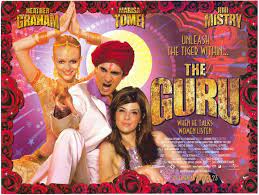
The Guru

You know when you don’t go to the cinema for what seems like an age and then you suddenly go quite a lot? No, well, I do this on-off thing with the cinema quite a lot. Yesterday, following on from my Men in Black II experience, I went to see The Guru at The Clapham Picture House (which, if you live in this part of the world, probably ranks as one of the better cinemas and it’s not part of an overly large chain – although there are more of them than you would imagine).

The people I was with loved it. They laughed (a lot). Many people in the cinema were laughing too. I smiled occasionally, and there was the odd laugh, but on the whole I was pretty quiet. So, to validate my lack of enthusiasm for the film (which seems to be generally well received), I got as far as The Guardian’s film site(which, I am sure was Film Unlimited at one point). Peter Bradshaw reassures me with,

There’s no bite or edge to this movie, though; it’s goofy, soft-centred romcom slush, with some very half-hearted Bollywood pastiche”and“… these moments don’t really justify the admission price

[Full Review]

and

… these moments don’t really justify the admission price [Full Review].

Now, I am using the web to reinforce my own opinions. This can’t be a good thing.

Not Hilarious or Surprising

Men in Black 2 poster

Strange, zany, generally amusing and very likeable without actually being all that hilarious or surprising, Men In Black II relies heavily on familiarity with and affection for the original. Fans of that film, who are simply content with more of the same, shouldn’t be dismayed or too seriously disappointed by a pleasantly insane bit of nonsense. [Empire Online]

This review tells almost all about my night last night. I went to UCI Sutton to see Men in Black II. I had enjoyed the first in a wash-over-me kind of way. Interest wanes at twenty minutes.