Blog

Helsinki Jazz

Listening to Jazz in the centre of Helsinki

Helskink Jazz
Sunshine & Jazz

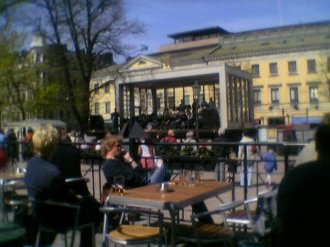
Yet again I am travelling. I have never been to Finland before, and today I am in Helsinki. This afternoon I was listening to a jazz band in the sunshine. Honestly, this is work. I’m going to try and put some more pictures online later, but for now I want to go to bed. The light kept me awake last night. Look at the figures for today – May 28, 2003: Sunrise: 4:16 AM and Sunset: 10:21 PM.

An identity crisis

A surprising take on identity cards over at The Telegraph

Latest Link: Telegraph An identity crisis

The issue of national identity cards is being raised again. What I am surprised about is this piece in The Telegraph – I thought they would be in favour of ID cards.

See also BBC NEWS: ID cards will ‘infringe civil liberties’. In all the hysteria about terrorism and ID cards, it is worth reminding ourselves that, “The terrorists who committed the atrocities in America on September 11 had legal papers”.

Still, I am unsure what to think about the whole ID card issue. What is telling is that, according to Charter 88, “Countries that already have identity cards have a written constitution and have those rights protected – we don’t”.

(Related: Entitlement Cards)

Michael Moore’s Website

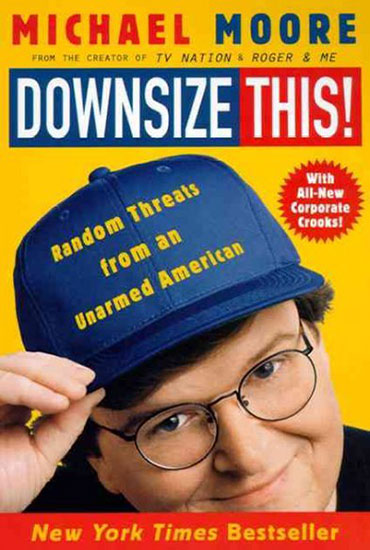
I have just submitted my reviews of Michael Moore’s Stupid White Men and Downsize This to Amazon. While reading the reviews, I visited michaelmoore.com and was intrigued to read this.

Well, take a look at my Oscar “backlash”:
On the day after I criticized Bush and the war at the Academy Awards, attendance at “Bowling for Columbine” in theaters around the country went up 110% (source: Daily Variety/BoxOfficeMojo.com). The following weekend, the box office gross was up a whopping 73% (Variety). It is now the longest-running consecutive commercial release in America, 26 weeks in a row and still thriving. The number of theaters showing the film since the Oscars has INCREASED, and it has now bested the previous box office record for a documentary by nearly 300%.

[Source]

Downsize This!

Inspired by Stupid White Men to read another of Michael Moore‘s books, I came away thinking that Downsize This was actually a better work. Sure, some of the scenarios are silly (‘What America Needs Is A Makeover’) and many of the examples a little dated (some have been overtaken by world events). It’s also true that some of humour doesn’t seem to sit well with the subjects but it is, nonetheless, a very welcome voice in the sea of opinions.

Moore does attempt to be humorous with his staple subjects: corporate greed and accountability, right to freedom/life and social and environmental responsibility. Like Stupid White Men the book makes subjects accessible that are often not covered by mainstream media.

If Stupid White Men has made you think about reading more then this is a good start if you’re happy to have many more American examples as the main topic. If you’re looking for something a little more British then this is not the book for you.

Read other people’s opinions at Amazon UK.

Fly Away

I never really had a fear of flying – at least not in the sense it stopped me doing anything. I just get nervous at take-off and then, generally, I am fine. I like a decent sized jet with seats that have sufficient padding on the arms so that, when I grip them, my knuckles can go white without serious injury to my hands

Why do I put myself through this on a regular basis? Occasionally I have to travel for work. Travel, they say, broadens the mind and I am sure that it does. But sometimes I wonder why I have to put myself through the ordeal.
I am not the greatest person to get on an aeroplane but for the best part of four years my working life has meant dealing with (and visiting) customers across Europe. I really enjoy these trips and it’s great to meet people face-to-face that you would only normally deal with on the telephone or via email. And, although I shouldn’t moan, the downside is that I never get to see any of the fantastic places that I go to. I’ve lost count of the number of times that I have been to Milan and never seen anything other than airports, offices and taxis. It’s such a shame.
I never really had a fear of flying – at least not in the sense it stopped me doing anything. I just get nervous at take-off and then, generally, I am fine.  I like a decent sized jet with seats that have sufficient padding on the arms so that, when I grip them, my knuckles can go white without serious injury to my hands. Once in the air, I am OK. Nothing to bother me until the return journey. So it’s not really too bad travelling to most of Europe for business. I appreciate the fact that I can travel and count myself lucky that it’s only a few minutes of unease.
So, here I am today in Dundee.  I have customers to see here who are very pleasant people to work with. I’ve been planning this trip for a couple of weeks and I had planned to take the train until I realised that, at best, it was going to be a six hour journey.  I had to take a flight to give me any chance of doing some other work today.
Now these flights are the worst. I can’t stand the small 30-seater planes (that seem to be a cross between propeller and jet driven) that bring you here. My nerves are shot and my palms sweaty. At take-off it’s easy to mistake the arm of the person in the next seat with that of the plane. Again, I am fine once high enough not to be shaken around by a passing air current that, I suspect, has desires to knock us 500 miles off course. That moment, however, as we’re picking up speed and racing down a runway, sends a panic through me that I hate.  Unlike those other journeys, these small planes seem to make me sweat and grip for longer than normal. The planes don’t go as high and so I can see the land – which I don’t think is good for me.
The fear is, of course, irrational – at least these flights are no different from the others. The more nervous I get about taking this short flight the worse I feel. I know that it is silly and I become annoyed by my own fear – I’ve taken so many flights it should be like taking a bus (which I think I do less than flying). I can’t stop the sick feeling. Every lurch of the plane, every shake and noise is analysed in a way I do not do with larger aircraft. Every expression on the stewardesses face analysed for a sign – should that clunk have happened? Should that beep be sounding? Should this window rattle so much?
And the very worst bit of it all? I know I have to do it backwards tomorrow evening.
Next time, I’ll take the train (maybe).
Why do I put myself through this on a regular basis? Occasionally I have to travel for work. Travel, they say, broadens the mind and I am sure that it does. But sometimes I wonder why I have to put myself through the ordeal.

I am not the greatest person to get on an aeroplane but for the best part of four years my working life has meant dealing with (and visiting) customers across Europe. I really enjoy these trips and it’s great to meet people face-to-face that you would only normally deal with on the telephone or via email. And, although I shouldn’t moan, the downside is that I never get to see any of the fantastic places that I go to. I’ve lost count of the number of times that I have been to Milan and never seen anything other than airports, offices and taxis. It’s such a shame.

I never really had a fear of flying – at least not in the sense it stopped me doing anything. I just get nervous at take-off and then, generally, I am fine.  I like a decent sized jet with seats that have sufficient padding on the arms so that, when I grip them, my knuckles can go white without serious injury to my hands. Once in the air, I am OK. Nothing to bother me until the return journey. So it’s not really too bad travelling to most of Europe for business. I appreciate the fact that I can travel and count myself lucky that it’s only a few minutes of unease.

So, here I am today in Dundee.  I have customers to see here who are very pleasant people to work with. I’ve been planning this trip for a couple of weeks and I had planned to take the train until I realised that, at best, it was going to be a six hour journey.  I had to take a flight to give me any chance of doing some other work today.

Now these flights are the worst. I can’t stand the small 30-seater planes (that seem to be a cross between propeller and jet driven) that bring you here. My nerves are shot and my palms sweaty. At take-off it’s easy to mistake the arm of the person in the next seat with that of the plane. Again, I am fine once high enough not to be shaken around by a passing air current that, I suspect, has desires to knock us 500 miles off course. That moment, however, as we’re picking up speed and racing down a runway, sends a panic through me that I hate.  Unlike those other journeys, these small planes seem to make me sweat and grip for longer than normal. The planes don’t go as high and so I can see the land – which I don’t think is good for me.

The fear is, of course, irrational – at least these flights are no different from the others. The more nervous I get about taking this short flight the worse I feel. I know that it is silly and I become annoyed by my own fear – I’ve taken so many flights it should be like taking a bus (which I think I do less than flying). I can’t stop the sick feeling. Every lurch of the plane, every shake and noise is analysed in a way I do not do with larger aircraft. Every expression on the stewardesses face analysed for a sign – should that clunk have happened? Should that beep be sounding? Should this window rattle so much?

And the very worst bit of it all? I know I have to do it backwards tomorrow evening.

Next time, I’ll take the train (maybe).
Stupid White Men

Probably the most famous of America Liberal thinkers at the moment, Michael Moore is a US treasure and they should treat him as such. Instead, the land of free speech tried to prevent this book being published following the attacks on the World Trade Centre.

Thankfully, this book made it out. It’s certainly very US centric (it was, after all written for that market) but many of the points apply too much of the western world. While suggesting that “we live in a society that rewards and honours corporate gangsters”, Moore does it with a humour that’s accessible and easily read.

Much political writing is hard to read whereas this written in small chunks and is easily digested. For those familiar with liberal writings much of Moore’s work may appear superficial but that’s to do with the style rather than the content. It is Moore’s style that has made this book number one on so many book lists but it’s the content that people will remember. For the British reader the challenge is to see where our democracy is following the US lead.

Why should you read this book? Because it puts the greed of the consumption society into perspective and genuinely makes you think about the society in which we live.

You can read other people’s opinions of the book at Amazon UK

What We Shouldn’t Be Talking About

Why we shouldn’t talk about click through rates. Really, is that the only value your expensive advertising has. Think about your brand.

Well, some good news for the online marketing industry at last:

Internet advertising is one of only two disciplines in the marketing services industry to report an increase in budgets over the first quarter of the year [Brand Republic]

and if we all stop talking about these online ad topics, what will we say to each other?

The biggest percentage of responders (13.1%) thought that click-through rate discussions are a waste of time. The second anti-productivity prize went to Branding vs. Direct Response debates (7.9%) [Media Post]

Other links of note I have been pointed to today:

  • Whoever buys the assets of UMS – and there are companies sniffing around – they will be doing so when there are signs, albeit tentative, of a recovery in the bombed-out dotcom sector. There are plenty of undervalued companies around – and also a lot of money. However, investors are still nursing their losses from the dotcom collapse and are reluctant to part with it [Guardian via Plasticbag]
  • Craig Newmark observed people on the Net, on the WELL and in Usenet, helping one another out. In early ’95, he decided to help out, in a very small way, telling people about cool events around San Francisco like the Anon Salon and Joe’s Digital Diner. It spread through word of mouth, and became large enough to demand the use of a list server, majordomo, which required a name [craigslist in London via Kottke]
  • A huge advertising campaign focusing on heterosexual tourists risks ignoring the increasingly important homosexual visitor [Sunday Hearald via Gay News Blog]
  • The new name for the Phoenix browser is ‘Firebird’ … In addition to securing Firebird, we’ve also got the OK from those contributing legal resources to use the name ‘Thunderbird’ for a mail client [via Mozillazine]

Elsewhere: Blitzed! The Autobiography of Steve Strange

In some respects it’s a fascinating tale of fame and hedonism. If, however, you’ve read biographies of other Eighties pop stars then you’ve heard a lot of it before. The story seems to have been repeated: humble beginnings drive creativity which lead to fame and then there is a some-kind of fa

I’ve just finished Blitzed! The autobiography of Steve Strange and posted my review to Amazon:

Blitzed! The Autobiography of Steve Strange

I’ve just finished Blitzed! The autobiography of Steve Strange and posted my review to Amazon:

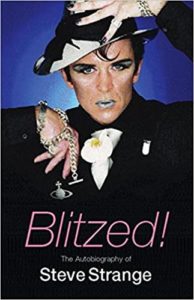
Steve Strange was an icon of the Eighties music scene, a visionary and a leader. I suspect he’s often overlooked, but his contribution was vital. His clubs kick-started a movement, and the band he fronted,Visage, were pioneers of what became the New Romantics: make-up, big hair, big hats, and even bigger shirt lapels and cuffs. From the beginning of the decade, and out of the punk movement, came the classic Fade To Grey. Visage and Steve Strange were combining fashion and music in a radical new way.

Blitzed: Steve Strange Bokoer Cover

Blitzed has an informal style, which makes it quite readable. Strange name-drops his way through a decade and apologises quite a lot for his behaviour. It’s a cautionary tale of a rise to fame, money mismanagement, and drug addiction. It’s the story of London squats and club-land rivalry and of a community that knew they were changing nightclubs, the fashion scene and music – and doing it all in a few short years. It is a struggle to stop a man falling over the edge and trying to make sense of a life where once his name was in lights, but the money is long gone.

In some respects, it’s a fascinating tale of fame and hedonism. If, however, you’ve read biographies of other Eighties pop stars, then you’ve heard a lot of it before. The story seems to have been repeated: humble beginnings drive creativity, which leads to fame, and then there is a kind of fall (usually, drink or drug-induced). Blitzed is an enjoyable read, but Boy George will give you more, and Marc Almond will take you further. If you knew the club scene of the time, there’s an insight into the door policies of the new breed of Eighties clubs and how they worked. If you are looking for the story of Visage, then, obviously, it’s covered here, and this will be a valuable reference – but it’s more about the man than the band.

If you remember the decade, then you’ll read this book regardless, but, sadly, I felt there could have been a little more. Nonetheless, Blitzed reinforces Steve Strange’s rightful place as a leader of a movement that’s certainly not about to fade away.

You can buy Blitzed!: The Autobiography of Steve Strange at Amazon now.

Leaving Metropolis

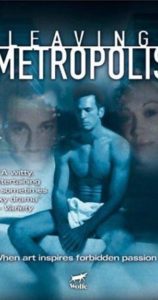
Sometimes, I get a block when trying to write about the films I have seen. Usually, that just means I end up with quite a short entry. However, with Leaving Metropolis, I am going to sum up the film in the words of a reviewer at IMDb:

This film is basically a gay love triangle. David is a famous painter with “painter’s block.” He has a live-in, HIV-positive, pre-op transsexual black live-in friend, Shannon. He has a famous-newspaper-columnist fag-hag friend, Kryla. To get his muse back, David decides to become a waiter again. He ends up waiting tables at a small diner owned by Matt and Violet, a married couple (recently married? it’s not clear). David is immediately attracted to Matt. Soon, as David encourages Matt’s secret talent for drawing comic-book characters and boosting Matt’s self-esteem, Matt begins to fall for David. David then paints a series of erotic images of Matt. The film ends predictably enough: Lots of tragedy (divorce, death, friends falling out, etc.) but also a “hopeful ending” (everyone starts over anew).

[Source]

It’s an enjoyable fantasy ride of a film, well-made with interesting characters. Matt (Vince Corazza) holds the screen well and is certainly worth seeing.

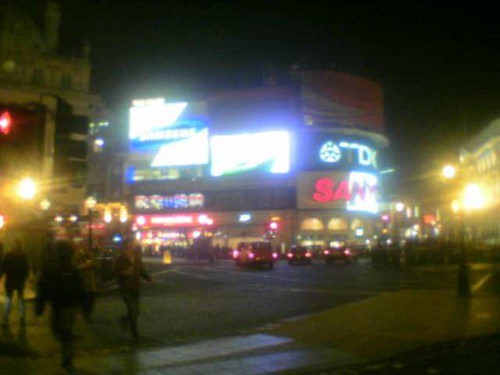
Piccadilly Circus, March 2003

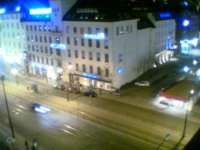
I acquired a new mobile ‘phone earlier in the week and it has a tiny camera in it which I used to take a picture of Piccadilly Circus at night

Piccadilly Circus At Night
Piccadilly Circus

I acquired a new mobile phone earlier in the week. I didn’t actually choose the model. I acquired a new mobile phone earlier in the week. I didn’t actually choose the model because I was sent it. It’s bigger and heavier than my previous mobile, and it doesn’t have a radio, which I really liked when I was walking to work. It does, however, have a calendar function, which I find quite useful, and it has one of those built-in cameras that people rave about.

It’s not the greatest camera in the world, but it is quite cool to have a camera that you carry with you all the time. For no real reason, on Tuesday night, I decided that I wanted to take a shot of Piccadilly Circus (I work just around the corner). I have just pulled the image off the phone. It’s not a great photo (in fact, it’s a pretty poor one), but I am really quite happy with it. There is something about the colour and the light that suggests the real buzz you get from walking across Piccadilly Circus at night. Now, let’s see how many more photos I post. 

Obviously, I am not the only person in the world to have a camera in a phone, I am not the only person to get excited about it, and I am not the only one to blog it. Guess there’s very little unique about me!

Has the tide turned for free online content?

I don’t think we’re about to see the death of free. Once you don’t charge it’s going to be hard to charge because there’ll be somebody else with a free carrot.

Has the tide turned for free online content? AOL Time Warner has announced that a number of its properties will move away from offering free web content. Much of that content is to move onto AOL:

We are making the move from the content being available for free, and (instead are) making it so you have to have a relationship with us, said Peter Costiglio, a Time Inc. spokesman

http://www.msnbc.com/news/891631.asp

I’d love to see all web content free, but it’s not practical, and I take it as a sign that the industry is growing up and getting real. It will be interesting to see what happens in a year from now when, hopefully, advertising revenues are up a little. Will it swing back in favour of ad revenues?

Luckily, I don’t want to read them!

Small Screens Look Good

You know, I am really impressed by the new version of Opera (which has always been a browser I have used).

You know, I am really impressed by the new version of Opera (which has always been a browser I have used). I love many features while others, like the new M2 mail client, I am not too sure about. I think they may have something in the different approach to mail, but I may just be too stuck in my emailing ways. Still, if you want to check out how your pages may look on smaller screens (phones, pdas etc.) if the vendor has selected Opera then boot up Opera 7, go to your site and SHIFT F11 for Opera’s small screen rendering. Left is my site as it looked the other day. I think it proved the power of style sheets as the whole thing is still quite browsable (is there such a word) and readable in the reduced format.

I may even browse the whole web like this!

A New World Order

America is the only real super-power with the economic and military force to pretty much try and do what they like around the world

Where does Britain go next? Polly Toynbee wrote an excellent piece in Friday’s Guardian [via Politix] about the state of the Union (European) and our (so-called) special friendship with America. Sadly, I really believe that the friendship is now very much a one-way street. We support the US, or we don’t. They don’t much care.

America is the only real superpower with the economic and military force to pretty much try and do what they like around the world. Yet a European Union – in several guises – could be a threat to that power and, therefore, a stabilising influence on a very one-sided world. And, if we are honest, even the Americans should understand that could be a safer way for the world to be. A second democratic super-power born not out of ideological fights, but pieced together from a similar model to that from which the US grew. In essence, a powerful and united European Union (united by stance and not necessarily under one flag) would provide the series of checks and balances the United Nations seems unable to provide at the moment.

Depending on your viewpoint, this war may (or may not) be right in many ways. Regardless, we are there now, and we are fighting alongside the US and other nations. When the dust settles on Iraq – as it eventually will – what will the new world order be like? Will we follow the US into any nation they care to wage war against (rightly or wrongly)? Can we still hold our heads high at meetings of the EU and look our neighbours in the eye? Are we capable of stepping back and looking for our appropriate place in the new world order? I hope we can.

Online Advertising is a Nuisance

43% of users think that online advertising is a nuisance. But will they pay for content? Isn’t that the question?

According to MSNBC earlier this week, 43% of users think that online advertising is a nuisance, and, in another survey, 53% respondents said online clutter was a problem – both via Marketing Fix.

Of course, consumers do not like advertising. Nobody likes being advertised at, just as everybody believes that they are not swayed by advertising (but they know people who are!). Is this a big deal? Well, of course, no advertiser wants to believe their advertisement gets in the way, and no advertiser wants to annoy users to the extent that they are turned off the product by the commercials. Yet, as noted in many places, TV advertising is the most intrusive advertising – the programme physically stops so they can show you an advertisement. So, why does online advertising come in for such a hard time?

Badly designed advertising can be a nuisance, but I think advertising isn’t generally too much of a problem. What I am interested in is the concept of clutter. So many sites these days surround you with advertisements. Banners at the top, buttons down the left, a skyscraper on the right and some kind of rich-media thing walking across the middle. There’s a very large portal that does this kind of thing all the time. They’re making money, but it’s very frustrating.

I’m sure cleverly designed advertising in the right place works – in all media. The online challenge is to make it work and make it profitable, at least profitable enough to pay for the sites we like.