Dark of the Moon

Adamson’s rock god lights the darkness.

The stage set of Dark of the Moon at the Charing Cross Theatre, bathed in deep blue light. Wooden barn-like structures flank either side of the stage, with a large, luminous full moon glowing at the centre between the buildings. Silhouettes of rooftops and distant mountains are visible in the background, creating an eerie, atmospheric night scene.
The dark of the moon has never looked so inviting.

I hadn’t heard of Dark of the Moon until we came across a ticket offer for tonight. Charing Cross Theatre is turning into a great spot for new (to us) musicals—we’ve seen Mythic, Violet, and Stiletto there over the past few years.

I don’t know the play Dark of the Moon is based on, but apparently it’s reasonably well regarded, according to The Internet. But I have to get this out of the way right at the start: the plot is preposterous. A witch boy falls for a human girl, strikes a deal to become mortal, and everything unravels when small-town prejudice and temptation intervene. It is a supernatural folk story, and I guess there is no rule that says it needs to be plausible. But it takes a bit of time to flip the switch that allows it to seem normal.

Richardson and Berney wrote this in 1945, and yet it doesn’t feel like a period story. Sure, the setting of a tight-knit Appalachian community closing ranks against what it doesn’t understand is not familiar (perhaps with the exception of some country music songs), but the dynamic is not. Intolerance doesn’t need a small town; it just needs enough people convinced they’re protecting something worth protecting. And that seems like a very contemporary theme to me.

What impressed me almost immediately was the staging. For what I believe is still an early-stage production, Libby Todd’s set is simple, but cleverly used. The village opens up to reveal its houses and shops, then closes back in to create a village square — or clears itself entirely to give the witches their performance space. Better still, the building rooftops serve as the witch world’s domain, a neat metaphor for the coven’s life high in the Smoky Mountains above the town.

The music and lyrics come from Grammy Award-winning, multi-platinum-selling songwriters Lindy Robbins, Dave Bassett and Steve Robson, and you can hear the quality in it. Ordinary Life, one of the opening numbers and recurring themes, sounds right out of the bluegrass country that I imagine when somebody says Smoky Mountains, yet it is also contemporary. Where some reviewers have found the blend of country, bluegrass and rock uneasy, I thought the rockier numbers integrated well. They bring a burst of energy at times. Certified Rockstar, in particular, is a genuine stand-out, a song that could hold its own in a much bigger show.

Much of the credit for that goes to Glenn Adamson as John, the Witch Boy. He is, possibly, best known for playing Strat in Jim Steinman’s Bat Out of Hell, and those echoes can be heard in the production. Adamson, in full rock-god mode, is captivating, and he brings to life John’s bewilderment at everything it means to be human, with the full spectrum of emotions, which keeps the character interesting even when the plot strains credibility.

One dramatic device did wear on me, however. A character from the past — a former witch, a kind of predecessor whose fate shadows the whole story — is sign-posted rather too heavily from early on. The telegraphing is so persistent that the eventual revelation lands with a “d’oh” rather than a gasp. I can’t remember the name you should be listening out for.

The ending. I won’t spoil it, but I left the theatre wishing the writers had taken the other path — the one I’d hoped for — even if that might have strayed too far from the source material. Perhaps my preference for the alternative ending means the show has done its job of making me care.

Nominated for thirteen Fringe Theatre Awards, and not without reason. A flawed but genuinely interesting piece of new musical theatre, with several star performances at its centre: I didn’t mention Barbara Allen (Lauren Jones), who is also fantastic.  Go and fill the theatre.
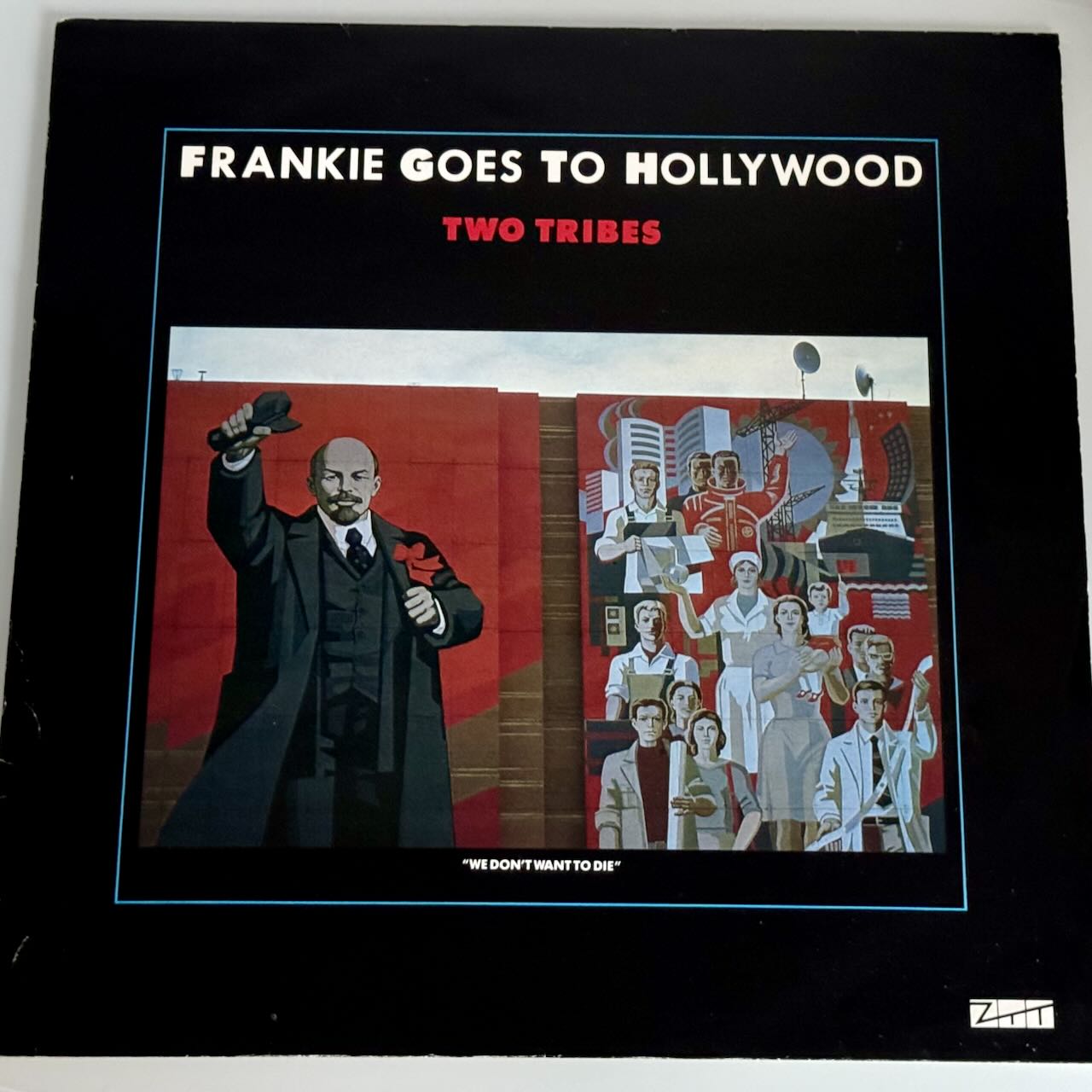
Mine is the last voice you will ever hear

Frankie’s “Two Tribes” was the sound of my last weeks at school in 1984. We played it loud enough for the air-raid siren to carry across the school grounds.

Cover of Frankie Goes to Hollywood's twelve-inch version of Two Tribes
Two Tribes 12″

When I was a child, and once I understood what an atomic bomb was, the nuclear attack public information films were some of the scariest things I saw. Fortunately, we didn’t have any way to see them often unless they were shown on television, and I don’t think anybody scheduled them in children’s programming.

Add the ‘Don’t Die of Ignorance’ films from the middle of the 80s, and you have the perfect recipe for a frightening decade. I was only just a teenager. They were scary to watch in the moment, and then I played Wham! and forgot about taking a door off its hinges and hiding under it with the curtains closed.

I’m nearing completion of Trevor Horn’s book, Adventures in Modern Recording, an insight into the life of a music producer who created some of the biggest hits of the 1980s. In particular, I just finished the chapter on Frankie Goes to Hollywood: Relax and Two Tribes. In the book, Trevor discusses the Annihilation twelve-inch mix of Two Tribes. I looked it up and played it on the train on the way home yesterday, and it brought back many memories.

Back in the early summer of 1984, my family was preparing to move from Lancashire to Shropshire. Those were my last weeks at school with a group of friends, some of whom I wouldn’t hear from again until Friends Reunited connected us twenty years later. Two Tribes was the UK’s number-one single for what seemed like most of the summer.

I am trying to remember who in my friendship group had a radio cassette player, but I can’t recall it now. The machine they brought into school may have been called a ‘boom box’ at the time, or that name might have come later. My memory tells me it was a big machine. It was the kind you’d imagine New Yorkers had on their shoulders while they strutted around The Bronx or wherever. We didn’t strut; we were 13. Somebody had a cassette version that featured both the single mix and, what I think was, the Annihilation Mix of Frankie’s Two Tribes. It was being played—on the radio and by others with their cassette machines—everywhere, especially on the school grounds at Standish High School.

A group of us sat in the sunshine on the grassy bank behind one of the school buildings, listening to Two Tribes repeatedly. We might have taken our lunches out there. As I write, I can’t recall lunch at that school for some reason, but I remember sitting on the grass with music blaring quite clearly. We played Two Tribes loud so the air-raid siren was audible across the school grounds. We liked the song, but we also thought playing it again and again was rebellious. Of course, nobody would believe it was an actual air-raid warning, would they?

When you hear the air attack warning
You and your family must take cover

Looking back, what’s most surprising is that nobody ever asked us to turn it down or off. They let us do it every break time for days. We even did it when most of the school had bunked off to the Radio One roadshow. It was my last week at the school. I thought I should be there to say goodbye. Looking back, I wonder why I didn’t go and watch Simon Bates & Janice Long. Who would have noticed I was absent? I wasn’t coming back next term.

At the time, I was also presenting a top 30 music show on the local hospital radio station. It’s only now that I wonder what patients must have thought about a child playing a song—albeit an anti-war song—with an air-raid siren as its introduction. Many patients would have lived through the real thing. What was I doing reminding them of the horrors of war while they were in a hospital bed? I thought it was a good song and played it more than I should have.

But when I played it yesterday, I kept my headphones on and didn’t subject the other passengers to that sound.

My Digital Advertising Orchestra

We gathered customers in a room and asked them what they wanted from our products in the future. Strategy was discussed but not revealed here. Sorry. It was, however, an interesting insight into the dynamics of a group of industry competitors who really shared a common view on the way forward.

Yesterday, we tried something new (well, new to us, anyway). The kind of thing that could have gone horribly wrong had we not got it quite right. We gathered a small group of our customers and, more-or-less, locked them in a room with some of our product and development people to discuss what’s next in online advertising (we did feed them, it wasn’t cruel!). Truthfully, there was no key (although I sat blocking the door for some of the day, but that was to do with the shape of the room) and customers could leave if they wanted to, although if they tried I, in turn, tried to lure them back with coffee (the Dutch said I made it too bitter by plunging too quickly, but that’s another story). It was an interesting experiment and one, I hope, we’ll repeat again.

The first lesson is that managing a group of competing interests like this is akin to conducting an orchestra in that there are many sections that all need to play their part to get the best out of the day. There will be the large string, brass and woodwind sections who have clear ideas what they want from your product and each wants to make sure they are heard. Then, of course, there’s the percussion section, which seems to fill in the gaps with novel little additions or ideas that hold the other parts together. Fortunately, we had a great conductor in the shape of one of our key product managers from our US office. I guess the rest of us turned the pages on the musical score for the others. Here, my metaphor breaks down, and I’ll move on.

I’m not breaking any confidences by suggesting that the key themes are universal to the digital ad-serving business: the industry is maturing, and major organisations have moved from wondering what their web presence is all about to how they can make the most money from it and how it integrates into the rest of their business portfolio. I took away a consensus that suggests that the top three things important to the industry are:

  • video advertising is only going to get bigger but measurement metrics are still being figured out
  • ad units are going to get bigger to ensure they make a splash; but we may see fewer units per page
  • understanding inventory availability is a major concern for publishers of all sizes who can sell

And, as all great customers should do, they would like these issues resolved in the next release cycle. Of course, we were given a much deeper insight into what our business needs to do to meet these – and the other less obvious – requirements and industry challenges (do you think I’m going to tell you now?). It was fascinating to see how players in our orchestra interacted, many having never met before. It’s great to see competitors sharing information, and if any of them read this, I’d like to say thanks for your input. I’m sure we’ll do it again. We kept the group small(ish) – more chamber orchestra than philharmonic – so that we could get the best out of the day, but if you’d like to be considered for the next one, then you’d better be a customer in about 12 months from now!

Now, I’m starting the weekend by heading off to see a solo musician. Tori Amos is playing Hammersmith Apollo in a few hours. I believe she can play the piano rather well. I guess she’ll conduct herself.

Brother Beyond Star Charged

Brother Beyond star charged with kerb crawling.

The Scotsman is tonight reporting:

The former lead singer with boy band Brother Beyond was charged with trying to pick up a street prostitute in London’s seedy King’s Cross red light district. But friends of the former model claimed the accusation was ‘ludicrous’ because he is gay. Moore is to appear at Highbury Corner magistrates’ court in north London tomorrow, charged under the Sex Offences Act. [source]

And more on this story from Google.

UPDATE: 6 JUNE 2004: Moore pleaded guilty to soliciting a prostitute at Highbury Corner magistrates’ court.