Weeknotes #155: innuendo, interruptions, and insights

A reflective week of culture, transport mishaps, and quietly pleasing observations

Week commencing Monday, 5 January 2026
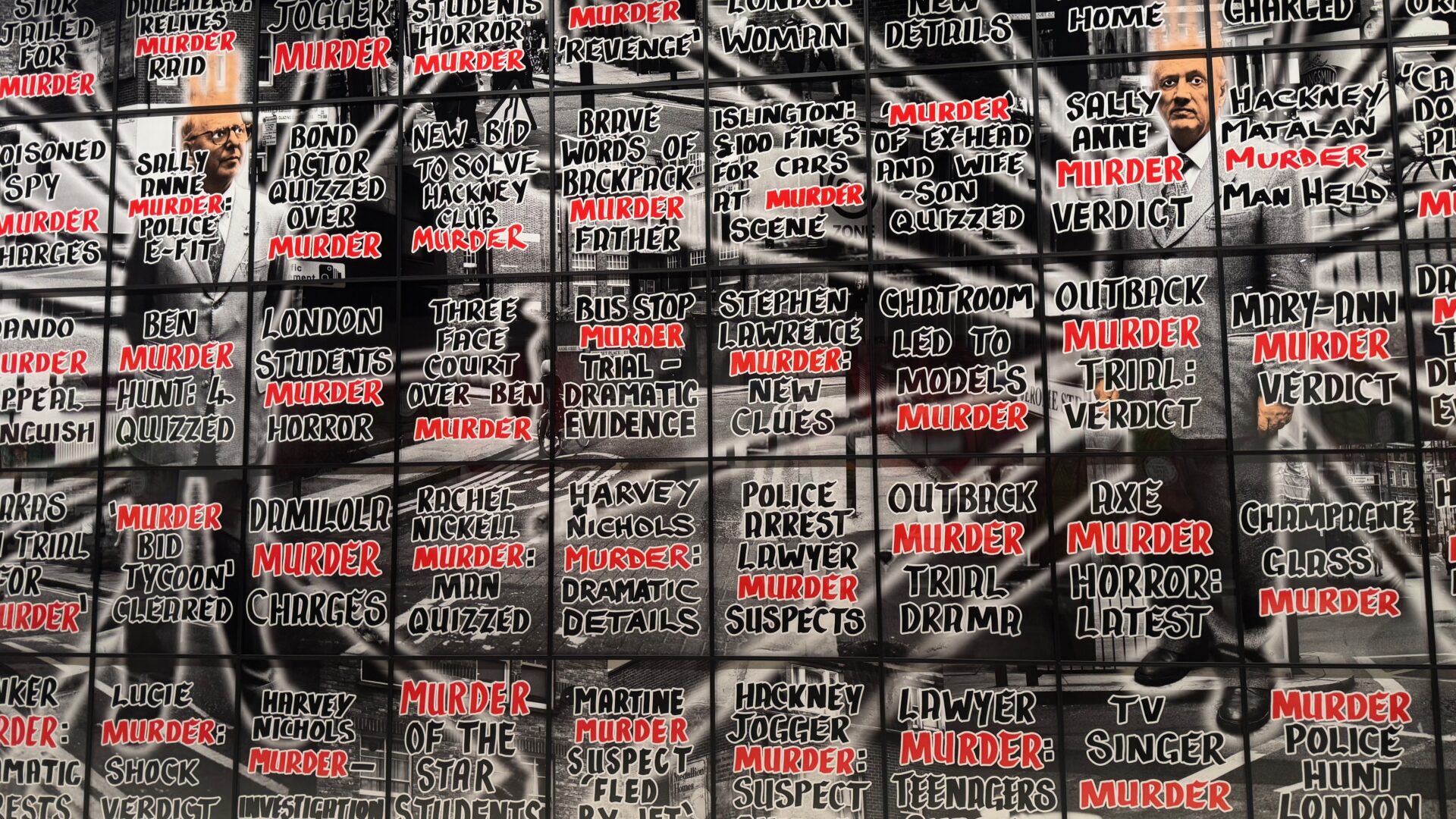
A large-scale photographic artwork composed of a grid of panels showing repeated newspaper headline posters. The word 'MURDER' appears prominently in red capital letters throughout multiple panels against a black and white background. The headlines reference various crimes and incidents including student murders, jogger attacks, and police investigations. Two suited male figures appear in the central panels of the grid composition.
Tabloid headlines transform urban tragedy into a visual cacophony. Gilbert & George, London Pictures series (2011)

Quantified Self

  • This week: Stand 6/7; Exercise 3/7 and Move 6/7. (71%). Morning walks: 0/4. Office days 1/5. Total steps: 49,424. 18.8 hours in meetings.

Life

  • This year, I am tracking a new QS metric: the number of hours I am in calendared work meetings. I thought it would be interesting to see.
  • The story of Markdown reminded me how much simpler the web was when self-publishing began. I still write these notes in Markdown.
  • Monday’s pub quiz provided a high score for us, but no prizes for third. I was pleased with myself for identifying “A Kind of Hush” in the music round, but immediately irritated that I said it was by the New Seekers when it was, in fact, The Carpenters.
  • Tuesday, it’s bigger, better, glitzier, and (probably) more expensive than ever. It’s a smut-filled delight, anchored by the King of Innuendo: the Palladium panto, which I reviewed for you.
  • Thursday, people had said Daniel’s Husband was good, and I am delighted to have kept to my “don’t read any details” rule because this play benefits from that lack of pre-knowledge. But you can read my spoiler-light review.
  • Friday night, there was a tree on the line. We were diverted and then terminated early. As much as I love it, sometimes train travel is a frustrating pain.
  • Saturday, I said “good morning” to a bus driver when it was clearly afternoon, found out the coastal path is now named after the King, and had a lovely time by a wood fire.
  • By the wood fire, I talked about my recent radio stats post. PY thought an interesting additional view that would give better context would be to understand how much time we were spending with each type of audio. So, the chart’s here on page 11. Sixty-five per cent of our audio consumption is live radio, plus another 3% for catch-up.
  • Sunday, Gilbert & George use the Evening Standard, and probably other newspapers, headline boards as part of their art. There’s an upcoming generation that won’t understand what they are and, therefore, the inspiration for the art.
  • Related, very glad I got to see the G&G exhibition. It’s big, bold, and probably not as controversial as it might once have been.

Media

  • Grantchester is back. There are almost as many murders here as in Midsomer. And the vicar is still allowed to interview suspects. Cosy fun nonsense.
  • We started series two of Blue Lights. I’ve forgotten much of the first season, so I can’t work out what’s new and what’s recurring. Definitely not cosy.
  • We started The Traitors. This is the first time I have watched the non-celebrity version. Don’t tell me.

Daniel’s Husband

A spoiler-light theatre review of Daniel’s Husband, where a cosy dinner party becomes something far more urgent.

Theatre poster for 'Daniel's Husband' showing five people in black clothing posed together against a dark background, with production details including playwright Michael McKeever and director Alan Souza, displayed at Marylebone Theatre for performances from 4 December 2025 to 10 January 2026
Daniel’s Husband at the Marylebone Theatre, January 2026

I’ve been to see a play. I may as well make this the week of three reviews. My verboseness won’t continue for the year (although I secretly hope it will).

I try to enforce a personal rule — if not a philosophy — when it comes to theatre: the less I know about the plot beforehand, the better. When invited to a performance, I almost never want to know the plot or what the reviewers said. People had said Daniel’s Husband was good, but that’s about it, and I am delighted to have kept to my rule because this play benefits from that lack of pre-knowledge. Not only was I walking into this story completely blind, but it was also my first time visiting the Marylebone Theatre. So the whole thing felt new.

Almost no spoilers here, but stop now if you are going to see it and want the real experience.

Because I knew nothing of the plot, the play’s structure caught me completely off guard. It is very clearly a “play of two halves”. The first act is a witty comedy in which we are invited into the stylish home of Daniel and Mitchell for a dinner party.

If I’m honest, after a while I did wonder if that was it: an evening of light-hearted comedy, with a few intellectual arguments thrown in to amuse — in this case, about the heteronormative state of marriage. It’s light and breezy. Even when ‘mother’ arrives, it’s humorous, if a little awkward.

And then, the shift happens.

The second half is a dramatic illustration of the brutal reality of the legal status of unmarried partners when a crisis hits. It is emotionally quite powerful; laughter subsides, and maybe your heart breaks. It took me a while to process the second part.

The moment the play shifts from scene-setting humour to high-stakes drama is one of the most effective mood changes I’ve seen on stage. This transition is anchored by a monologue delivered by Daniel (Joel Harper-Jackson), perfectly pitched off the back of the first part.

Looking back, it’s clear what’s being set up in the first half. In hindsight, the basis of the conflict that’s so essential for drama becomes obvious, but it is nicely masked in the warm tones of a cosy life.

The cast is flawless across the board. Luke Fetherston is heartbreaking as Mitchell, watching his belief crumble in the face of a cold legal reality. Liza Sadovy, as Daniel’s mother Lydia, is equally brilliant; she starts as the basis for some of the laughs but transforms into a formidable force. I don’t think you can love her; you might hate her, but one of the smart achievements of this play is that you understand her even when you want to scream “no” at her.

I don’t want to spoil the plot, but the message is clear: don’t procrastinate life’s admin.

Review: Palladium Panto 2026

A gloriously smutty, nostalgic spectacle, irresistibly entertaining.

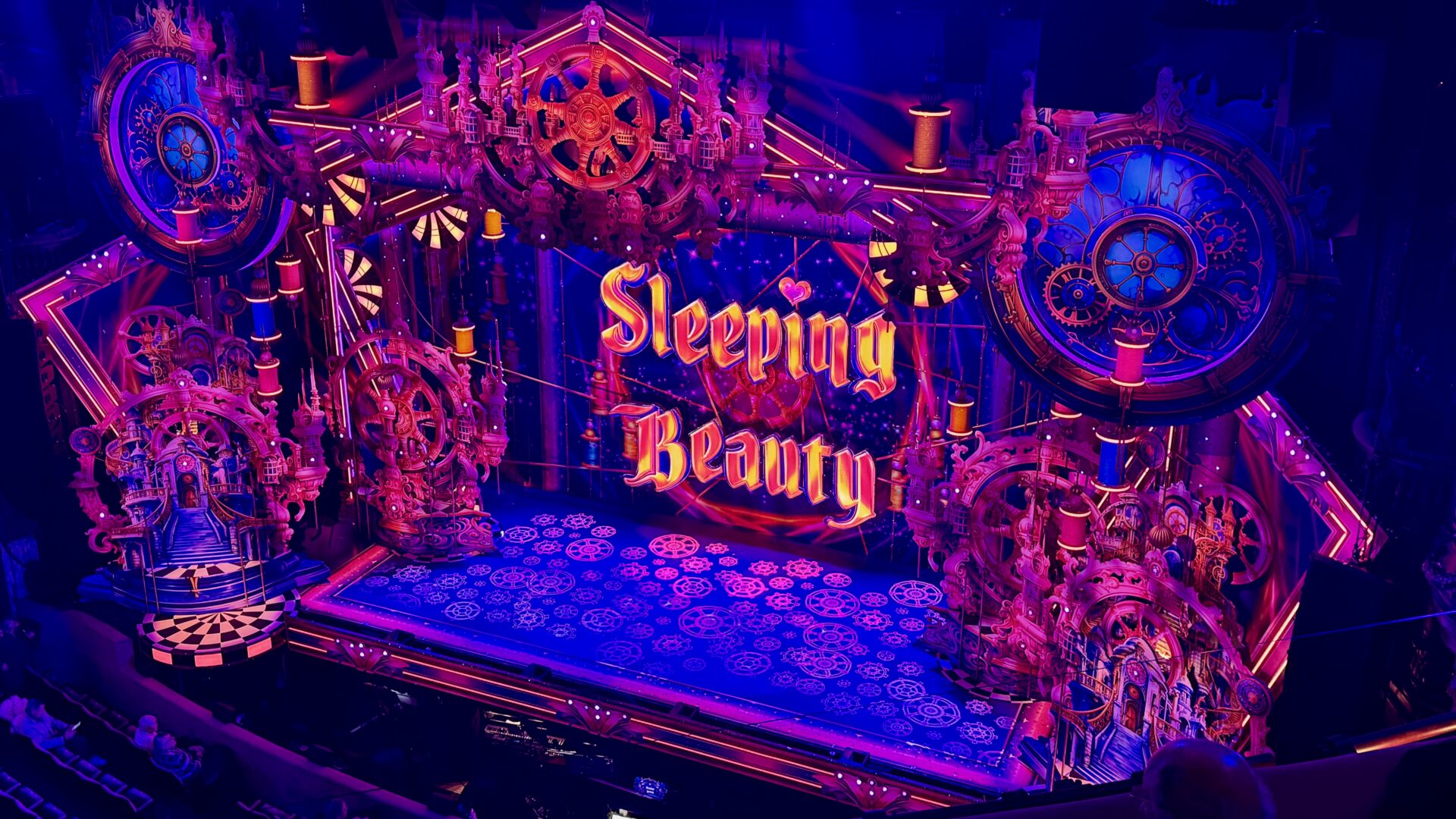
Elaborate theatrical stage set for 'Sleeping Beauty' pantomime illuminated in vibrant pink, purple, and blue lighting, featuring ornate spinning wheels, clock towers, thread spools, gears, and Gothic architectural elements
When Sleeping Beauty’s Castle Gets a Steampunk Makeover

It seems like I am in the mood to write reviews this week. So here comes another one. I do not expect this trend to continue all year.

Sleeping Beauty at the London Palladium – A 10th Anniversary

If you’re heading to the London Palladium expecting a sweet, Disney-fied retelling of Sleeping Beauty, you’ve clearly missed the memo of the last decade. Now in its 10th anniversary year, the Palladium pantomime (this year there’s a Sleeping Beauty plot somewhere) has faced a wave of headlines from outlets like Metro, branding it a “smut-fest” after reports of families walking out. But let’s be honest: if people are still shocked by the innuendo after ten years of this specific brand of comedy, that’s on them. This isn’t just a panto; it’s an institution with a well-established “adults-first” policy. Do your research. I really don’t have much sympathy for people who don’t know what this is. Although I do expect news outlets to run with and embellish this story every year.

What makes this year feel different is how self-referential the show has become. It’s been heading this way for a while, but this year’s opening retrospective is a masterclass in nostalgia, setting a tone that feels less like a fairy tale and more like the series finale of a beloved sitcom. Like the best long-running comedies, the jokes here are funnier because we’ve come to know the characters: we know Nigel Havers will be the charming punching bag, and we know Julian Clary will have a new, increasingly ridiculous entrance, and make a gag about somebody’s hand on it.

This “insider” feel is probably the secret to its enduring appeal for the regulars, but it does make me wonder: what do the newbies think? If you haven’t been along for several of the last nine years of lore, you might feel like you’ve crashed a private party.

Amidst this whirlwind, the show’s ringmaster is Rob Madge as the Diva of Dreams. While the rest of the cast seems content to let the plot drift out of the stage door in favour of sketches, Madge is the one who keeps the show flowing. They act as the essential “glue,” holding onto the limited plot and preventing the evening from devolving into a disjointed series of routines. Madge brings a modern, theatrical energy that bridges the gap between the “old guard” and the new.

The big draw this year is Catherine Tate as the boo-able Carabosse. While she delivers exactly what the crowd wants (including a show-stopping appearance of “Nan”), I had a nagging sense that she is underused. Tate is a comedy powerhouse, yet she often feels relegated to “special guest” status. Between the impressions and the sketches, you can’t help but feel she could have given even more if the script allowed her to go beyond her “greatest hits” reel.

There is no denying that Julian Clary is the heart of this machine. However, this year feels more like “The Julian Clary Show” than a balanced ensemble piece. In years past, the magic came from a heavyweight team; the presence of the late Paul O’Grady, the charm – and songs – of Gary Wilmot, or the triple-threat energy of Charlie Stemp provided a balance that kept the show from relying too heavily on one person. While Clary holds it all together with effortless camp, the absence of those contrasting “anchors” is felt.

Visually, the staging is bigger, better, glitzier, and (probably) more expensive than ever. From the neon sets to the “forest of thorns” in Act 1, the production values are impressive. However, some elements are starting to feel familiar. Paul Zerdin remains a master ventriloquist, but after a decade, his routine lacks “newness.” When a show becomes this self-referential, there’s a fine line between a “classic callback” and just running out of fresh material.

It’s still a 5-star spectacle with heights of staging wizardry. It’s loud, it’s proud, and it’s very, very blue. If you want a plot, go elsewhere. If you want to see the most expensive variety show in London anchored by the King of Innuendo, there’s no better place to be. It helps if you’ve watched the “previous seasons” to get the most out of the jokes.

I loved it (again).

Weeknotes #154: here comes another one (year, that is)

A gentle, celebratory start to the year, filled with shared rituals.

Week commencing Monday, 29 December 2025

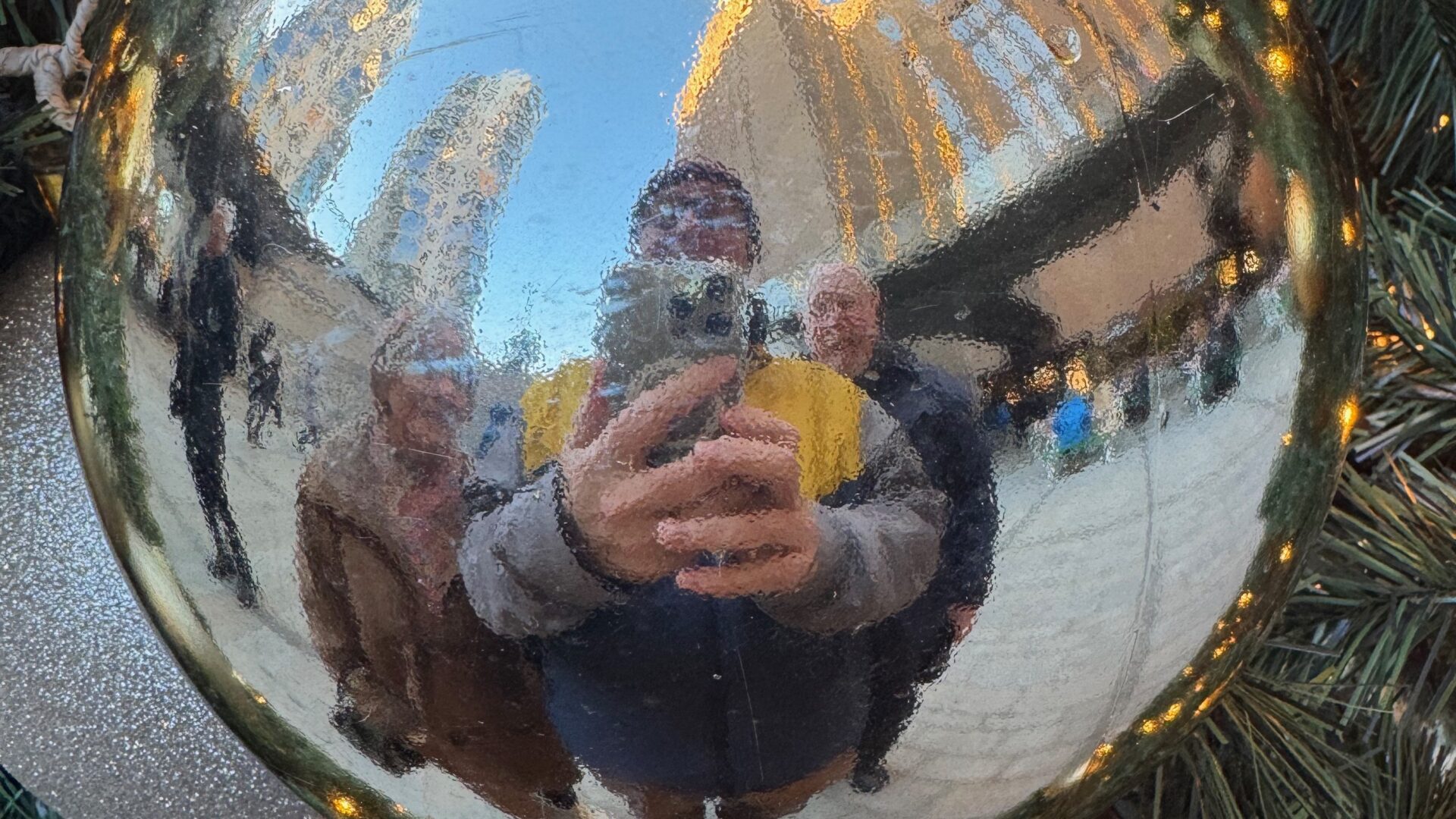
Distorted fisheye reflection in a gold Christmas tree bauble showing a person holding a phone taking a selfie, with Battersea Power Station's iconic chimneys and blue sky visible in the curved reflection, framed by green pine needles
Battersea Power Station captured in spherical festive form.

Quantified Self

  • This week: Stand 7/7; Exercise 3/7 and Move 6/7. (76%). No work this week.Total steps: 62,837

Life

  • Hello 2026! Aren’t you looking fine?
  • Monday afternoon, we all walked to The Lockdown Bakehouse, where there was cake and coffee. When we returned, we watched Peter Ustinov in Death on the Nile.
  • Tuesday, a matinee performance of Disney’s Hercules (the musical). It’s the everyday story of the son of Zeus being stripped of his immortality as an infant, who must perform a series of heroic feats and prove himself a “true hero” on Earth to reclaim his place among the gods on Mount Olympus. You see this kind of thing everywhere, every day! Review: it’s not on the level of The Lion King.
  • Bong: I went outside so that I could usher in the New Year when Big Ben bonged for the first time in 2026. Champagne and music on television, plus we used the last of the indoor fireworks outside to create our own tiny display. People gradually drifted to bed over the hours to 3 a.m.
  • Related, I was in the kitchen by 8:30 a.m. to cook the breakfast I promised everybody (although people took a while to appear).
  • Friday, Battersea Power Station has been beautifully decorated for Christmas. We didn’t buy anything in the shops, preferring instead to stand and look at the turbine halls in their glittering glory.
  • Saturday, rather than doubling back underground, we decided to walk from Marylebone to Waterloo. It turned into a really pleasant route through Mayfair, across Piccadilly and down towards the South Bank. The sky was a clear blue, the air crisp but not cold, and the streets were busy enough to feel alive without being pre-Christmas crowded.
  • Sunday, we took the tree down. The room felt bare without it.

Media

  • NYE: Kiss Me, Kate, filmed live in 2024 at the Barbican. Adrian Dunbar, from Line of Duty fame, starred alongside Stephanie J. Block. Brilliantly done; I now wish I’d seen it live.
  • New Year’s Day: watched the new Knives Out film — Wake Up Dead Man — on Netflix. It’s full of odd characters and a plot with twists, but, strangely, Benoit Blanc is pretty much absent for the first third.
  • Sunday, Marty Supreme on the big screen. See it for the style and the performances, but make sure you have a comfy seat and don’t expect to fall in love with the hero. I wrote a fuller review.

Curtains up on October

A busy October of theatre visits: five very different productions, each a reminder of London’s endless stage creativity.

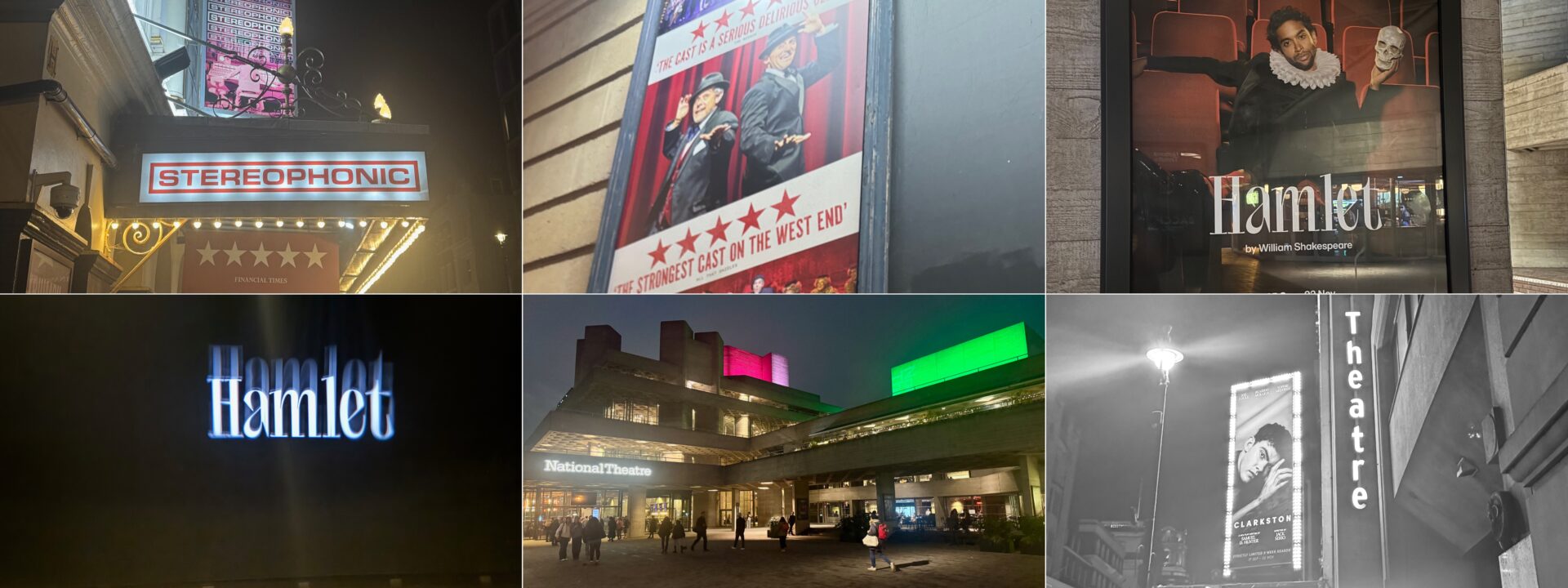
A collage of six photographs showing London's West End and National Theatre at night. Top row from left: the illuminated Stereophonic theatre marquee with decorative scrollwork and stars; a promotional poster advertising "the strongest cast on the West End"; signage for Hamlet by William Shakespeare. Bottom row from left: neon blue "Hamlet" title illuminated against darkness; the National Theatre's iconic Brutalist architecture with pink and green lighting on its terraces and evening crowds outside; a vertical theatre banner and signage visible in low light.
To see a show or not to see a show? (The answer is always yes)

For some reason, October turned out to be a fantastic month for theatre visits. Some of these were planned months in advance, a couple, very last minute, which meant that I saw five very different productions, from quiet intimacy to loud, inventive spectacle.

Clarkston — 8 October, Trafalgar Theatre

Joe Locke, best known from Heartstopper, starred in the UK premiere of Clarkston, a tender three-hander about two lost souls working the night shift in a Costco warehouse.

Jake, newly employed in the warehouse, is tracing the route of his ancestor, the explorer William Clark, while facing a recent Huntington’s diagnosis; the other lost soul, Chris, is bound to his small-town life by a chaotic mother, Trisha.

It’s beautifully acted — Locke is excellent, but Ruaridh Mollica quietly steals the show with a performance full of tension. I must mention Chris’s mother, played by Sophie Melville, who is also magnificent, injecting unstable energy just as the plot might slow. Overall, a simple setup with quite powerful performances.

It clearly brought a good number of Heartstopper fans to Whitehall for a mid-week performance, which must be a good thing. The Guardian’s review, perhaps less enthusiastic than I would have been.

Still playing, until 22 November 2025.

The Bacchae — 13 October, National Theatre (Olivier)

Euripides reimagined for the modern age: loud, kinetic, and full of swagger. This Bacchae mixed rap, spoken word and pounding beats, transforming the ancient tragedy into something fast-paced and streetwise. King Pentheus branding Dionysus and his followers “terrorists” added a touch of contemporary relevance.

The set — unadorned movable platforms — opened with an unforgettable image: a blood-soaked white horse’s head looming over the stage. It was visceral, fast-moving and utterly gripping. One hundred minutes without an interval flew by.

Time Out gave this one fewer stars than I would have, questioning whether it even works as a tragedy. I would have definitely suggested you go to see this, but sadly, it ended last weekend.

Hamlet — 15 October, National Theatre (Lyttelton)

Two nights later, another National Theatre production — but a different energy entirely. Hiran Abeysekera’s Hamlet bounded across the stage in beanie hats and oversized jumpers, his performance full of humour and restless energy. The costume might have been modern, the setting aiming for some period between then and now, though the language stayed pure Shakespeare.

Francesca Mills’s Ophelia was brilliant, her descent into madness raw and unflinching. The production never quite found a political edge, and I christened it “bouncy”, which feels like the right word.

The Observer, who don’t seem to be giving out stars these days, said what a lot of the reviews have commented on, that soliloquies are gabbled and that rather spoils the effect. Despite the pace of this performance, I think it felt slow. But it was certainly worth watching.

This one is still running, also until 22 November 2025.

The Producers — 24 October, Garrick Theatre

After so much tragedy, The Producers was an amusing tonic. Mel Brooks’s gloriously tasteless musical, now revived from its Menier Chocolate Factory run, remains, IMHO, one of the funniest shows ever written.

Bialystock and Bloom’s plan to profit from the world’s worst musical — Springtime for Hitler — is still hilarious and, surprisingly, hasn’t been cancelled. It’s satire at its sharpest, making me wonder what today’s equivalent might be.

The Evening Standard gave this one five stars; “The line Bialystok quotes from a review of Springtime for Hitler also sums up The Producers: ‘It was shocking, outrageous and insulting – and I loved every minute of it.’”

Stereophonic — 27 October, Duke of York’s Theatre

Finally, Stereophonic: a fly-on-the-wall drama about a 1970s rock band recording an album. It’s definitely not Fleetwood Mac — though the parallels are obvious. The “play with music” cleverly blends dialogue and original songs by Will Butler of Arcade Fire, capturing both the tedium and the magic of studio life.

It’s long, occasionally exhausting, but the second half finds its rhythm. I wasn’t entirely convinced it merited its thirteen Tony nominations, but it’s smart, stylish and very well performed.

WhatsOnStage gave this five stars, as did a number of others, but I agree with The Times, a little editing (in my view of the first half) would have helped.

Another production that finishes on 22 November 2025. I wonder what’s happening after that?

I don’t know when I’ve seen so many shows in such a short time. That’s five shows in one month, showcasing the varied nature of London theatre. Yes, I enjoyed some more than others, but I’m glad I went to them all and would recommend you see any of them (just get into a comfortable position for Stereophonic). There’s so much talent out there, it’s amazing.