Elsewhere: The News Bulletin Is Now Mine And I Determine The Running Order

I opened a dictionary today (by which I mean a paper book). I haven’t done that in a while (no sarcastic comments about spelling, please). I wanted to see what the definition of ‘news’ was and if it was substantially different from that currently published online by Oxford Dictionaries1. It’s not. I think it was pretty similar 20+ years ago when I was a student (and probably the same when the term was first used in late Middle English).

“newly received or noteworthy information, especially about recent events” [source]

Nothing more. Nothing less.

Of course it’s got a bunch of modern associations taken from the world around us: we’re all used to it being presented as ‘today’s top stories’. Is it what Alastair Hetherington determined it was when he edited The Guardian or William Rees-Mogg when he did the same at The Times? Is it what Tom Bradby or Laura Kuenssberg think is news at ITV? Or what Nick Sutton thinks is news on Radio 4’s The World At One? Of course. But it’s much, much more. There’s a lot of information that’s newly received or noteworthy about recent events that doesn’t cross James Stephenson’s (editor, BBC TV News at 6 and 10) desk.

By this definition there’s more ‘news’ than can fit into any existing bulletin, so for the most of the last 311 years (since 1702 when The Daily Courant launched as Britain’s first regular daily newspaper)2 we’ve relied on news editors to determine a priority and pass this information to us via the press, radio or television (yes, I am leaving the town crier out of this discussion).

Today, I came across an interesting blog by John Myers where, when talking about visiting media students, he says,

“I always start my sessions by asking students to tell me about the big national news stories of the day” [source]

and is surprised by the silence he is met with. I too was surprised, not by the silence, but the fact that most of the commenters on the piece tend to agree with him and think it’s pretty bad that students are not interested in ‘the news’.

Of course, they are interested in ‘the news’. Just not ‘the news’ if it’s narrowly defined as the list of stories on the radio, on television or in the press.

So, to me, the silence is not surprising at all because most of the time there are no ‘big national news stories of the day’ that are common to us all (of course, I will concede, there might be exceptions). This is because most of the students he’s addressing have grown up in a world where you create your own news agenda. News no longer needs to be the prioritised list of events from an unknown (except by byline) editor at my local newspaper or radio station nor what Radios 1-6 think nor anything broadcast by a rolling-news television station. Today, across the world, we create our own news running order from Twitter, Facebook or a million other online tools. It’s a continuous stream of stories that mixes the global with the hyper-local and the personal.

So I wrote a reply about it (copied below). One subsequent commenter claims he was

“left thinking that Jon believes no-one should be aware of the news in their local area or in current affairs” [source]

which is, of course, not what I am saying at all. But I am saying no one needs to be beholden to a far-off editor to prioritise what’s important news to them. It may be a breaking world story, an interesting piece about the industry I work in or news of a new birth in the family. I think asking journalism students to name recent stories might show they can read/watch/listen, but it means we’re training (and hiring) people for a way of working that’s stuck in a 300-year-old history of doing things that’s not fit for presenting the news in the future.

The news bulletin is now mine, and I determine the running order.

Here’s what I wrote and you can read it in context at News – who cares?

For more-or-less twenty years almost all digital news outlets have offered some kind of news personalisation services whereby I can opt to see news that interests me. There’s a whole generation who have grown up with the ability to determine their own news agendas and not a prioritised list of items from an editor in another city. On most days, do ‘the big national news stories of the day’ really still exist? Isn’t it ‘my big stories of the day’ from a wide range of sources? Twitter is just the latest incarnation of news. Certainly there are lots of issues with the bias of self-selection but they’re only a new take on age-old editorial bias concerns.

Far from making us ‘dumber’ aren’t Twitter and Facebook The News for some people? If I’ve opted to prioritise Formula 1 news or tech stories from Silicon Valley over today’s political posturing over the ECHR (which is front page on the newspaper next to me)3 then I’ve made a decision that’s no different from the editor that decided to pop that story in the paper. Isn’t Facebook’s timeline just news from my ‘community’ (which is what the news was for most people prior to rise of the mass national press in the late 1700s)?

I think if a copy of Metro on the campus of University of Central Lancashire was leading with the Boris/Ken story for the race to be London Mayor then you have your answer as to why students go elsewhere for more relevant news.

Perhaps better questions for your students or job candidates might be what are their news agendas for the day? I bet you’ll find articulate people fully aware of news (just different from your definition of news) and thoughts on alternative ways to package that news to make it relevant. If they can’t name Tim Farron (he’s on page 4 of my paper)4 then the internet exists if it becomes necessary. I see a bleak future for newsrooms that persist with the one-size fits all agenda whereby one person’s idea of the top stories should be the same as mine.

Notes

1.My dictionary (the paper one) is twenty years old. I was checking to see if the definition had changed in any way.
2. It’s a somewhat arbitrary date to pick as the point where news agendas are set by remote people/editors. But I felt the first regular daily paper wasn’t a bad point in time to use as a marker. I took the date from here.
3. I’m looking at i (or do we call it ipaper?). It was free this morning from Starbucks. This is the front cover.
4. According to the newspaper sat next to me he’s President of the Liberal Democrats. I wouldn’t have known that had I been tested (even after reading the paper). I just picked it as a random name ‘in the news’.

Update

The very next day, as if to help prove that nobody wants a one size fits all news bulletin, I read this (and it made me laugh):

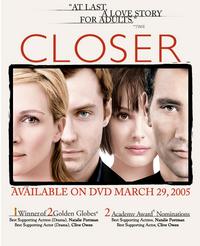
Closer

A mixed film with the most cringe-worthy chat room flirtation that I’ve ever seen. Sadly, not recommended.

closer.jpg

I thought Closer was a mixed bag of a film. The performances of the four protagonists are not too bad: Jude Law as Dan is convincing as a bit of a self-obsessed wimp; Natalie Portman as Alice isn’t too bad with some interesting character quirks; Clive Owen is the most real as Dr Larry, but Julia Roberts is cool (nay, cold) as Anna in a role I was least convinced with.

I haven’t seen the stage play, but the sexual intrigue and adulteries of the film lose believability as the film progresses. While it’s both a simple love story told through a complex series of inter-woven relationships and coincidences, I still wanted to shout out at the characters for their self-centred stupidity.

I did, however, like the film technically. You have to stay engaged to keep up with the way the story is told. The edits jump (but don’t jar) and you can’t dose. The four players are, more or less, the only performers on the screen and, despite what I say above, the intensity of the performances does help keep you engaged, and they should all be credited for that.

A mixed film with the most cringeworthy chat room flirtation that I’ve ever seen. Sadly, not recommended.

  • The Guardian: The fizzingly talented Marber may well write a great film soon. But this isn’t it.
  • Empire: frank enough to push back the boundaries of how explicit non-porno film can be about sex but manages to be brutally funny with it
  • BBC: Nichols’ clinical approach fails to elicit deep empathy for any of these characters whose foibles are intended to reflect us all

Graffiti Shop

Wandsworth council clean up at a so-called graffiti shop in Clapham Junction.

My local council has just cleaned up what it calls a ‘graffiti shop’ at Clapham Junction. Without wanting to comment on the merits of graffiti as an art form, I think the shop covered in graffiti looks OK. Perhaps not the best thing ever, but it’s not the worst. If you look closely, you’ll see the nice, neat edges to the graffiti, so it doesn’t cross onto anybody else’s wall – which is a nice touch, don’t you think?

You Can’t Hear Yourself On The Tube

Plans are afoot to allow you to use your mobile underground. I hope it doesn’t happen.

Does the thought of being able to use your mobile phone on the tube fill you with dread? Actually, that’s probably a little excessive, but being underground has always been the one sanctuary from the calls (admittedly, you have to switch it on to be reached – which is something that I must learn). At least it’s only on the stations. The thought of people talking on a packed train in the morning really does fill me with horror. It’s bad enough on the overland trains.

Love Revolution

I wonder who does the Phixx marketing? A low-budget way to get noticed?

this is the phixx car sticker - honestly
this is the phixx car sticker – honestly

So, the official Phixx website alerted me to two interesting facts this week. Firstly, Andrew is giving away his car. Honestly. In one of the most bizarre (and possibly desperate) publicity stunts for a single, Phixx are giving away Andrew’s car. How do you win? I’ve no idea because they won’t tell you until the single is out. And then, today, I received an email with the subject ‘Phixx Window Sticker’. The clever marketing bods have ‘put an A4 poster together for you to download and place in the back window of your car’. I thought that it might be a nice idea to go and look at it – except anybody could have knocked this up. What a disappointment. That’s the picture. The pdf doesn’t render properly on my machine (but the World version does). All in all, that’s brightened my afternoon. So, despite the simplicity, I may now be forced to buy the single – Love Revolution is out on Monday. You may have seen the car stickers!

Elsewhere: Blogging & Advertising

If you decide that your audience will accept advertising, what does this mean, and how will it work for a blog?

Over on the ukbloggers-discuss mailing list at Yahoo Groups, we’ve been discussing advertising, prompted by Tom Coates asking, “Did we ever come to any conclusions about the appropriateness of advertising?” in the context of blogging. In essence, we’re saying that blogging is personal and, if you decide that your audience will accept advertising, what does this mean and how will it work for a blog?

I started quite open to the concept,

I believe advertising is a compromise. Are you comfortable with a reader questioning your independence? I know it’s a very grand term, but, nonetheless, it’s at the heart of the advertising debate. It may not matter to the vast majority of readers, but it could (should?) to some. I don’t think anybody, but me, cares about my independence, but it is the reason why I wouldn’t want any advertising on my blog.

But is it that simple? Blogging generally costs something – hosting, bandwidth, time and effort. Should a blogger be entitled to get a little something back? I don’t think advertising is a bad thing on blogs,

When typing my previous post, I was being very careful not to say that I felt the acceptance of advertising is inappropriate (because I don’t think it is), but I do believe that while it shouldn’t change what you do or what you say, it may very well change the way you are read. And for some people, that’s a consideration (admittedly, probably not for many).

Or am I putting an undue emphasis on editorial independence for bloggers? Perhaps I am. Is it a silly notion to (try to) apply to weblogs in all their forms?

But then Tom introduced me to projectblog.com, a site aimed at recruiting bloggers with reasonable audiences “who would be willing to help advance their marketing efforts”, and introduced the concept of blogging about products you may have been sent as freebies or paid to write about. I think I turned cynical,

My first reaction was that it proved my point about editorial independence. Then, I was going to cite traditional broadcast media. There are some rules there to ensure a clear distinction between programme and advertising content.

However, when you think about it, how many morning DJs talk about having seen a new blockbuster that’s not released yet? Many of them. And most of them went for free. You do not consciously think their opinion is biased.

Perhaps the online world is playing catch-up with traditional media. And I can’t decide if that’s a good thing or not.

Maybe it’s sad that I cling to the notion that connected networks somehow empower people. I am not against the commercial web, but weblogs are a great example of a (generally) positive use of the technology. When the marketers get involved, it changes my expectations. It’s not a surprise, but the next time somebody raves about something new, won’t you question it (even a little bit)?

Is it possible to turn into a world-weary cynic in the space of two hours?

And now? Well, I stand by my thoughts that you should be clear about what you write. Blogging to me is the fulfilment of the web’s promise of personal publishing for everybody. But, of course, money always gets in the way and there’s nothing wrong with advertising online. After all, it’s what I do, isn’t it?

Commercial Free

Should Blogs carry advertising? What happens when it’s not clear if a blog is really paid-for commercial content being passed off as something else?

There’s been an interesting discussion on the UK Bloggers discussion list today regarding online advertising and if it’s appropriate in the blogging world.

I need to put my position into context. I came to the web (and, therefore, to employment) because I truly believe that personal publishing can empower people. To me, the pull of the medium was access to views and interests outside the mainstream. The ability to publish what you had to say without an editor’s red pen. That doesn’t mean that you can ignore laws of the land, but within an existing legal framework, it is relatively easy and cheap to publish. It’s not easy to guarantee the audience, but that’s a different story. The message is out there, and that’s a starting point (and should be a right in a democratic society). This is a good thing.

I also believe there is a need for a commercial web. The fact that we buy things online, read content paid for by subscription or advertising, etc., helps pay for the infrastructure that allows the rest of us to publish. The commercial web is a good thing, too.

Advertising is also a good thing; it pays for things, so I don’t have to. I’ve made a career out of working in advertising-related industries. I have no objection to advertising.

Where it starts to blur for me is when the three points above mix. When it’s not clear if an opinion blog is really paid for commercial content being passed off as something else. It’s not a problem unique to the blogosphere, but it’s something that I haven’t pondered a great deal until today. It is a problem other media have had to deal with for years – some have done it better than others.

I honestly believe that giving marketers access to a weblog audience (and you can see why they would want a mass of referrals) starts to compromise the reason why weblogs/journals, etc., are so successful and such an important part of the landscape these days. Any media with access to an audience is bound to attract the attention of marketing men. Let’s face it, that’s how Amazon grew – lots of affiliates making small amounts of money, and we’ve been linking away to them for years. Is the integrity of a weblog at risk? Well, readers should be asking whether a link to Amazon is borne of genuine appreciation for the book or is placed purely for profit.

The idealist in me thinks the freedom to publish personal opinion shouldn’t be mixed with commercial interests. The realist believes people have to pay for server space and bandwidth, so a little commercial involvement may help allow people publish what they want to say. Thus, the two are intertwined.

As always, it’s difficult to come down on one side of the argument. I would honestly like to believe not everything in the world needs to carry a commercial message. I would like to believe that bloggers did it because they had something to say, even if, like this site, it’s not earth-shattering. The world, however, is much more complex.

UPDATE 10 March 2003: Tom Coates– who sparked the discussion – wrote (as always) a great piece on this subject.

A Quieter Life

I was having one of my ‘why do I stay here?’ days. Luckily, I was heading to Soho with friends that evening.

Thank goodness that tonight I am going out with a group of friends. They are some of my oldest friends in London (by that I mean I have known them longest and not that they are all ancient). I’ve just decided that I am quite relieved, as I am having one of my “why do I stay here” days.

I love London. There is no doubt that it is one of the most vibrant and wonderful cities around. I love the dirt, the pollution and the travel chaos. I love the way the British put up with congestion with some quiet mutterings. There would be riots in some counties.

I don’t use London as much as I should. I work, and I travel home to my little Zone 3 house. Sometimes I go out with friends and visit a much larger range of bars than I ever would in a smaller town. I see films before they hit the screens in the rest of the UK, and even get to see films and theatre that never make it outside the West End. Occasionally, I will visit a gallery or museum or wander the historic sites. I adore the view from The London Eye, think St Paul’s is a great place for quiet contemplation, the South Bank is a wonderful place to relax and believe the Thames Barrier is one of the finest structures around. Oxford Street, Covent Garden and surrounding areas have every shop you could ever dream of – and many you couldn’t (or wouldn’t). If I lived here for the rest of my life, I probably wouldn’t have time to see and do everything I would like to.

Yet today I am having a “get me away from here” day. Take me somewhere where the pace is slower, people are friendlier (but not as pushy), and I can see the sky, not commute an hour each way on an overcrowded train. I think it started last night when I watched one of those programmes about people who give it all up and set up home in France, Italy, or Spain. They seem to live off the land and suddenly develop gardening talents that would make Alan Titchmarsh proud. They rebuild old barns and turn them into holiday accommodation that pays for their entire existence. They spend all their days on the land with the one they love and are at peace. Wouldn’t it be idyllic?

I imagine I would be bored. It’s not really a life for me – yet. I would miss Theatreland and Soho, but today I feel I still want that stillness and peace, that de-stressing lifestyle. I know it’s a lie, but I want the dream. And that’s why I am glad I am off to the bars of Soho tonight. It’s time for my friends to give me a quick injection of reality.