Algorithmus on the mountain

Rewrite my history: AI assisted coding experiment by a non coder product manager

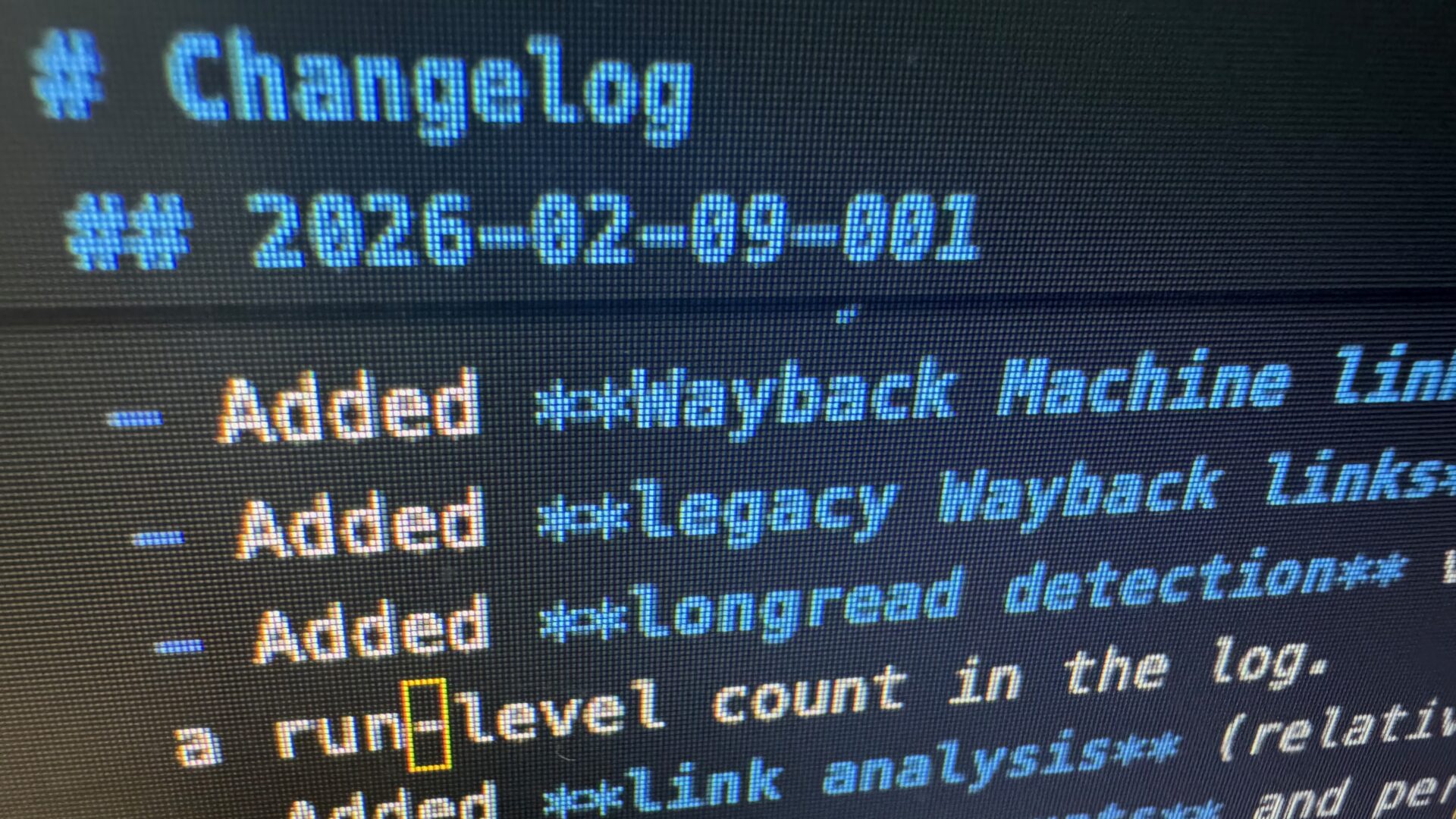
Changelog displayed on a computer screen showing entries with added functionality for Wayback machine time, Legacy Wayback links, and Longread detection, along with a run-level count in the log.
Version control: because someone has to remember this

I was going to start this post with, “Do you read the papers?” But of course you don’t. Nobody does. But you watch TikTok for news, or see clips of a shouty man on LBC. Something like that. And, if you’re aware of the world around you, you’ll know that things aren’t going well. Unless you are a billionaire with stakes in Artificial Intelligence. Then, well, you are pretty much treated like some kind of God. If this were ancient Rome, you wouldn’t be another minor deity. You would be a figure of cold, calculated logic and immense influence. You will be called ‘Algorithmus’, or something like that.

If you were Algorithmus, you’d look down at the lesser gods on Mount Olympus and enjoy all the excitement around AI. The hype would be your strength. Meanwhile, ordinary people sacrifice their privacy for your benefit.

The Romans didn’t have AI, but they would understand hype. That’s what’s happening with AI today. I’m not ancient Rome old, but I do remember the internet buzz in the early 2000s. The internet was overhyped and in a bubble, but after the excitement faded, people found real uses for it. It’s similar to how Roman roads were built for armies to destroy villages, but ended up helping everyone.

My memories of the internet hype, more than Roman roads, shape how I view today’s AI tools. AI and machine learning are clearly useful. The chatbot trend will likely become something practical for society, hopefully in a positive way. Lots of people already use basic AI tools to be more productive. Still, I wanted to try it myself. I was curious about “vibe coding”—the idea that you can build complex software just by giving prompts to an AI coding tool. Could I really create working software just by chatting?

I’ve worked in technology my whole career, but I’m not a coder. I did take a computer studies O-level back when that existed, long after the Roman Empire, just to be clear. So I have a basic grasp of coding. As a product manager, I understand the challenges and limitations engineers face. I once worked with a senior developer who thought anything could be built with software if you had enough time. Now, I’m not so sure, since deadlines and delivery dates matter just as much as what’s possible in theory.

Software development has changed a lot in my lifetime. It wasn’t really a formal field when I was in school, but now it’s central to millions of jobs. Some companies only build software, and everyone else relies on it to run their business. Engineers have always turned ideas from people like me into real systems. Now, the question is how much of that work AI can do, and what skills you need to guide it well.

A small experiment at work a few weeks ago got me started. I needed to make sense of one of our system logs, which are tough to read. Online tools can make them look nicer, but without context, they’re not very helpful. I built a simple tool and provided enough context to organise the log output in a way that made sense for us. That experience inspired me.

A big part of being a product manager is turning business or market needs into things engineers can build. That challenge doesn’t disappear with AI. In fact, you might need to be even clearer about what you want. Human engineers usually have some background knowledge, but AI agents don’t, no matter how much training they get. They’ll improve, but for now, they really need clear instructions.

Recently, OpenAI added more features to its coding tool as part of my plan, so I decided to try something personal and see if I could “vibe code.”

The project

Back in the early 2000s, when blogging was at its peak, I wrote often and hosted my own site. It’s still online. About ten years ago, I added a feature that shows me posts I wrote on this day in past years. Usually, that’s two or three posts.

I’ve long wanted a small app that could pull up those posts each day so I can review them and decide if they should stay as they are. Part of that depends on whether the links still work. I see those posts as a time capsule and don’t really want to delete them. But blogging was fast-paced, and I didn’t always check spelling or proofread. I want to fix that, but not all at once. I need something I can run occasionally, fix a few posts, and move on.

So I described a tool that would pull the right pages, find each post, check spelling and grammar, and look for broken links. It needed to run on my computer and create a report with suggested fixes and any links that didn’t work.

Ramblings to working software

I told the coding agent to assume I didn’t know how to code and to guide me through the process. Within an hour, I had a working prototype. I was surprised at how quickly I could go from a prompt to something that worked. I could test it, provide feedback, and request changes. The next day, I added more features, and the AI even found a list of over 2 million UK place names to improve the spellchecker.

Now, I have a daily web page that links to my old posts from that date, each one checked for spelling and links, with a log file that explains what the system did. It’s not commercial software, and there’s no extra interface beyond what I asked for. But it does exactly what I need.

Encouraged by that success, I tried building a second tool. This one would download any of those blog pages, reformat the text, and let me paste the result somewhere else. The AI suggested making a Safari extension, so I needed extra build tools and had to connect it with software already on my computer.

This project was more complicated and a bit frustrating. I probably could have guided the AI better if I understood the build tools more. I wanted it to work with an existing app that has a command-line interface. The AI kept suggesting solutions that didn’t work on my setup, even though I explained what I was using. That’s when my limited coding experience became obvious.

After some compromises, I got a working version. It runs on my computer and does what I wanted. During the process, the AI just waited while I went to meetings and came back hours later. It picked up right where we left off. Since language models don’t exist between chats, there’s no one waiting impatiently. I just came back when I had time.

I can see how a skilled engineer, who knows when to step in on complex parts, could get much more done with this kind of help. But my experience shows that even someone with limited coding skills, as long as they can describe the problem clearly, can quickly build useful software and solid prototypes.

There were other small surprises, too. I asked the tool to write a user-friendly description of the software’s functionality. In less than a minute, it came up with something better than I could have written in hours. With a few more tries, it could have made full documentation. The log file it created explains each step in plain language, which I’ve always liked for systems that need to be clear to non-coders.

So, where am I on the hype cycle now? I don’t think AI will replace engineers. You still need someone to turn ideas into working solutions. Clear requirements and context are still important. But I do think that for people who understand technology, AI makes it much easier to build small, useful tools. It lets you try things that might have stayed as just ideas before. For experienced engineers, it’s definitely a superpower.

The hysteria may fade. The Roman invaders will leave. Algorithmus might end up in jail. But the useful things will stick around.

Weeknotes #107: tofu and gardens

A week of discoveries, good food, and reflections.

Week commencing Monday, 3 February 2025

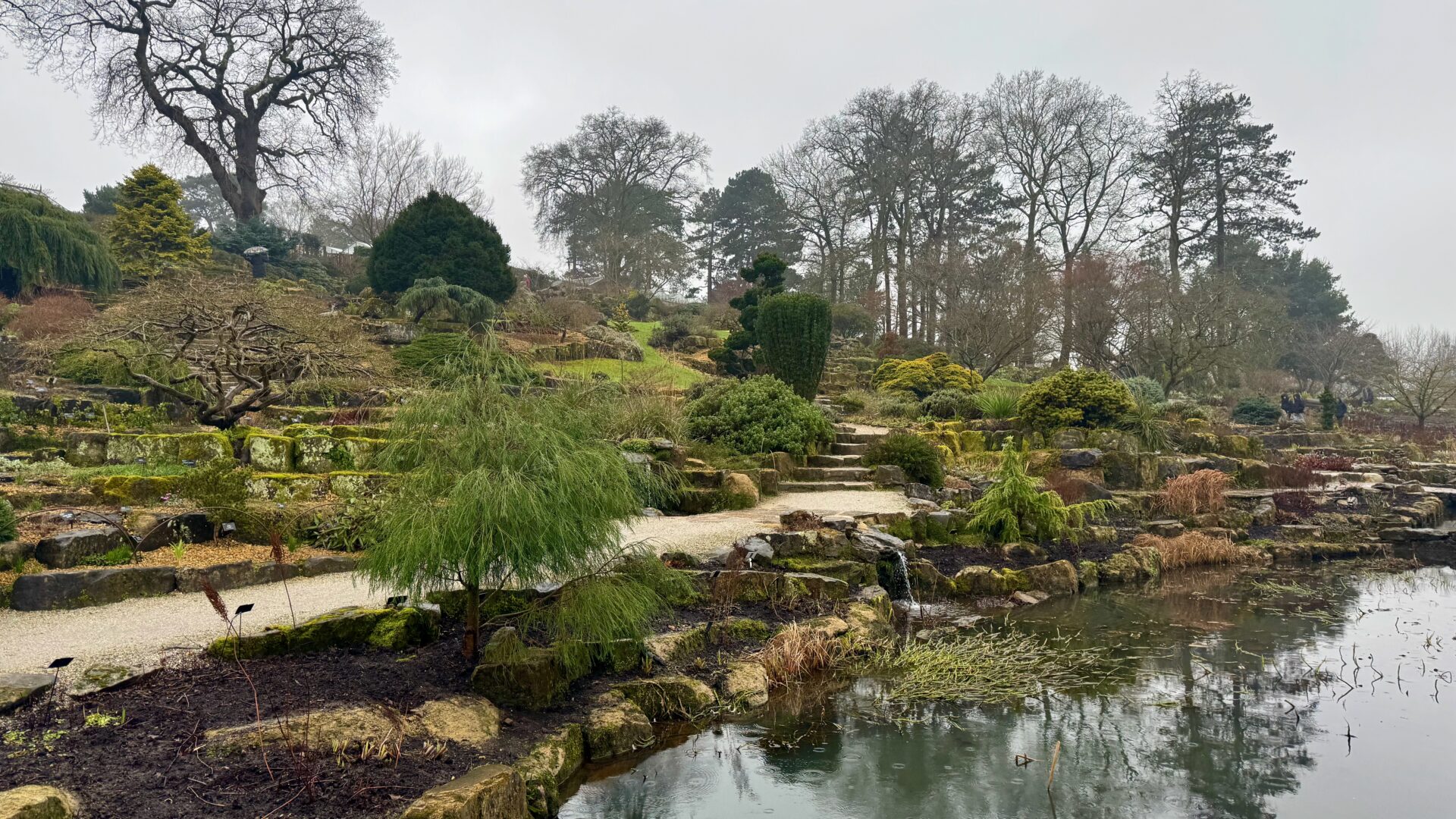
This image shows a winter scene at RHS Wisley, capturing one of its distinctive rock garden areas alongside a reflective pool of water. Despite being taken in February, the garden displays the characteristic year-round interest that Wisley is known for, with various textures and forms creating visual appeal even in the dormant season. The rockery rises in terraced levels, with moss-covered stones creating natural-looking steps and platforms. A gravel path winds through the rocky landscape, leading upwards through the garden.
A winter scene at RHS Wisley

Quantified Self

  • This week: Stand 5/7; Exercise 3/7 and Move 4/7. (57%). Morning walks: 0/4 (days in the office don’t count). Office days 1/5. Total steps: 46,616

Life

  • To prove that I am nothing if not a mass of contradictions. After last week’s dive into, perhaps, useful AI, this: “The LAST thing we needed was a better way to generate plausible-looking horse shit for random gullible people to consume unwittingly, but here we are, and it’s only going to get worse.” Rachel By The Bay is also spot on. What a world.
  • Relatedly related. It was announced that Google’s Gemini assistant is being enabled at work. That would allow me to add material to the notebook service I talked about last week. I am not expecting hitherto unnoticed insights. Yet.
  • Thursday was too cold to sit out for drinks for our usual Thirst Thursday, so we moved to Mildreds, where I continued my rule of not ordering anything “chick+n” but broke my rule of avoiding tofu. The kimchi bokkeumbap, which contained salt and pepper tofu, was delicious.
  • Saturday, to the RHS gardens at Wisley. The Orchid House had colour, and there were snowdrops in bloom. I bet it’s even more impressive in summer.
  • Sunday to a crowded Ikea to buy a light. And then a tram and bus to Lower Morden Garden Centre, where we bought some new plants. To avoid carrying it, potting compost was ordered from Amazon for delivery tomorrow.
  • Note to future self: parsnip gnocchi was a lot of work, but delicious.

Media

Wogan

Two white mugs printed with the repeated word "WOGAN" in diagonal blue and grey bands alongside a small "BBC1" logo, photographed in close-up.
A pair of vintage BBC “Wogan” mugs.

When I was a child, I recall that every morning we sat in the kitchen eating breakfast cereal. My mum had BBC Radio 2 on in the background, and Terry Wogan was the host.

In the late 1970s, Radio 2 was a very different-sounding station from the one it is today. This was during Wogan’s first period on the breakfast show, which ran from 1972 to 1984, and his Floral Dance era.

In 1985, Michael Grade overhauled BBC One’s early-evening schedule. EastEnders was introduced on Tuesdays and Thursdays, while Terry’s chat show, Wogan, aired on the other three weekdays. It became a staple of our early-evening television viewing. At about 15, I was probably waiting for the pop act that often appeared on the show. I recall not knowing who many of the other guests were.

These Wogan-branded mugs have been sitting in my cupboard for years. I must have acquired them during a childhood trip to London in the mid-1980s. There used to be a BBC shop near Broadcasting House on Regent Street, and I may have bought them there. Visiting it would certainly have been on my wish list.

It would have been the heyday of the chat show, and I imagine there was plenty of *EastEnders* merchandise around too. This is what I opted for.

I doubt the mugs are valuable collector’s items, but I don’t really want to use them because they are not replaceable. They remain in the cupboard, preserving a small part of the radio and television I grew up with.

Contactless Payments: All Rise

Some comments are just too long for Twitter, but I’m unsure if they are worthy of a post like this. Still, having no other place, I want to comment. Here goes.

Last October Apple launched Apple Pay; the contactless payment mechanism using your mobile phone and not a plastic credit card. At the time, I wrote a quick summary of my payment day for those who were new to contactless payments (hint: not really aimed at the UK market). It’s now pretty mainstream.

According to the BBC, in the UK, £2.3billion was transacted this way in 2014,  where “30% of all transactions [in London] below £20 were contactless,” according to Barclaycard. Last Friday, the BBC even had a Six O’Clock News item on the rise of contactless payments, with the three-fold year-on-year rise amusingly illustrated with loaf tins at a baker’s (pun, one assumes, absolutely intended). They also noted that an increased transaction limit is coming, which is useful. See the video on BBC News.

But no mention of any of the non-plastic card ways to pay: pay tags or mobile phones. I found that a bit odd given they are likely to grow quickly as they are introduced.

Every Little Helps You Spend

There is a new store and it’s right around the corner.

new tesco metro on lower regent street

It was noted in January that Britain’s biggest grocer, Tesco, takes around one pound from every eight spent by UK shoppers. Well, today, they’re trying to take even more of mine as their new store on Lower Regent Street opened (including a barber shop quartet singing to welcome customers this lunchtime). The shelves were nicely stocked and where they were not, people were replenishing them. All the tills were staffed, and they seemed to be doing quite a nice trade indeed. Will the friendly service last? I wonder how it will change my lunch habits? I am used to using a local sandwich shop where lunch is made to order and doesn’t come pre-packed. I would like to think I will continue to visit but the lure of the big store and the ability to purchase something to eat tonight could be quite strong.

I have to say I am very impressed with the store’s look from the street; it fits in well with the buildings around it. Certainly, some thought has gone into that.

Better Than Buses In A Flower Market

Anybody reading this site will know that I seem to have lots of opinions on urban transportation.

Anybody reading this site will know that I seem to have lots of opinions on urban transportation. One of my favourite visits of recent weeks was to the London Transport Museum, which is housed in an old flower market at Covent Garden. I thought the place was great, but then I read about the New York Transit Museum, which is actually housed in a historic 1936 subway station in Brooklyn Heights, New York. How cool is that?

This weekend I was visiting my parents in Shropshire, and we went to Llangollen in North Wales for the day. I couldn’t get anybody to agree to ride the Llangollen Railway – which is part of the British rail network from Ruabon to Barmouth in North Wales which was closed on 1st April 1968. It would have been a good way to spend a Saturday so, perhaps, I will next time I visit.

My parents live in Shrewsbury, which this year has been a little protected from winter flooding by some new flood defences. There seems to be some dispute about the effectiveness of the defences. If you look at some of these pictures on BBC Shropshire’s site, you would have thought that nothing had changed. I am not always glad to be living away from the river, but at this time of year, I certainly am.