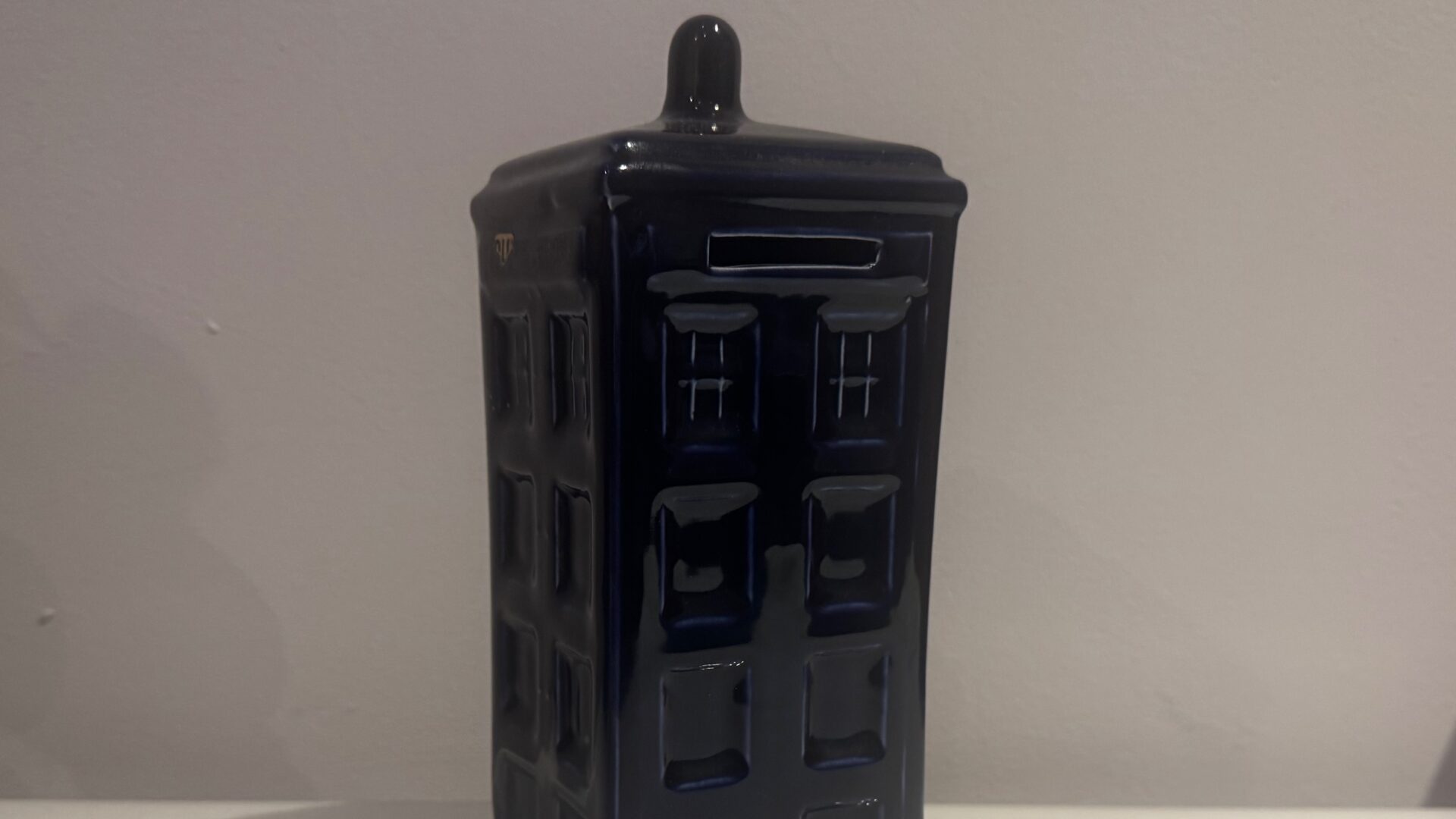
At some point, you will ask me a hypothetical question about time travel, because people always do. I always have the same answer, and it’s usually not the one people expect. I want to go to the future.
I suppose I understand the appeal of the past. All sorts of historical events would be interesting to observe, and there are people it would be wonderful to meet. But the past has already happened. We know how it turns out. Books, documentaries, photographs, and the entire Internet cover it. Admittedly, none of these would be quite the same as being there, but I don’t want to experience the Black Death firsthand, meet Guy Fawkes, or unexpectedly come across a dinosaur in a swamp. It might be fun to say I saw The Beatles at The Cavern Club before they were famous, but don’t most people from Merseyside over a certain age already suggest that?
The future, on the other hand, is a complete mystery. Isaac Asimov, Douglas Adams, Arthur C. Clarke, and even George Orwell had a go, and you may argue they were on the mark in some ways. But I can only judge those works from today’s vantage point, and I want to know what happens next. Does AI eat us all? Do we solve climate change? Does humanity finally make it to Mars? Do we discover life elsewhere in the universe? But, more mundanely, how do people live in 150 years? What are the gadgets? What’s the work like? I’ll never know.
Two blog posts I read last week brought this question back to mind.
In Why I’m Not Excited by HS2, Diamond Geezer describes visiting Colne Valley Viaduct, a remarkable feat of engineering that will one day carry high-speed trains across the countryside west of London. He’s impressed by the structure, but much less impressed by the idea of actually using the HS2 infrastructure. The project has been so often delayed that he wonders whether he’ll still be around when it finally opens.
At some point in your life, you start reading about the completion dates of this kind of big project and wonder whether you’ll see it come to fruition, even if simply to watch it from a comfortable chair, whether it’s your chair or a nursing home bed.
Meanwhile, Terence Eden has been writing about restaurant menu QR codes. He’s enthusiastic about the convenience of electronic menus, particularly when travelling abroad, and somewhat exasperated by people who complain about them. He points out that we don’t generally demand the return of enormous metal hotel keys, so why are we so upset about restaurants replacing folded paper with something more modern and useful?
The ability to sit down in another country, read a menu translated into English, see pictures of the food, order it and pay for it, all using a device in my pocket, is unbelievable. The younger me would have been astonished and excited. It’s jumped off the Tomorrow’s World screen, but we’ve really been waiting a long time for all the technology to come together to make this possible.
Imagine, back in the late-70s, thinking about everybody owning a telephone with no wires, a colour television screen, a camera, all the recorded music, a map of the entire world, and access to an almost limitless amount of information, in something that fits into a pocket. And if I didn’t think it was real science, I would have said it was fiction from an episode of Doctor Who.
Of course, not everything we imagined about the future has come true. Where are the flying cars, holidays on the Moon, and jet boots? Instead, we have self-service supermarket checkouts that get surprised when I add a tin of beans into the bag.
But that’s why I want to time travel forward. Almost none of the visions that came close to being real from either Doctor Who or Tomorrow’s World arrived as we imagined. They turn up in little increments; each seems a marginal improvement on what came before. One day you buy a mobile phone. Then it has a camera, and one year that camera seems better than an actual camera. Then the phone has the Internet. So, you stop carrying a camera, an address book, a diary, a map and a music player. And you find yourself standing in a restaurant, pointing the thing at a square of black-and-white dots to discover what the stew is.
By this point, the future isn’t as futuristic as it might have seemed.
The other thing about the future is that it keeps moving. George Orwell thought the mid-80s were the future. When I was young, the year 2000 seemed far too distant. It was a proper science-fiction date. By the time it arrived, I was 30, working, paying bills, and probably worrying about something else, though there were those few months when the Y2K bug made it sound like it would end the present.
I have no idea what 1980s me would have thought about 2026. Yet, I am here thinking about things that are coming in twenty or thirty years. But the future is 2100, and beyond. What’s that going to be like? Will we finally have jet boots? I’ll never know. I’ll be 130 in 2100, which is probably pushing my luck, even with all future medical advances.
And this is the part I find simultaneously fascinating and a little sad. I have already lived through technological changes that the younger me could never have imagined. But there will be another set of changes, probably even more extraordinary, that I won’t get to see. Somewhere in the future, people will be doing perfectly ordinary things with technologies that haven’t been conceived of today. They’ll take them for granted, complain when they don’t work, and perhaps wonder how we, their ancestors, ever coped without them.
I would love to know what those things are.
I don’t want to live forever. That sounds exhausting; my knees already hurt, and I suspect there would be an awful lot of software updates. But I would quite like the opportunity to pop forward occasionally, and have a look around.
I might make it, but I would love to see London in 2070. That seems a reasonable starting distance. Far enough away for something surprising to have been invented, but close enough that I might recognise the place. I’d want to see what people are carrying around instead of phones, whether artificial intelligence has turned out to be genuinely transformative or just another way of making customer service worse, and what the BBC has decided to do with BBC Three.
Then perhaps 2200. I’d be interested to see whether people still drive cars and whether London looks familiar in any way. What didn’t we anticipate? What social changes can’t we picture, and what problems will seem baffling because we haven’t yet invented the things that cause them?
I suppose the future might be disappointing. It could be worse than the present; there’s no guarantee. I know some of the things we take for granted will have disappeared. I’d love to know what they are. Now I am older; I see a world developing that will, eventually, carry on without me. But it’s still exciting.
So, if somebody ever does invent a working time machine, I won’t be asking to see the dinosaurs or attend the opening night of a Shakespeare play. If I arrive in 2043 and find myself standing on a platform at Euston, waiting for the first HS2 train to Birmingham, I won’t be happy. I’d like to go further forward. I want the jet boots.
When I get there, I would have to resist the temptation to look up the lottery results. Or perhaps I wouldn’t. The rules of time travel are rather vague.