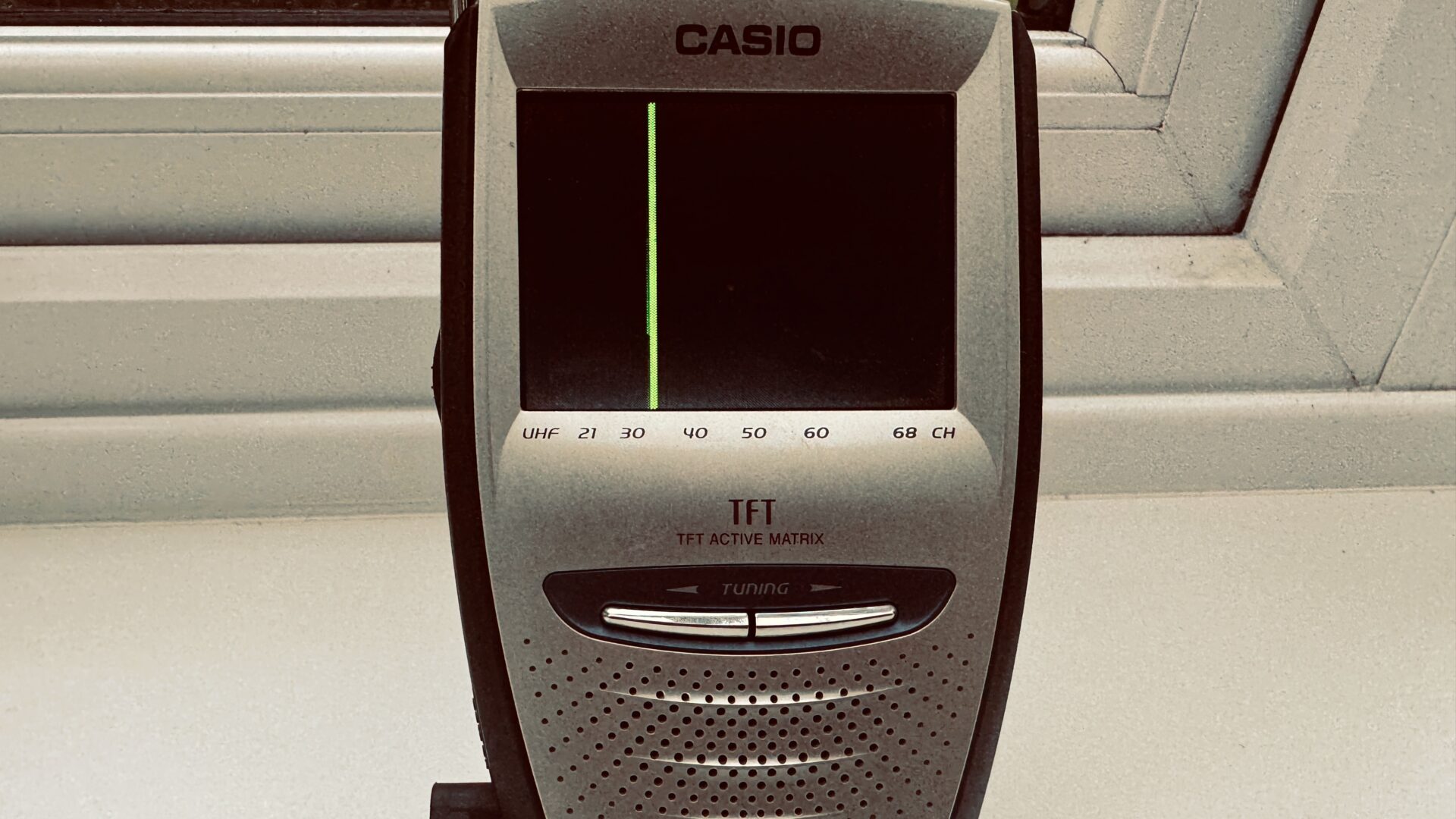
I am at my Mum and Dad’s house. We cleared out a cupboard earlier today and found this device: a little pocket television I think my brother used.
This Casio portable television dates from the late 1990s. Back then, it was a vision of the future. I imagine there was a corresponding fanciful notion that featured jet boots. From today’s vantage point, television has changed, but boots still don’t have jets.
The box price was £149.99, a reminder that this gadget was fairly expensive at the turn of the century. The picture shows a three-inch screen on a device with UHF reception, a telescopic aerial, and a headphone socket. It could run on four AA batteries or an optional mains or car adaptor. The Guardian reviewed the device in July 2003 and noted it was available from Comet (a name many readers won’t remember). The reviewer described watching the FA Cup final on the television while attending a wedding. Football was surely almost impossible to watch on such a tiny screen, and I can only imagine waving the aerial around at a wedding. Surely, Aunty Mary wouldn’t have approved.
The 80s answer to a modern-day Silicon Valley tech giant, Sir Clive Sinclair launched the TV-80 in the early 80s, one of the earliest miniature TVs that was, kind of, affordable. But, from my memory, Casio was the only, certainly the biggest, name in town. They had expertise in liquid crystal displays for watches and calculators, which I guess translated into small television screens. All the cool kids, and those of us that weren’t so cool, had a Casio digital watch. And, I gather, they’re back in vogue today.
By the time the EV-660 was being sold, these devices had reached their sophistication peak. But they were also approaching the end of their technological life. By 2002, Freeview made digital terrestrial television attractive, because it offered more channels without a subscription, and the move to a digital future was on. By 2008, Dixons, Currys and PC World stopped selling analogue television sets. In July 2010, The Guardian reported that all major high-street electronics chains had stopped selling analogue-only televisions ahead of 2012, when London’s Crystal Palace transmitter shut down analogue transmissions, making it the first region in the country where digital television was the only way to watch.
Like old-school TV, digital television was also on UHF, but required a completely different decoder, and this little Casio couldn’t make sense of the signal. No matter how much we moved the tuning control or extended the aerial, it didn’t help. That little green line shows where on the tuning dial the device is searching for a signal; of course, today it couldn’t find anything: it was searching the atmosphere for a signal that wasn’t coming. A bit like looking for life on Mars
It seems the digital switchover didn’t immediately end portable television as a category. However, I wonder how many people bought a digital-compatible version, given the obvious problem: reliably receiving digital broadcasts through small aerials is difficult. An imperfect analogue signal produced a snowy but watchable picture. With digital reception, the image can freeze, break into blocks, or disappear when the signal weakens. This made reception while travelling particularly difficult, and these devices were meant to give people access to television when they didn’t have a big box in the corner.
I reckon (and I don’t think this is a unique or clever insight) that the smartphone finally killed this category of device. The BBC launched iPlayer in 2007, the same year Apple introduced the first iPhone. Maybe, at first, people watched streaming television mostly on desktop computers. But increasingly capable smartphones, Wi-Fi, faster mobile networks, and dedicated streaming apps transformed how people watched video away from the living room, often on their own, and the mobile experience was better than portable digital TV. At least for the viewer, perhaps the commuter sat next to somebody blaring out last night’s EastEnders from a phone, thinks differently.
The pocket television was an early attempt to make television available anywhere, an ambition that was ultimately realised by the smartphone rather than the television industry itself.
