It’s Burbn*

It was a suburban snowy view: housing, parked cars and the occasional bare tree branch. It was also the first picture I posted to Instagram.

It was Saturday 18th December, 2010. I don’t remember what time I woke. I do know that I’d been to see Lady Ga Ga at the O2 arena the night before – so I don’t imagine I got up that early (I don’t have many specific memories of the concert except that she played the piano at one point and I remember that, whatever the song was, it was incredible).

A blanket of snow greeted people that morning in Earlsfield. At some point before lunch I looked out the window, snapped a picture of an undisturbed car park outside the house where we lived then. The cars had a couple of inches of snow covering their windows – still to be swept away. I was heading to the Southbank for a Christmas meet-up and I wanted a picture of the white carpet before it was disturbed by feet. It was a suburban snowy view: housing, parked cars and the occasional bare tree branch. It was also the first picture I posted to Instagram.

I’ve always liked Instagram. The filters were ideal in an age of early mobile camera technology when most pictures were really not that good. But, somehow, it’s just become an interesting snapshot of ten years. Back in 2004 I wrote something about the pictures taken on a mobile phone presenting a different perspective on your life when compared to those taken on a camera. In the intervening years the phone has become the camera but my Instagram timeline reminds me of the early mobile camera rolls: a collection of pictures taken in a moment when, perhaps, once upon a time, I would never have pulled out a camera.

The world has moved on. For me the intervening ten years have been full of wonderful people and places and a lot of them have been recorded on Instagram. Instagram has changed from being a place to post classic square pictures: it’s added video, it’s got stories and reels and now it has added shopping too (big-up the Instagram PMM team working on this). But the feed is still here and all ten years are recorded.

Next week (because I think there is some effort involved here), I intend to try and pick one picture from each year to sum up that year as seen via the Instagram lens. It’s pure sentimentality but if you can’t be a little sentimental in December then when can you be?

Footnotes

* According to their Wikipedia entry, Instagram was orginally a mobile check-in app called Burbn. My unwavering – continuing – loyalty to Foursquare would have meant I’d never have used that.
Another Radio Era Ends

Perhaps it was something about Radio 2 in the 1970s that remains underappreciated because the flares distracted us. A generation of broadcasters deeply integrated audience participation into their shows long before anybody knew what they were doing.

I haven’t written about radio for quite a while, unless you count my comments – on Matt Degan’s excellent site – about Commercial Radio blaming its woes on the BBC, and I don’t think that counts.

As I look back I see I wrote about The End of A Radio Era in December 2002 when Jimmy Young left Radio 2. And I find myself wanting to use that self same title today as Sir Terry Wogan leaves his top-rated breakfast show. Throughout my childhood I was aware of Jimmy Young but, as a family, we actually listened to Terry Wogan.

The news people say it’s 27 years, of course, we know that the number represents years actually talking on the breakfast show. There were years off for good behaviour (when he did that television thing) meaning that it’s really four decades that Terry’s been an intricate part of our lives.

Many people have written elsewhere about what a remarkable broadcaster Terry Wogan is and I wouldn’t say anything different. It’s a special talent to be able to talk, cross-generational, to such a large audience and yet make it seem like you’re sharing in a small, intimate – and thoroughly entertaining – dinner (breakfast) party. And that, to me, is what marks out great radio broadcasters from average and poor ones: people who can really ‘do’ radio make it seem like your part of the conversation. The rest shout at you.

I do believe today marks a bigger transition than the end of a much loved breakfast show. Radio 2 has been able to call out Wake Up To Wogan as a shining example of its difference: there’s isn’t a commercial broadcaster in the land who would have done that show and I find it unlikely would any would have let it go on so long (although for that audience?). But from today Radio 2 can not point to Sir Terry as a difference that helps validate its existence.

I hope Chris Evans is given a chance (the BBC will but I wonder about the rest of the media). He too is different and I find it frustrating to read the many views that assume he is still a 30-year old Radio 1 breakfast host and not the consummate, radio-loving, professional broadcaster that he clearly is. But Wogan came from a different era. It wasn’t his physical age that helped secure Radio 2’s difference, it was the fact he started a career different broadcasting era, an era when broadcasters felt like your friends. And he was able to become part of our breakfast routine before we, as a nation, took to the sport of shooting down our celebrities quite as quickly as we do today and before the radio industry replaced presenters after a bad ratings quarter or two. I hope the new host will be different enough allow the BBC to continue to point to Radio 2 as something that can’t be heard elsewhere. I think it’s going to be a challenge: not because Chris is not unique but because the broadcasting landscape has changed and Chris has played his part in today’s tabloid celebrity fascination. Will we be able separate his history from his present?

But I don’t want to end pondering about Radio 2’s future. I find myself looking back on the words I wrote about Jimmy Young and realise that many of them can be applied to Terry Wogan. It was an interactive show from early on. Letters about the Poison Dwarf and the M1 cones may have been replaced by emails but the audience has always been integral to a large amount of the content. As a style it is decades old but it still appears to work. Making you feel part of show is important. Making you feel like a friend is, surely, a gift.

Perhaps it was something about Radio 2 in the 1970s that remains underappreciated because the flares distracted us. A generation of broadcasters deeply integrated audience participation into their shows long before anybody knew what they were doing. While all radio uses input from listeners very few shows are actually built around that input. I wonder if radio should look backwards to understand its value because, in the rush to work out what a digital future means for it, I sometimes think it’s losing sight of how powerful a medium it really is. Surely, if Sir Terry and his 8 millions TOGs are to leave a legacy it should be to remind us of the power of the audience contribution when making unmissable radio.

Thank you for being a friend. Indeed.

Update: 22 December
Celebrity broadcasters pay tribute to Sir Terry Wogan | Terry Wogan signs off from Radio 2 breakfast with a crack in the voice

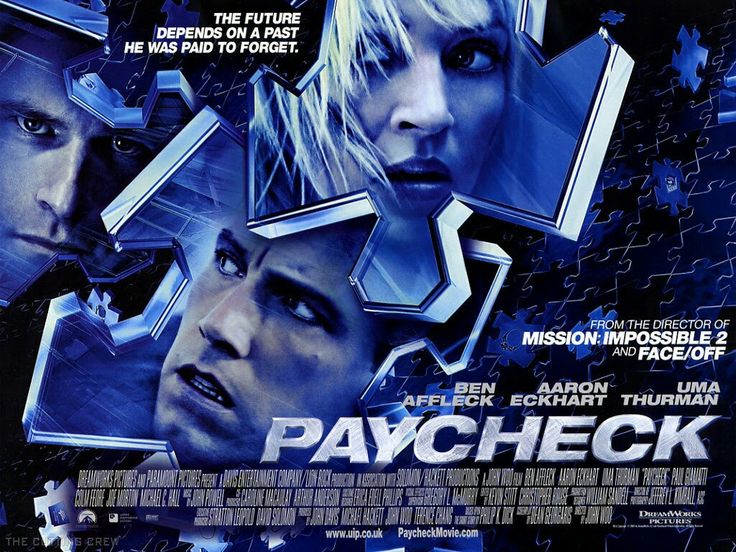
Paycheck

Surprisingly enjoyable.

Paycheck film poster

Essentially the plot runs like this: Ben Affleck reverse engineers technology and then has his brain wiped so that he can’t remember doing it. Of course, something happens and he has to remember. Luckily, he sent himself clues and we all get to play along and workout what the twenty items all mean and how he will (more-or-less) save the world.

Surprisingly enjoyable.

Pop Up (Up and Away)

There has been great discussion recently about pop-ups. Are they doomed? Well, it’s a subject close to my heart as, being in the online advertising/research business for many years, they have become an important part of my life.

I have to ask, how they can properly be controlled? They are a useful marketing tool and can be useful to site publishers outside the advertising arena but some companies have exploited them far too much. MarketingFix notes that Netscape has announced it’s going to start offering the facility to block pop-ups. Interestingly, the pop-up filter has to be enabled by the user and then “Once enabled, the filter is preset to allow pop-ups on some sites, including several of AOL’s own properties”

I only wish it was possible to stop the multiple spawning.