A New Identity

UK’s digital ID revival rekindles old doubts about trust, privacy, and control.

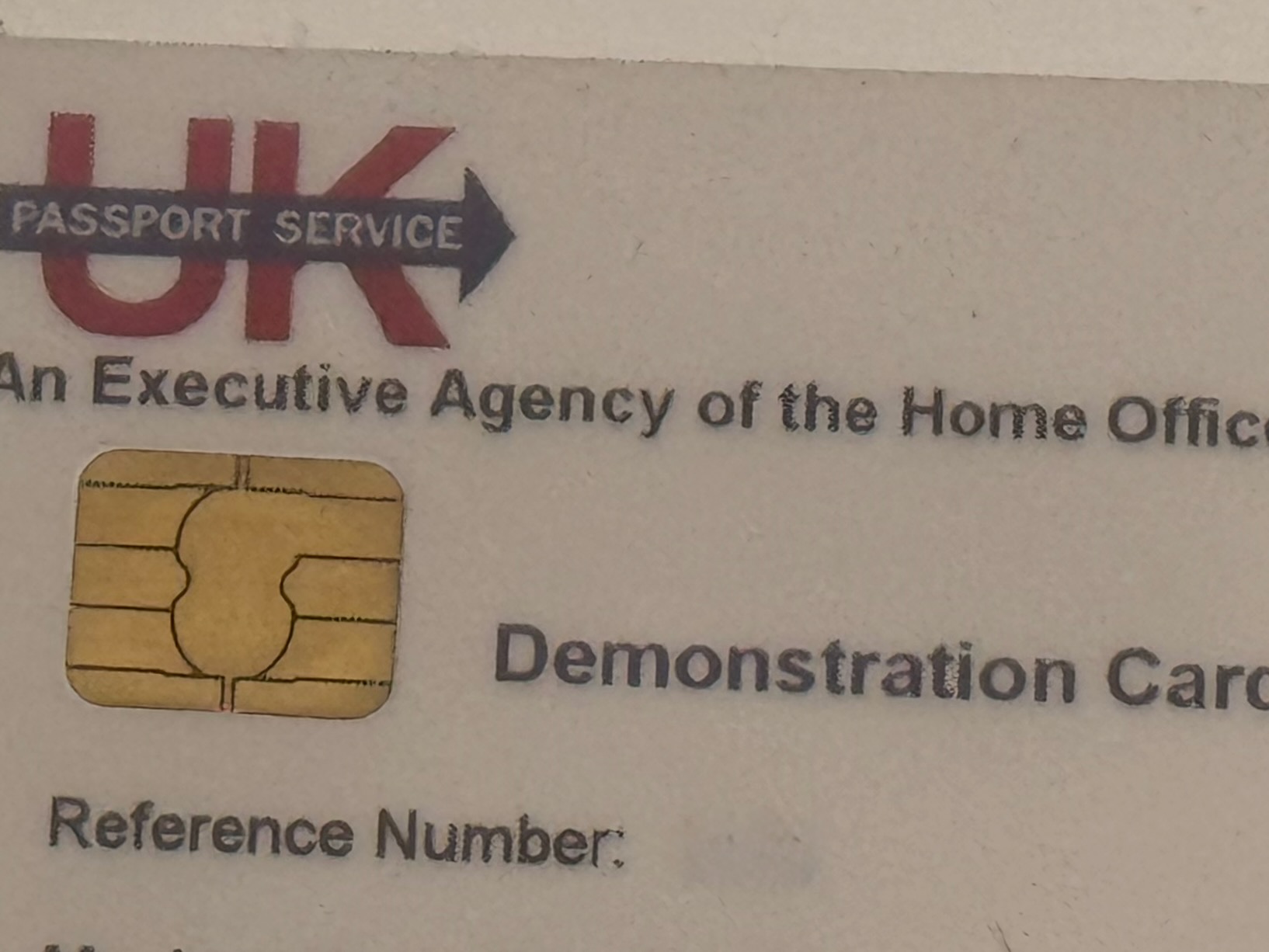
A close-up photograph of a worn card showing the UK Passport Service logo in red with an arrow, text reading "An Executive Agency of the Home Office", a gold EMV chip, and the words "Demonstration Card" and "Reference Number:" printed below
A relic from the UK’s 2004 biometric identity card trial – an official demonstration card complete with chip that served no purpose beyond showing what the future might have looked like, had it ever arrived.

Back in 2003, I wavered. The government wanted us to carry ID cards; I wasn’t convinced, but I wasn’t completely against them either. My main worries were privacy and the lack of proper debate. It felt like something too important to be slipped through quietly. I did take part in a 2004 Passport Service trial of biometrics, which I imagine paved the way for the biometric border controls we have today. But they did give you a little identity card: it couldn’t be used for anything, but it might have been the start of something.

Now, more than twenty years later, here we go again — but this time it’s not a plastic card in your wallet; it’s a digital identity on your phone. The sales pitch is familiar: security, fraud prevention, migration control, efficiency. The packaging has changed — “digital wallet,” “verification services,” even the cheerfully tabloid nickname “BritCard” — but the underlying tension is the same. How much do we give the state in return for the promise of convenience and safety?

I can’t help but notice the parallels. In 2006, the Identity Cards Act received Royal Assent, yet the scheme collapsed under its own weight: too expensive, too intrusive, too unloved. Today’s plan is billed as leaner and smarter: no centralised biometric database (at least not yet), a free app instead of a paid-for card, targeted use cases like “Right to Work” checks rather than a universal compulsion. Progress, of sorts.

But the old worries remain. Function creep is the classic risk: once the technology exists, the temptation to expand it becomes irresistible. And for those excluded — the people without smartphones, the ones who struggle with digital bureaucracy — “alternatives” often mean long queues and clunky paper processes.

That temptation to expand is not theoretical. We’ve seen how governments argue for backdoors into encrypted messaging or demand that companies like Apple weaken their security “for national security reasons.” If a digital identity scheme exists, the same logic applies: today it’s Right to Work checks, tomorrow it could be banking, housing, or even access to encrypted communications themselves. The concern isn’t just about convenience or cost; it’s about whether a tool created in the name of efficiency slowly becomes a lever of control.

We don’t even need to speculate to see how this plays out. In Spain, where the FNMT digital certificate has become the de facto way of dealing with the state, the risks are clear enough. Citizens have been tricked by phishing emails promising their certificate was “ready” — only to deliver a Trojan instead. Trust has also been shaken when FNMT itself let key certificates expire, triggering browser warnings on its own official pages. A system sold as frictionless, in practice, adds its own layers of risk and dependency — and once embedded, it’s very hard to opt out.

So, two decades on, has my thinking shifted? Maybe only slightly. The technology is better, and in theory the safeguards stronger, but my scepticism hasn’t gone away. If anything, the experience of the last twenty years — hacks, leaks, surveillance scandals — makes me more cautious. A shiny app doesn’t change the fundamental question: do we trust the state with the keys to our identity? Or are we just being asked to trade the old plastic for a sleeker way of showing our papers at the digital border?

Still, at least if it all goes wrong, we won’t have to cut up a plastic card — we’ll just delete an app and hope the database forgets us too.


Weeknotes #88: social and sea views

A productive week filled with events, reflections, and engaging media.

Week commencing Monday, 23 September 2024

Motor boats on land in the foreground, the sea and blue skies beyond.
Pub with a sea view

Quantified Self

  • This week: Stand 7/7; Exercise 7/7 and Move 7/7. (100%). Morning walks: 0/3 (days in the office don’t count). Office days 2/5. Total steps: 66,251

Life

  • I could write about train delays and missed connections, but I won’t. Except to say it happened Monday, Tuesday, and Thursday. Although I also made the last train home on two of those days.
  • In the office for two days this week. Tuesday was a divisional ‘All Hands’, and there were sponsored drinks afterwards, which was nice. The later drinks started to border on discussions about agile development practices. I’ll admit I was part of it and shouldn’t have been (see below).
  • Thursday, there was a small team ‘All Hands’ followed by a leaving do. It was emotional at times.
  • Friday, a carpet was fitted. I saw it when I arrived in the evening. It’s very nice underfoot. We had more fish and chips.
  • Saturday involved a rail replacement service where we were the only ones on board, a nice walk, and lunch in a pub with a sea view.
  • Sunday was almost identical, but the pub and sea views were different, and the bus was the regular service bus (winter timetable starts today).

Media

Curns’ Ad Links for 29 September 2010

I Pressed The Button

The one thing that David Page probably should not have done when he thought he had uncovered a second world war mine in his yard was to push the button on the end of it.

There was an amusing news story last week about a man who pressed what he thought was a the trigger of a second world war bomb only to discover it was part from the suspension of Citroen car. I read it in a newspaper that was discarded on the underground on my way into work. It stuck in my brain, so I’ve been telling people about it for a good week now, and to share it with even more of you, I’ve found a link to the story in The Guardian.

Silent For A Week

I have been unintentionally silent for a week. It’s funny because I can’t pin down the reasons for the lack of attention this site has had in the last seven days or so.

Anyway, I finally caught up on some episodes of Sex And The City, which has been sitting on my SkyPlus, and it finally dawned on me (seemingly after the rest of the nation) that this is a fake advertisement for Absolut. How come I didn’t catch on to that then?

Am I the only person who thinks that the Absolut Hunk, Jason Lewis, has more than a passing resemblance to Calvin Klein model, Travis Fimmel. Perhaps it’s just me and the fact that long hair has never been much of a turn-on for me before. Anyway, apparently, Travis is playing Tarzan in a new Warner Brothers serial, which means there’s lots of reason to see him with no shirt on, should the show ever make it to the UK (although he is, apparently, not that happy about having to take his shirt off all the time – via Let Me Get This Straight).

Sill with the media, last Wednesday brought the revelation that one of my favourite broadcasters, Eddie Mair, is leaving Broadcasting House (the show and, maybe, the building). Sometimes you just can’t tell when he’s being serious or if it’s just his humour. Anyway, don’t miss his final shows on Radio Four, Sundays.

Media Guardian’s site (source of the above) also brought us an interesting profile of Graham Norton (originally from yesterday’s Observer) talking about his forthcoming attempt to break into America. It seems he has developed quite a cult following in the US (Jase is a big fan), and perhaps, it might not be too bad for the UK to take a little break from Graham. I really miss the fact that the guests on the original So Graham Norton shows didn’t know what they were getting themselves into. Nowadays, they’ve either done it before or been warned in advance. I’m sure he’ll come up with something to move the show along, and I think it’s probably a very wise thing for him not to start on one of the big US networks.

Which brings us, more-or-less, to today and the very good news that London’s Mayor is stopping those advertisements for holiday companies that say things along the line of “romantic, mixed-sex couples only”. Sandals, the resorts in question, advertise under the slogan, “Love is all you need”. Yeah right. [Source: The Independent]