Weeknotes #190: control and evacuation

Birthday adventures, theatre, music and unexpected detours made everything memorable.

Week commencing Monday, 7 September 2026

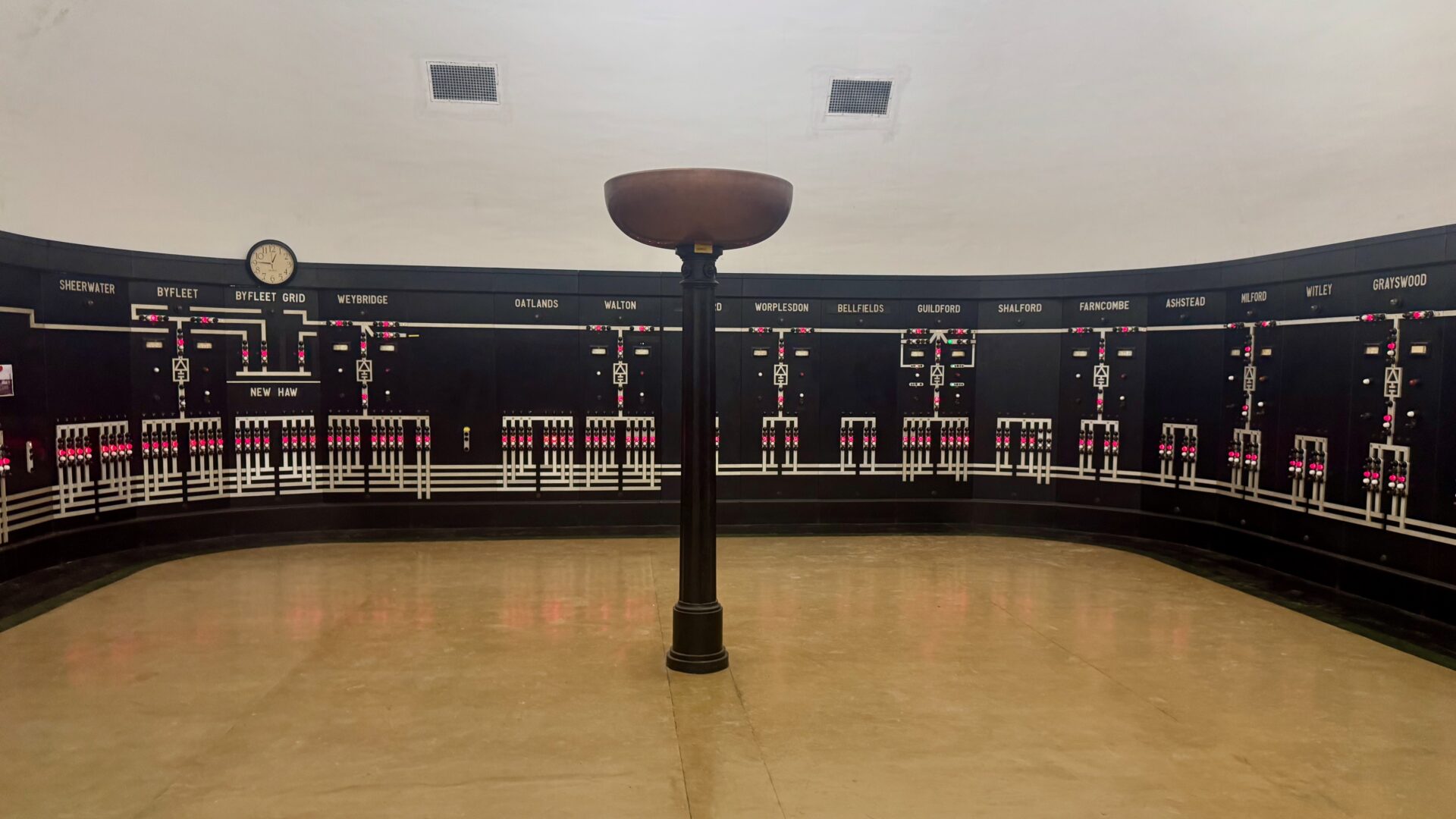
Interior of the 1936 Southern Railway electrical control room at Woking, with illuminated railway power diagrams around the curved walls and a large Art Deco uplighter beneath the domed ceiling.
The preserved Southern Railway electrical control room at Woking.

Quantified Self

  • This week: Stand 5/7; Exercise 4/7 and Move 4/7. (62%). Morning walks: 0/3. Office days: 2/5. Total steps: 53,592. 18.3 hours in meetings.

Life

  • Sedentary start to the week. At least I had my Tai Chi class on Zoom on Tuesday.
  • I’ve never been a big fan of foldable phones; I’ve always thought they were flimsy, but the promotional video and demo at this week’s launch of the iPhone Duo looked more compelling than I expected. But, at least for now, I don’t think it’s for me. One day?
  • Thursday, I know we need rain, but perhaps not on my head at that time of the night.
  • Related, I stood in the entrance of Wood Lane Tube, talking longer than I should have done, because by the time I’d walked round to Shepherd’s Bush, I was soaked through to the skin, and as I was crossing the bridge towards the platform, I watched the last train of the evening depart.
  • Relatedly related, I ended up in a FreeNow cab, which worked well. Maybe they are my new go-to ride app.
  • Unusually for a Friday, I went into the office. I decided to go in later than normal, assuming Fridays on the trains would be quieter than the rest of the week. That turned out to be a bad assumption. Not only were they much busier, but they were delayed, and we were being shuttled between platforms 1 and 17 at Clapham Junction, waiting for a train up to Shepherd’s Bush.
  • Friday evening, to see Sinatra the Musical: the story of Sinatra from the 1940s to the early 1950s, which opens with his Paramount-era stardom, the Ava Gardner scandal, the resulting commercial collapse, and his comeback. It doesn’t cover the Rat Pack years, and I think that made for a good story. He didn’t come out of it brilliantly, but not as badly as the story might have made him.
  • Also, on Friday, I published a thing about the world’s most preposterous song.
  • Birthday Saturday, a visit to the former Southern Railway electrical control room at a special open day. The control room itself is a large oval room with a white domed ceiling and a small central switchboard/control desk. Poles hold copper dishes that light the room from uplighters, rather than fluorescent tubes. The walls are lined with black control panels, each corresponding to a substation along the line. Everything was left as it was in 1997, but very much disconnected. It was beautifully Art Deco and designed to be looked at, which I guess explains the Grade II listing.
  • Birthday Saturday, lunch at Loft Sky Bar on top of the Hilton in Woking, a place with incredible views over Surrey. We could see one of the roller coasters at Thorpe Park, a tower at Heathrow and some buildings on the Wentworth estate.
  • Related, at the end we were asked to evacuate via 22 flights of stairs. I have no idea what happened, and we could see nothing, but a fire engine greeted us as we left the building.
  • Birthday Saturday, Lil Nashville in Chiswick. BBQ brisket nachos, loaded with hickory-smoked brisket, were a great sharing plate. Kerryl was performing when we arrived, and then The Wranglers took the stage with a mix of covers, including a tribute to Dolly Parton, and their own material. It was a really fun evening, and I’m glad we got to go.

Media

  • Finished Ride or Die. It’s very much set up for the next series. I hope they make it.

Last Week In Digital Advertising #5

Video is, of course, a popular topic in digital advertising. It’s rapidly evolving, and we’re seeing strong adoption from both those of us watching and those buying & selling in the space.

Last week’s Last Week felt a little like a bumper edition because there seemed to be so much I didn’t have space to mention. One item stands out and deserves a mention. The UK Advertising Standards Authority (ASA) extended its existing self-regulatory rules for digital media to cover advertisers’ own websites and advertiser-controlled marketing communications in other non-paid-for space, say the UK IAB. That should be welcome news to marketers because a few rules are good boundaries, aren’t they? The move got a lot of coverage, but it struck me that there was little mention that the ASA already has a remit in the digital space, and I would have been interested to understand what they had discovered, since they’ve been following a digital path.

Rules are good, but, perhaps to contradict myself a little bit, I can’t help but agree with Tim O’Reilly, CEO of O’Reilly Media, who, in the light of the Federal Trade Commission’s discussions around privacy regulation, is quoted on internet.com saying,

“I’m really worried because it’s so important when we enter a new technological era to realize that there will be mistakes,” O’Reilly said. “It really worries me when we see this rush to criminalize mistakes as we are starting to enter a new world that we don’t fully understand.”

So, somewhere we’re looking to find a balance. I was particularly impressed on Friday by a post on the Ghostery blog that was particularly open about their privacy policies and why they’d like us all to opt in to a data collection exercise. Ghostery is free to use, but it’s not free to maintain and make better. We’d really like you to participate in GhostRank, because it’s safe for you, and they go on to explain their data collection policies. The main point: collecting the data supports this free tool. Ghostery, if you don’t know, is a nice little browser plug-in that tells you what tracking pixels, beacons, and other such things are on any given website. It’s very useful, and I’m more than happy to send them some data in return.

I’m not sure I’d heard of Borrell Associates until last week (when I quoted their report that predicted a rise in online display targeting), but they continued to get coverage for their work this week. I noticed brand-e.biz picked up on the video aspect of their report, noting that the “streaming video format is expected to continue its dramatic growth, increasing more than 60% to $5.6 billion next year”.

Video is, of course, a popular digital advertising topic. It’s rapidly evolving, and we’re seeing good adoption from those of us watching to those buying & selling the space. My new favourite website name, newteevee, quoting ComScore, reported that 1.4B minutes of live online video were watched (in the US) in July. That’s an impressive 600% growth, which Business Insider happily charts for us. Meanwhile, in the UK, the IAB reports that almost 50% of the media buyers polled in a recent survey said they planned to spend more money on Video On Demand over the next six months.

Broadcast Engineering, a journal I don’t tend to follow, reported, The number of U.S. households with broadband service that watch full-length online video on the TV will reach 57 million by 2014, according to a new report from researcher In-Stat which, if the trend is followed this side of the pond, is great news for Yahoo!, who, according to reports, plan to launch their Connected TV product in Europe at the beginning on 2011.

YouTube rolled out some new targeting features (basically a set of restrictions on age or page URL that will go some way towards helping brands feel safer advertising on the platform) and, by a happy coincidence, that TippEx bear ad (viewed on YouTube) went viral and managed to show that online/digital video ads can be so much more than running your TV spot. I liked it although I am not sure how it would stand up to repeat viewing.

Hearing that newspaper ad revenues have slumped isn’t really a surprise to anybody. In my opinion, a Newspaper Association of America report (quoted by Reuters) saying that newspaper “online revenue rose nearly 14% to about $744 million in the second quarter compared with the same period a year ago” can only be a good sign. If newspapers can eventually see a way through with digital advertising, what will that mean for paywalls? I read reports of a crack in a pay-wall on Friday. Is there more to come on that?

Borrell got another mention, over at MarketingVox, in an article that also hinted at the “commoditisation of display advertising”. I think that risk is real, but innovation remains strong in the digital display business, which should hold off any commoditisation for at least a while. Picking up on the targeting theme that I had things to say about last week, MarketingVox noted that it was the technology “which of course, powers the targeting” that can drive display’s growth. I’m not sure it’s the most innovative thing I’ve seen; after all page-peels and interstitials have been around for a while, but I do like Undertone Networks’ PageGrabber format that they announced this week. Of course it’s not all going to be technology and big formats that get brands online. Zach Coelius, CEO of Triggit, has a good piece on how to bring brand dollars online. Reassuringly, display ads are still worth buying (if you do it right), according to Mashable (The Future of Ad Agencies and Social Media).

In the section that’s never before been titled”stuff we didn’t know last week”, we discovered that women “deliver a 23% higher click-through rate than men, but after clicking, men follow through with an action” (Bizo via MarketingVox); 78% of millennial internet users engage with social media compared to less than 45% of their parents’ generation (Harris via eMarketer) and, a local UK stat, more than 30 million UK individuals now go online every day (ONS via eMarketer) but three-fifths of people 65 and older have never gone online. As part of a feature on Google advertising their own display business, we were told Google’s display network consists of over 1 million partner sites (New York Times). They may just need to grow that number, as another chart-of-the-day told us that time spent on Facebook was greater than time spent on Google sites in the U.S. in August for the first time in history. That figure was helped along, no doubt, by news that older users have been rapidly adopting social media (Pew Internet & American Life Project via Adotas). Facebook’s growth would appear to be unstoppable for now.

Finally, back to privacy. Ars Technica reported on another cookie type that’s not cleared by standard browser settings; this one utilises HTML5’s local storage options. Also on a privacy theme, Adotas ran an interesting piece on retargeting, which did summarise part of the story they told with, “What actually seemed to creep her out was that Internet display advertising was effective”. Eric Picard, on iMedia Connection, might have summed it up best with, “when we make them [consumers] feel like someone is watching over their shoulders as they do things online, make no mistake — they resent it.” And therein is, perhaps, a lesson for us all. Effective advertising is likely to get attention, and that means we’d better be doing it properly.
Sshh. Don’t Mention It.

There are some things in life that it is not good to mention in polite company. Heathrow Airport is one of them.

They used to joke that you shouldn’t mention The War (at least not in the same breath as the English World Cup victory of 1966). Maybe they still joke about it; I am not sure.

Then again, perhaps it wasn’t a joke. Maybe people were serious about that and, in polite company, you shouldn’t mention The War. I thought it was a joke because Basil Fawlty first taught me that mentioning The War was not good, although spilling soup is not good, and he didn’t seem overly concerned about pouring hot tomato down the front of your trousers. So, I may be wise not to cite Basil Fawlty as a mentor (and wiser to steer clear of such conversation topics).

Still, it’s fair to say that The War has been replaced in recent months by Heathrow Airport. It may seem odd that a stretch of land to the west of London can be compared to one of the most terrible events of the 20th Century and I am obviously not comparing the great evil which attempted to take Western Europe to a mass of concrete and jet noises in any way as being on a similar scale but take it from me you don’t want to be talking about either.

You see, right now, people will work themselves into a purple-faced rant about how terrible Heathrow is in a way that makes me wary of mentioning it. You should not make the mistake of saying the words ‘flying to Oslo’ and ‘terminal three’ in front of anybody who has been out to, what was, the Great Western Aerodrome for you will be subjected to an outpouring of such rage that you will wish you’d said something all together different (I wanted to use a comparison there to something truly awful but decided against it lest people think I was serious about the previous paragraph).

Heathrow has become the chattering class’ villain du jour (and you know it’s serious when you invoke a du jour). Nobody likes it. Ken Livingstone doesn’t like it. Kitty Ussher (City minister, did you know we had one?) isn’t keen, and former Chancellor Lord Lamont labelled the airport a “national disgrace”. Really, Heathrow is not winning a popularity contest right now.

The problem? Well, that depends on who you ask. To some, the airport looks shabby and not a giant gleaming temple to London’s greatness that some think it should be. To others, it’s the baggage (or lack of) that seems to cause consternation. While others think the queues are to blame. All of which is nonsense. Regular readers (well, the regular reader) will know I travel regularly on business, and I often go from Heathrow. And I have been laughing in the face of these naysayers for months. My mantra was ‘read the rules, and ye will have a speedy voyage’.

On recent trips, I have been astounded by people who were passing through. The large signage reads ‘only one cabin bag allowed’, yet there is a lady with three, and she’s getting frustrated that she’s having to go to the back and check the others in. Then it says ‘No bottle over 100ml’ and yet, lo, here’s some chap with a bottle of aftershave containing enough liquid to give us wave power for twenty years. Put your metal objects in your handbag before you go through screening? Well, it must be written in invisible ink given the number of times the alarms go off. We’d actually given these people passports.

I am a Heathrow fan and these people, as my mother would say, were just showing themselves up. Give yourself time, pack properly, and all will be well. At least, that’s what I had argued until Monday, when I headed for Oslo from LHR T3, where I was greeted by an enormous security queue and a probably very pleasant young man. You know the sort; his power simply oozed from his fluorescent yellow jacket.

I present to you, gentle reader, the man whose job it was to ensure the right people got through the queue at the right time. So, only people whose plane was leaving within the next two hours could join the line of passengers waiting to be scanned. The rest of us had to wait patiently until our time was called. A sound and reliable plan (and the lack of seating for the waiting crowds was not his fault).

“Not time yet, sir. Only planes leaving before half past,” he would say.

“Please come back two hours before your flight. We’re only letting people through then,” he added in a reassuring ‘you won’t miss your flight’ way.

All in all, a very sound and sensible approach to the growing crowds and the lack of resources to screen everybody quickly. No earlier than two hours. Please don’t cheat the queue. Get yourselves a Pret while you wait. Except for one little problem. The man charged with filtering stressed passengers and tasked with keeping the calm and encouraging the nervous flyers to wait until they still had two hours to get to the plane didn’t have a watch. Not only that, he didn’t have a clock. He had no clue about the time. You can imagine the rest.