It’s My Radio Station

I’ve been meaning to write something for quite a while about radio services in an age of connected devices and multiple music services. But news of Apple being awarded a patent to enable “seamlessly switching media playback between a media broadcast, such as a radio broadcast, and media from a local media library” and the subsequent Media UK discussion finally got me to start writing.

I’ve been a radio fan for most of my life but lately my love affair with the medium has turned into a marriage where we don’t speak much anymore. So much radio seems to be back-to-back music (which my phone does better, thank you) or back-to-back Big Brother chat (or back-to-back songs with Big Brother chat breaking them up) that I normally work with iTunes running. I listen at breakfast for an hour or so and that’s about it. Perhaps that’s fine with the industry, I would hope not.

I read, occasionally, an argument from radio people that the only way to compete with music services – such as Spotify or Pandora, or personal libraries like iTunes – is with the bits between the songs (the entertainment that I don’t store on my iPod). That seems a reasonable position. So, I’ve been wondering what would happen if there was a ‘mashup’ between radio (for the entertainment bits) and my music player (for the songs I really like)? The technology can support it, Apple’s patent just reminded me about it.

Simply put, my radio station would allow me to set preferences allowing me to opt-in to news (say, every hour); to add local travel news every 20 minutes (between 0700 & 0900 if there was something to report); to add sport (every 2 hours except during the Olympics when I’d change it to more often) and to add celebrity news (once per month). The rest of the time music is coming from my local music library of tunes I want (sometimes I select individual tracks or albums; sometimes I pop it onto random). The content is downloaded in the background and inserted between the songs I’m hearing. Of course I could opt-in to a bunch of other things if I wanted to (one new music track every 90 minutes; breaking F1-news as it happens; interviews with artists in my library or a ten-minute blast of a phone-in). All of these things could be surrounded by an ad break or sponsors (as they are today) but the station pays no music royalties, bandwidth costs are limited to only updating content and if the connection is down the music keeps coming.

Take it a stage further and my news comes from LBC; travel news direct from Transport for London, sport from Sky and, perhaps, a film review from 5Live. If the content is what I want, I’d choose it and hear supporting commercials (or promos, if it’s the BBC). I don’t need a presenter telling me what I just heard, my phone shows that to me quite happily so the entertainment is more than being successfully able to ‘hit the vocals’ with station name-check.

I don’t see that it would be hard for Spotify or Pandora to add these services in now (perhaps they already are and I’ve missed them) but experience with this kind of content is certainly at radio stations today (and, if we’re honest, RDS has been allowing it for years if you’re in a car and listening to your own music).

Of course, radio’s real advantage is that there’s no effort involved to turn it on and start listening; this would be an effort to set-up and configure. If I wanted live presentation then I’d still switch to radio services but, this way, I get news & entertainment on a schedule I want and it really would be a station playing today’s best music mix (just for me).


Elsewhere: New Apple Patent Could Kill Commercial Radio

Over at Media UK’s radio discussions section there’s a thread about a new patent issued to Apple that allows for “seamlessly switching media playback between a media broadcast, such as a radio broadcast, and media from a local media library”. It reminds me that I have some thoughts brewing on this (update: my thoughts are now written-up here) but this is what I added to the thread (with the typo seen at Media UK cleaned up).

An obvious use of this tech would not just be for targeted ad insertion but also for some kind of content switching when a user’s streaming connectivity drops. Using Apple’s Genius functionality & a station’s playlist, an app could store a list of station-appropriate tracks that are already on my device and seamlessly switch to them. Let the station cache a few idents in the app and I may never notice I’d lost connectivity driving through the tunnel again.

Take it a stage further; could a station save on music royalties (and the listener on bandwidth costs) if it only provided the links and all music tracks were sourced from the user’s local music library (of tracks they own)?

The future of radio is at an interesting point. Even as a self-confessed radio geek I am finding that I spend more time listening to music and entertainment services that could not traditionally be called radio. More to come on this.


Elsewhere: Will 2011 be the year that internet radio will pass traditional radio?

Then there are habits to break. Others here have touched on the car radio but broadcast receivers are also clock radios, shower radios, kitchen radios etc. I imagine substantial number of these form part of a routine and there’re not easy, nor cheap, to replace quickly. And why would you if it’s still working well for you?

In the spirit of keeping things in one place. I just answered my first question on Quora, a question and answer website that’s hooked into your social network – via Facebook and Twitter. I imagine it’ll become overwhelming pretty quickly as it needs much more engagement than Twitter so, should all the people I follow on Twitter start posting questions, I’m going to end up swamped with questions. Still, so far, so interesting.

The question: Will 2011 be the year that internet radio will pass traditional radio? [link]. And my response:

I can’t see internet radio will pass traditional radio for quite some time.

There are too many broadcast radio (AM, FM, HD, DAB) receivers out there for this to happen quickly, and – even today – the number of FM receivers continues to grow as they are added to mobile phones, MP3 players etc.

Right now, broadcast radio remains more portable (mobile data is inconsistent) and FM receivers can generally handle a poor signal quality in ways that data connections don’t seem to be able to do (at least, without resorting to continual re-buffering).

Then there are habits to break. Others here have touched on the car radio but broadcast receivers are also clock radios, shower radios, kitchen radios etc. I imagine substantial number of these form part of a routine and there’re not easy, nor cheap, to replace quickly. And why would you if it’s still working well for you?

(There are some interesting figures for streaming & mobile listening produced in the UK by the Absolute Network and analysed at James Cridland’s blog.)

You can add something to the answer by joining quora and going here.

Timmy On My Tranny

There was something faintly exotic about the mad-cap antics and celebritry filled audio that came out of the radio. I imagine today it would seem tame but our only chart fix was Look-In magazine and, when I discovered it, Smash Hits.

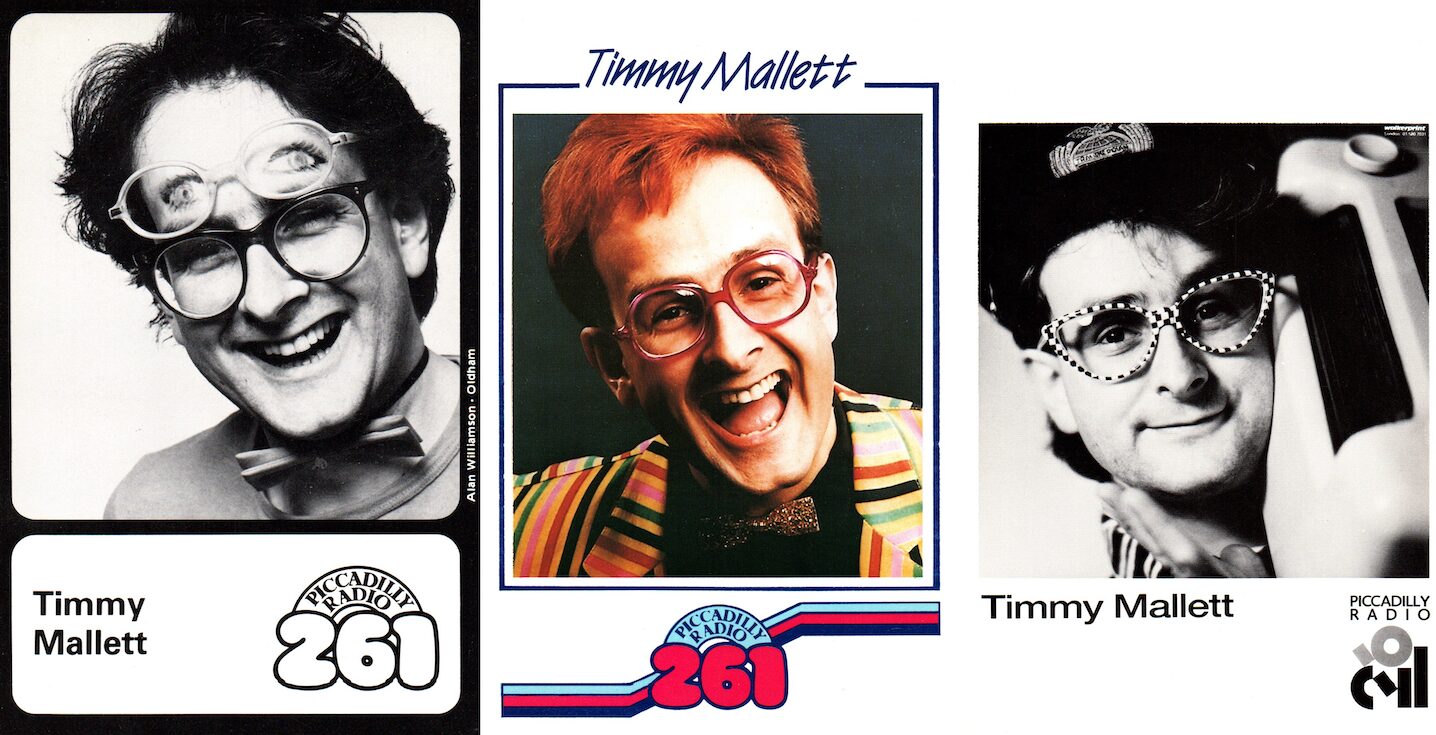
Timmy Mallett's autograph cards from Piccadilly Radio in the 1980s
TOTT

I’ve been re-reading my piece about radio and how my love affair with the medium started; all prompted by a certain person making a big splash on a recent TV show.

It occurs to me that in my radio reflection, I listed names that, even today, many would be familiar with, and I started to wonder who in that list jumped out when when people read it. I’m fairly certain one jumped out to many: Timmy Mallett. Whenever I tell people that radio story, Timmy Mallett (along, possibly with Chris Evans) is the name that makes people chuckle most. I guess people think of Wide Awake Club or the spinoff, Wacaday. But those aren’t my memories.

Timmy Mallet was enormously famous in the North West for his evening show – Timmy on the Tranny – on Piccadilly Radio. At least, he was famous at my school which – to me – meant everybody in the world must have known who he was. And years, and a little rationale, later suggests that we were right. Timmy Mallett won Smash Hits awards which, given they were voted for by national audiences (many of whom wouldn’t have heard his shows), seems to suggest a good few others listened-in. Aunty Boney, Padlock the Poet and Chris Evans’ Nobby No-Level where characters that filled out our homework evenings. And then we’d talk about them in school the next day.

To me, Manchester seemed a million miles away from Wigan but had the advanatage that the biggest stars of the day played Mancheter gigs (I don’t recall anybody playing Wigan, not even Kajagoogoo whose front man, Limahl, hailed from somewhere up the road. I think Bucks Fizz played a sports centre once just outside Wigan, but I may have invented that). And long before I would be able to go and see bands, they all visited Timmy Mallett at Piccadilly. No interviews from studios many miles away, if a chart act played Manchester they visited Timmy (or, at least, all the chart acts I cared about as a teenager did). There was something faintly exotic about the mad-cap antics and celebritry filled audio that came out of the radio. I imagine today it would seem tame but our only chart fix was Look-In magazine and, when I discovered it, Smash Hits (of the awards fame).

So, I guess, well done to Timmy Mallett for getting close on I’m A Celebrity but, to me, he’ll always be the madcap voice coming out of my evening radio. And without a foam hammer anywhere to be seen.

A Ten Year Old’s Happiest Memory

The happiest memory I have is the time I visited the studios of Piccadilly Radio in Manchester in the Easter holidays in April 1981. We were shown around by Julian. We got there ar quarter to four.

As I’ve prevously written, when I was much younger  I was a huge fan of Mancheter’s Piccadilly Radio. So much so that when I was eleven I spent hours writing a letter asking to see their studios. That didn’t quite work out but I got there anyway. A couple of days ago I was sorting through some old papers and discovered that, apparently, when I was in class J3C at Standish High School I declared that visit to Piccadilly as my happiest memory. To read it amuses me now but it’s recreated here for nostalgic reasons:

My Happiest Memory

The happiest memory I have is the time I visited the studios of Piccadilly Radio in Manchester in the Easter holidays in April 1981. We were shown around by Julian. We got there at quarter to four.

First we went into the master control room in which programmes are recorded and it is where the producer sits to make sure the programme is runnning smoothly. At four o’clock we went into studio two w(h)ere DJ Phil Sayer was getting ready for the second hour of his show. As the news was on he told us how the cart machines work (cart is short for cartridge). The carts are jingles and advertisments played on the radio station.

As Piccadilly is an independent radio station it plays advertisments to cover the running costs. Businessees can buy an advertisment to be played at the time of day they pick. It can cost them well over a hundred pounds! There are a maximum of nine minutes of advertismentsin each hour.

After the news finished and Phil faded down the record he announced the first competition of the day, ‘Beat The Intro’ in which you have to guess the name of the record before the words start. It was a phone-in competition but nobody cuuld get through because Julian had pressed some buttons and jammed the lines. When somebody got though, Phil read out one name, there was a crackle, and somebody else got on the air. Phil Sayer was in a panic so he put another record on after the competition and looked in the control room window, saw what happened and told the phone girl to put things right. We left quickly …

Julian then showed us the editing and commercial production booths. When we left my dad bought me a t-shirt. I also got a lot of stickers.

It was a very interesting day. We were there about an hour.

June 2009: I scanned a photo of the original, my ten-year old handwriting isn’t that bad, really.

Radio Reflections

Ask anybody who’s known me for some time and they’ll eventually mention I can talk about broadcast radio a little too much. I think my true anorak tendancies died a few years ago but radio is, to me, the best of all media rolled into one universally accessible package

Piccadilly Radio Logo
Piccadilly Radio

Ask anybody who’s known me for some time and they’ll eventually mention I can talk about broadcast radio a little too much. I think my true anorak tendencies died a few years ago but radio is, to me, the best of all media rolled into one universally accessible package. The best radio sounds like it’s being created for you and, even if the presenters are talking about people who’ve written, emailed, texted (is that even a word?) or called-in, it’s still yours. People on the radio play records for you, they read the news for you and they interview famous people just for you. It’s there when you get-up (and you don’t even have to open your eyes to be part of it) and can be there throughout the day. At various times in the day you pay a little more – or a little less – attention but it can always be with you. You can listen alone or in company, on the move or at home, you can focus and enjoy or it can be your ever-present background.

I grew up listening to the mighty Piccadilly Radio which, with many, many, fewer stations on the dial back then could be heard across the whole of the North West of England. Sure,there was Radio City from Liverpool and, er, Manx Radio, but there wasn’t anything else until you hit some far-off Yorkshire town or even Newcastle, or maybe Wolverhampton if you were heading south. And certainly nothing on my dial that played pop music in crystal clear FM-stereo (I thought this was impressive despite only owning a mono receiver). If the stories are true, ‘Piccadilly, luv’ became shorthand for £2.61 in some northern shops (261 being that crackly medium wave frequency that disppeared when you drove under motorway bridges and was, therefore, not quite modern enough for a ten year old).

You can, no doubt, read in many other places that there was a lot less media back then but the lack of other media isn’t – by itself – that important. To me, the important aspect of that time is that there wan’t anything that a teenager like I was becoming could consider to be theirs. There were no teenage bedroom televisions and only three channels if we could have had them; no connected computers of any sort, gaming or otherwise; no texts or social sites. Books were for libraries and mobile phones belonged on Star Trek or, maybe, Tomorrow’s World. In fact, nothing that was yours aside from a radio or, perhaps, a record player and record players relied on a handful of vinyl you might be lucky enough to own and were not exactly portable. Pop music radio from the BBC was on that crackly old medium wave and we were supposed to like Ed Steward’s Junior Choice. No, for me, interferance-free pop music on 97 MHz.

So for my early teenage years radio became mine, as I imagine it did for millions of others. Pete Baker, Phil Wood, Mike Sweeny, Phil Sayer, Timmy Mallett, Chris Evans, Andy Crane, Susie Mathis, Jim Reeve, Mike Shaft, John Evington, Steve Penk, Tim Grundy, Gary Davies and Dave Ward (along with countless others) became part of our lives; voices that were simultaneously funny, informative and friendly. Piccadilly’s strapline when I first started listening was ‘Your Music & Your Friend’ and it certainly felt that way to my teenage ears.

As with all memories from your formative years, things that once seemed magical are still vivid and I can quite easily remember the excitement: the excitement of the first time I listened to late-night phone-ins using headphones illicitly under the bed covers; the excitement of seeing the DJ’s photographs plastered all over the front of the studio building; the excitement when it was announced Piccadilly was having a ‘Wigan Week’ and we’d see their branded radio car in town and even the excitement of seeing Gary Davies on the Piccadilly road show bus at Haigh Hall. If people are to be believed, rock’n’roll had an effect on a generation in the 50s & 60s, and later, it was Pirate Radio. Today, is it an MTV or something online that people will be looking back at? But for me, Piccadilly is etched in my memory in a way that I find myself recalling snippets like they were yesterday (Susie Mathis’ ‘I’m gonna run, run, run a marathon’ anyone?).

I’m not one of these people that think radio should be like Independent Local Radio (ILR) was back in the late 1970s or early 1980s. The world has moved on. Full service commercial radio of the old style doesn’t have a place anymore but that doesn’t mean that the unique qualities of the medium don’t apply. Despite all the digital, multiple-platform desires of an industry, radio’s ubiquity is its most import asset. Good quality programming still counts. The personal music player (Walkman, Discman or iPod/mp3 player) have been around since the early 1980s. It hasn’t killed the industry yet and, I don’t think it will. Even though I have a computer showing 30+ days of music, I am set here listening to the radio.

I don’t think it’s right to be sentimental about radio. I know that teenagers today aren’t going to have my relationship with radio because their world is vastly different and much more connected but I genuinely believe a cheap device that plays music you like, and can go anywhere, has the power build reationships better than almost any other – except, perhaps, for actually meeting people. And even there, radio can be part of the real-life conversation.

Yes, I can still take along a tranny and listen to my friends (and I really do mean that in the radio sense).

Reduced Commercial Clutter

Reduced commercial airtime also makes those ads that are aired stand out more. Won’t advertisers end up paying a premium for this? Maybe not in the short term but I would have thought that in the long run it could work. But then again, what do I know?

On Monday I mentioned Capital Radio’s decline in the London market but completely missed the comment piece by Paul Robinson on The Guardian’s site. He notes that slashing commercial hours could ‘knock about £7m off Capital’s top-line revenue in 2006’. This I find interesting. Reducing commercial clutter (as it’s called) will hopefully drive bigger audiences. Reduced commercial airtime also makes those ads that are aired stand out more. Won’t advertisers end up paying a premium for this? Maybe not in the short term but I would have thought that in the long run it could work.

But then again, what do I know?

Fined. Big Time.

When I was a child, my favourite radio station was Manchester’s Piccadilly Radio. To me, it was the most exciting station in the world.

I noted some newsworthy stories about the radio industry yesterday but forgot to mention another from last week. When I was a child, my favourite radio station was Manchester’s Piccadilly Radio. To me, it was the most exciting station in the world. Pete and Geoff, who I mentioned yesterday, started their award-winning partnership on that station. It’s now Key 103 and last week was fined the biggest ever financial penalty imposed by a regulator on a UK radio station [source]. Nothing really to add to that but I wanted to note it.

All Change At Capital

When I first came to London, everybody listened to Capital Radio. Everybody talked about whatever Chris Tarrant did in the morning. That was a very different radio world with much less competition in the London market. Right now, I don’t know anybody who listens

cap media logo
cap media

When I first came to London, everybody listened to Capital Radio. Everybody talked about whatever Chris Tarrant did in the morning. That was a very different radio world with much less competition in the London market. Right now, I don’t know anybody who listens. Last week, GCap Media – which own Capital FM (as it’s now known)- announced a slump in profits and has promised a radical overhaul of the station. The new management are blaming the old management for the slump. Well, I guess they would, wouldn’t they?

In other news, Pete and Geoff announced they are going to split their award winning partnership and only one of them is to stay on at Virgin. I only listen to part of their show each day but have always found them quite good listening.

Talk Radio

Saturday morning talk radio.

Saturday morning and, for some reason, I was up early so I decided to do a little bit of work. In the background I’ve had the radio on. Listening to Vanessa Feltz on BBC London and then Wendy Lloyd on LBC. I guess the topics must have been interesting (why do we seek to impress our parents and why don’t kids do enough around the home – to name but two) but, regardless, I thought both programmes were presented in an intelligent and thoughtful way. And that’s not what you always expect from talk radio. I read earlier in the week that David Prever had left LBC to be the new breakfast host on Smooth FM. That might make the London breakfast market interesting.

Audience Up

After a shaky start to the summer, which saw big names Danny Baker and Jon Gaunt depart, the station turned its fortunes around, with a new line up including JoAnne Good taking the Breakfast show chair and Jono ColemanÂ’s return to the BBC London 94.9FM airwaves.

According to the press, ‘BBC London 94.9FM has recorded its second highest audience figures ever, with 561,000 tuning in every week, according to the latest RAJAR figures covering July to September’. As I have mentioned several times, I love BBC London right now. It was sad when Danny Baker left – his was one of the most innovative mornings shows – but JoAnne Good and the team have been excellent. I am very worried about Jono Coleman as I am not very keen on him as a broadcaster but I guess we’ll just have to see what the rest of the year brings [source].

Danny Baker Shuts Up His Tree House

Danny Baker is taking what the station described as “an extended summer holiday” after three years on his BBC London breakfast show, during which he will work on a film script for channel Five.

So, I get back from my vacation and try to settle into my regular routine. Firstly, it’s disrupted by a strike by BBC jornalists although I was amused that somebody quipped you could hardly tell and thus proving they’re over-staffed anyway.

I digress. What I came back to was the news that Danny Baker won a Sony Radio Award and prompty went on to quit his breakfast show:

The ebullient presenter is taking what the station described as “an extended summer holiday” after three years on the show, during which he will work on a film script for channel Five.

He told listeners: “We will reform and come back in another shape one day. People thought we were crying wolf … we were just crying. We’ve been saying it for a while now. We’ve been doing it for three years. We’re packing up the tree house at the end of the month.” [The Independent]

Now that’s going to mess up my morning routine something rotten – there’s nobody else on air anything like Danny Baker. It’s not just the fact that he is the only speach-driven presenter that’s not news-based it’s because he is bloody entertaining. Ahhh. I think a paragraph from another article in The Indpendent says it all,

Such confidence that radio requires unique skills will always make Sony award-winning breakfast presenters highly sought after. But they have to be carefully looked after when they arrive. Getting up in the middle of the night to sound fresh at the microphone can become gruelling for even the most dynamic broadcasters. BBC London’s breakfast ace, Danny Baker, proved it with his response to Sony Awards triumph. Named DJ of the year, beating O’Connell, Baker announced his departure from the airwaves within the day. He is going to write a film script for Five. Radio executives searching the market for proven breakfast talent are hoping it flops [The Independent]

Less Clutter On The Air

At last somebody in the commercial radio business has noted that one of biggest reasons to turn off isn’t poor music policy, crap jokes or bad station identity – it’s annoying and repetive radio commercials.

At last somebody in the commercial radio business has noted that one of biggest reasons to turn off isn’t poor music policy, crap jokes or bad station identity – it’s annoying and repetive radio commercials. Somebody in the UK should take on board the Clear Channel approach of trying to make better radio ads and brodcast fewer of them: “Radio is the most difficult medium because there are fewer senses to work with. For the most part, radio ads are a yawn” [source]. With online catching radio in terms of advertising spend (Britain’s Online advertising market will surpass the £500-million mark this year – Independent Online) radio’s revenues may be in for a rocky time. Inn the UK the Online industry may well surpass radio during the next 12 months so it’s important that the industry wakes up and does something to ensure that the recent history of growth and development can be sustained.

Digital Radio Lust

You will be aware of my love of radio and my delight at Pure’s other products: the Evoke-1 and the Tempus-1. I want a Pure Digital Bug radio. I can’y jsutify it. Is it the look or the features?

Adot’s Notblog discussed the concept of tivo for radio a few Fridays ago. This reminded me that only last weekend I had picked up a leaflet for Pure Digital’s Bug in a store. You will be aware of my love of radio and my delight at Pure’s other products: the Evoke-1 and the Tempus-1 (actually, I never mentioned that I also have a Tempus-1). The Bug looks cool (it’s designed by Wayne Hemingway) and has a host of features (including some recording capabilities and radio rewind). I am not sure if I’ll actually invest in it (given I am running out of rooms to put digital radios in) but I will be keeping an eye out on the products that Pure come up with. I think Pure (or Imagination Technologies as they are also known) have some really imaginative products of high quality. They only lack one thing in their range: I wish they’d come up with a small, nicely priced portable radio that included FM for times when you can’t get DAB reception.