In February, I described a small project I developed with AI assistance. My aim was to build a tool that would find the things I had previously written online and published on that day, check the spelling and links in those entries, and produce a list of items needing correction. Running it every day has meant that I have been going through a large number of my own writing in small amounts. It has also given me a tiny nostalgic hit every morning.
What started as a simple bit of software now counts words, identifies topics and builds indexes, thanks to an AI coding agent. I could have tried to do all this myself, but it’s unorganised, spread across multiple URLs, and seems like more effort than it’s worth. This method does not feel irksome, and I get presented with a list of broken links, missing images, and spelling errors. I don’t really like that last bit. Pre-2000 me could have done with a spellcheck. Remember kids, some of us had it hard back in the days of dial-up!
Six months on, going through my writing has become the most interesting part of this exercise. I don’t know which part of me wanted to make a working archive; after all, the Internet wouldn’t have minded if I had simply deleted everything, but I do plan to carry out the full twelve-month cycle.
The entries include posts from February through July for all the years in the archive: 648 separate posts and just over 190,665 words. A number of the posts can be found on both my previous blog domain, musak.org, and curnow.org; I have counted the writings only once rather than praising myself twice. Fortunately, the small program checks both versions, so it has had to process more words than my brain has.
Before the blog
Early personal websites were static; my own was mostly a biography together with a list of favourite sites. At that time, such sites told us very little about the person who had created them, but they did give a little insight into the lives of people all over the world. When blogging came about, we suddenly felt that we knew the person on the other side of the Blogger page.
The oldest material that I have from this six-month period dates back to 1999. Very little from that time or earlier is included in the figures since so much of it did not survive the redesigns, the move to new hosts, and new jobs. This shows that an archive can seem authoritative and final even when it is incomplete, though you only come to that conclusion because I am telling you.
Between 2002 and 2006, there are 459 posts: just over 70% of everything checked so far is from that timeframe. Together they contain about 91,000 words, but the average is only 199 words. This was blogging at its most bloggy (my current spell-checker is not flagging that word): links, quick observations, reactions to news, short reviews and things that would probably become social media posts now.
Blogging was quick and, at times, crude; I published to keep pace with the day and did not always wait until I had built up an argument, which is why there are spelling errors. That spontaneity gives the archive a sense of place and time, even if it hasn’t been thoroughly polished.
One of the biggest surprises was a series of tiny posts about London’s bid to host the 2012 Olympics. On 6 July 2005, I posted as the vote unfolded: the preliminary result, the tension and then the celebration. They are possibly the most blog-like posts in the archive. Reading them now, you can see why Twitter won.
I had forgotten that I blogged through that day. I had also forgotten the abrupt change the following morning, when the mood of London changed. The key point is that this little sequence of entries captures excitement followed by shock without the benefit of hindsight. A later summary could not recreate that; I’ve found little bits of my archive are like this.
The subjects remain
I asked myself whether there are any trends in this first section of what I might grandiosely term “my archive”. If we examine the (rather) imperfect labels that I used for the posts at the time, London occurs 39 times, technology 35 times, travel 33 times, music 28 times, and the web and reviews 26 times each. Entertainment appears 23 times, radio 21 times, gay life 20 times, and Formula One and film 19 times each.
That paints a reasonable summary of me: technology, London, radio, music, film, television and travel. The better posts usually use those subjects as a way into something personal.
The archive also preserves opinions I no longer remember holding. I mentioned my uncertainty about the congestion charge in My digital history. I also discovered that I did not particularly like The Producers when I first saw it. I fell in love with a recent production and would never have remembered my original disappointment without the blog. There are business trips I can only remember because I posted; at the time, one office looked very much like another to me, even if the people spoke a different language. I really wish I had written more about those trips.
I am not going to rewrite my previous posts to make them match my current views, since their worth lies in showing what I thought back then, even if some of those thoughts were inconvenient or a bit embarrassing now.
The blog gap year(s)
After 2006, the number of entries drops sharply; between 2007 and 2015, there were only 28 posts, even though the average length increased to about 540 words. Quick links and minor observations were moved elsewhere, and the posts on the site became longer.
For a great many bloggers, ‘elsewhere’ meant Twitter, since it was perfect for posting a link, making a brief comment or having a quick exchange. The blogs had tried to set up conversations – trackbacks, anyone? – but there had been no true equivalent of a conversational thread.
Back in the day, Twitter was a more pleasant environment than it is now, and met that desire for conversation. In reality, most social media platforms were. We had not, at that time, realised how toxic the new medium could become. A number of ex-bloggers continued to stick with short-form publishing, and I do have a Twitter archive somewhere, but I moved back towards long form.
A quiet blog year may not have been a quiet year online; it is simply the part I still own that looks less chatty. At one point, my site archived all my social media posts, but it got messy, so I ditched it. Now that data is locked in with the mega-corps. I wish it were easier to combine it all. I had a small writing revival between 2016 and 2021, when 35 posts emerged during this sample period, but writing had become something I didn’t do – at least not where I had the most control – and I now think that’s a shame.
Weeknotes and the current phase
Starting in 2022, the pattern changes once more. There are 121 posts, amounting to almost 65,000 words. Eighty-eight of them are weeknotes, averaging about 446 words, while the remaining 33 posts average roughly 767 words.
I had already come across weeknotes online, but it was Giles Turnbull’s The Agile Comms Handbook that encouraged me to start. Weeknotes were generally associated with ‘working in the open’. In my first version, I included a section on work, even though that part was not made public. I decided to get rid of it since I didn’t think it was necessary, even though I did use the format at work for a brief time.
What appealed to me was the growing archive of weekly summaries that I would amass. At first, I thought weeknotes would be what I wrote. Instead, the habit encouraged me to start typing whenever I wanted to record something else.
Weeknotes reveal my habits and life patterns: chronology is easy to document; explaining why something mattered or how it felt takes more work. I have written about that problem before. A public archive can record a life without always revealing the person living it; I am trying to do better at that.
Readable
A good deal of my earlier writing is still easy to understand and, in a surprising number of cases, remains relevant to me. Certain entries deal with technologies that at the time appeared new, while others are simple records of a particular phase in my life—such as a trip, a place of work, an argument about politics, or my view of London before some change took place.
A post may continue to exist even though the web surrounding it disappears. A linked site may close down, change its address, or take down the page that prompted my reply. In some cases the Internet Archive still has a copy; in other cases there is only my part of the conversation. I have already explained the mechanics in Cool URLs, so I shall not go over them again. The key point is that it is possible to preserve my words, but not all of their context.
Not all old posts are valuable; some were intended to be thrown away when first written and have not got better with time. Yet a brief piece of text can still put me in a certain place and bring back a thought I had forgotten.
Choosing the best
The most recent section of the project uses AI-assisted analysis to go through the archive by subject and select the best writing. It is not always true that the years in which the greatest amount of writing was produced are also the ones that contain what I consider good writing, and recent efforts are not always more interesting than an uneven early entry that includes one interesting observation.
I had forgotten some pieces now appearing in those lists. Moscow: War & Advertising in a Week brought back memories of flying into Russia while my parents were leaving Georgia ahead of the advancing Russian army. It is not just a record of the trip; it recovers the memories and feelings from that time. The people in Russia were very concerned about my Mum and Dad. They didn’t want the advancing army either. That post reminded me that people are more similar than they are different.
The shortlist that I have so far – what I refer to as my best bits – has several instances where a subject develops into a personal narrative. I’ve included some of these on my homepage. People will always have their own idea of what is best, but following six months of correcting and organising the archive, the project has taken on a completely new purpose. I am genuinely looking forward to finding out what the next six months of my archive have to tell me.
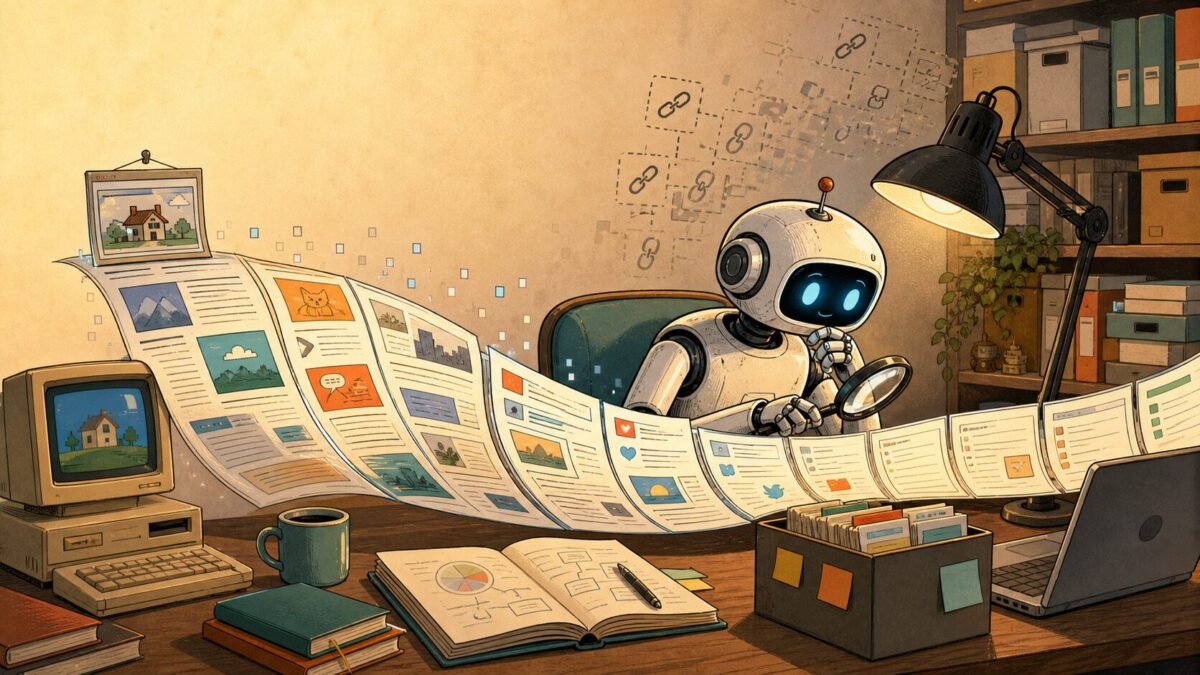
The featured image is AI-generated. For more information, see here.